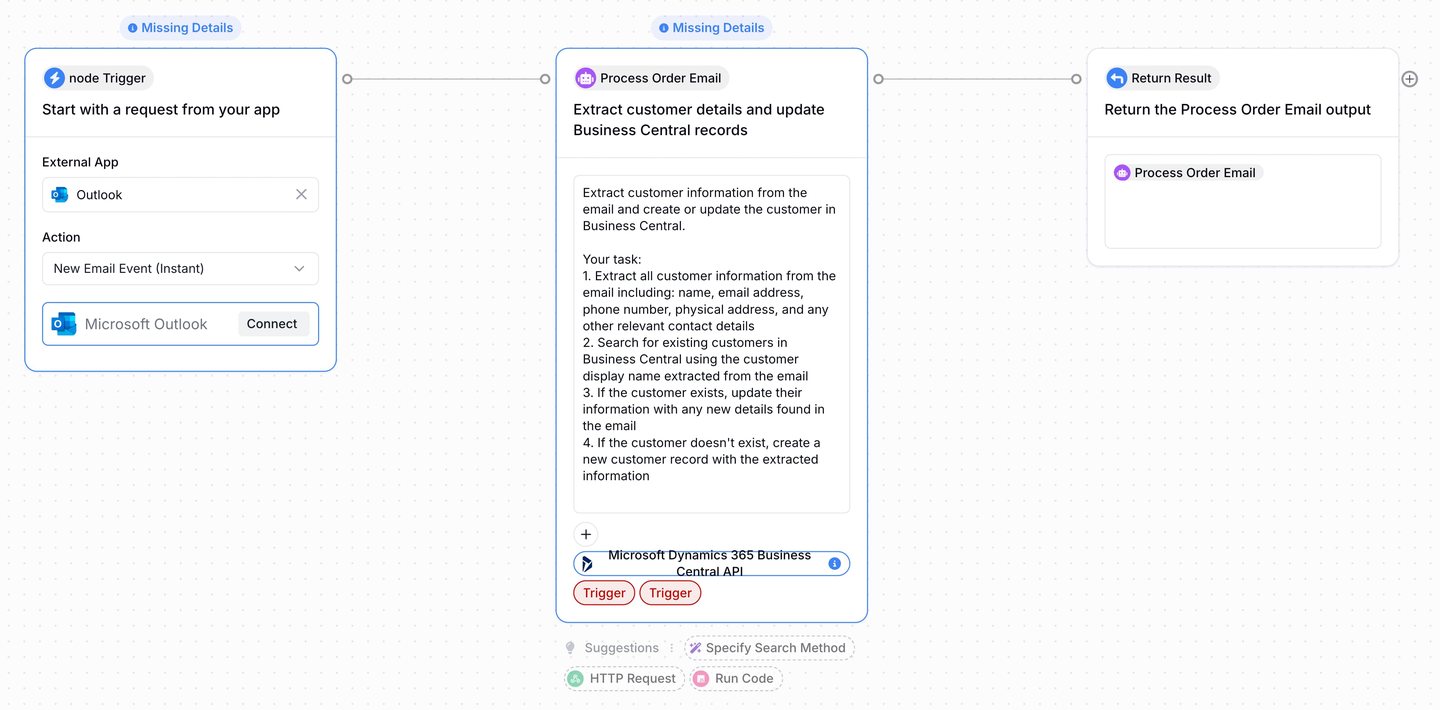
European manufacturers waste 25 minutes manually processing each sales order from email to ERP, costing companies €180,000+ annually in lost productivity. This deep dive reveals the hidden costs of manual order entry, why traditional automation fails for 80% of orders, and how AI-powered order processing eliminates the bottleneck crushing manufacturing efficiency.
A customer emails an Excel file with 47 line items. Another sends a PDF with handwritten notes in the margin. A third forwards last month's order with "same as before but double the quantities."
Your order processing team opens each email, deciphers the format, cross-references article codes that changed six months ago, checks actual available inventory (not just what the ERP shows on paper), validates delivery addresses, applies customer-specific pricing rules, and finally creates the sales order in Business Central or SAP.
This happens 200 times per week. Each order takes 25 minutes of manual work. That's 83 hours weekly, or more than two full-time employees doing nothing but data entry.
For a manufacturer processing 10,000 orders annually at an average labor cost of €35 per hour, that's €146,000 in pure order entry costs. Factor in error correction, delayed shipments, and missed sales opportunities, and you're looking at €180,000+ in total annual cost.
The numbers are worse than most operations managers realize. A 2024 study found that manufacturers using manual order processing spend upwards of €21 per order, while those with AI automation reduce that to under €6. Companies implementing order processing automation report 75% faster processing times and 40-60% reduction in order errors.
But here's the frustrating part: you've probably already tried to automate this. And it didn't work.
Why Traditional Automation Fails
Most manufacturers have some automation. EDI handles the standardized orders from large retailers. Your webshop processes direct orders automatically. Maybe you have an OCR system that extracts data from structured PDFs.
These systems handle the easy 20%. Your team is still stuck with the messy 80%.
The problem isn't your current systems. It's that traditional automation was designed for a world that doesn't exist anymore. EDI assumes everyone sends perfectly formatted X12 documents. OCR assumes every PDF has the same layout. Rules-based systems assume customers always use the correct current article codes.
None of these assumptions hold true in 2025.
Your sales inbox is chaos by design. Long-term customers have their own ordering habits. Some send formatted Excel files. Others forward old orders with changes in the email body. A few still send scanned handwritten forms. One major customer insists on sending orders as screenshots from their internal system.
According to recent manufacturing efficiency research, manufacturers with fully integrated sales order systems experience 37% faster order fulfillment and 42% fewer processing errors. Yet 60% of European manufacturers still rely heavily on manual processes for critical operations including order processing.
Traditional automation tools can't handle this variability. They fail on:
- Format inconsistency: Same customer sends Excel one day, PDF the next, plain text email after that
- Article code chaos: Customers use old codes, competitor codes, internal reference numbers
- Contextual information: "Same as order #4821 but rush delivery" requires understanding order history
- Regional logic: Delivery dates depend on customer location, warehouse capacity, carrier schedules
- Inventory complexity: Available stock isn't just physical inventory minus sales orders
This is why 48% of European manufacturing companies still use manual data entry according to industry surveys. It's not because they haven't tried automation. It's because automation couldn't handle the reality of their order flow.
The Real Cost of Manual Order Processing
The direct labor cost is obvious. What kills profitability is everything else that happens downstream.
The Error Cascade
Manual data entry has an acceptable error rate of around 1%. That sounds good until you process 10,000 orders annually. One hundred orders with errors. Each error costs an average of €1,200 in rework, materials waste, and expedited shipping according to steel fabricators who've measured this.
That's €120,000 in annual error costs. On top of the €146,000 in labor. And these are conservative industry averages.
The errors compound:
- Wrong article code means wrong product manufactured
- Typo in quantity means production schedules chaos
- Missed delivery date means angry customer calls
- Incorrect pricing means margin erosion or customer disputes
- Lost order emails mean shipments that never happen
The Speed Problem
Your competitors who've automated their order processing ship the same day. You're taking 2-3 days just to enter orders into your system.
In 2025, 76% of manufacturing customers expect real-time order status updates and 83% consider delivery speed a primary factor when selecting suppliers. When you're losing 25 minutes per order to data entry, you're losing market share to manufacturers who've solved this problem.
The Scaling Barrier
Want to grow? Every €1 million in additional revenue means roughly 100 more orders monthly. That's 2,000 more manual data entry tasks annually. At current processing times, you need to hire another order processor for every €3-4 million in growth.
This creates an invisible ceiling. You can't scale without proportionally scaling headcount. The death of data entry isn't just about saving money on the current workload. It's about removing the constraint that prevents growth.
The Opportunity Cost
Here's what manufacturing companies miss when they focus solely on direct costs: every hour spent on manual order entry is an hour not spent on customer relationships, process improvement, or solving complex fulfillment challenges.
Your most experienced operations people are typing. They're not optimizing delivery routes, negotiating with suppliers, or identifying patterns in customer behavior that could drive upselling opportunities.
The European Manufacturing Context
European manufacturers face unique pressures that make manual order processing particularly costly in 2025.
Market Conditions
European manufacturing has been in contraction since July 2022. New order inflows fell at their sharpest rate in 2024. Germany and France, the eurozone's two largest economies, saw manufacturing conditions worsen significantly.
When margins compress and demand weakens, operational efficiency becomes survival. Companies can't afford to waste 25 minutes manually processing each order.
Competitive Pressure
European manufacturers compete against Asian producers with lower labor costs and increasingly against North American companies with aggressive Industry 4.0 implementation. Oliver Wyman's 2024 Industrial Goods Sector report notes that US firms are experiencing favorable conditions and value shifts due to manufacturing digitalization.
European companies maintaining manual order processing are at a fundamental competitive disadvantage. They're slower, more expensive, and less scalable than automated competitors.
Labor Availability
Europe's manufacturing sector faces persistent labor shortages. The staffing sector outlook for 2024 predicted continuing staff shortages as a main challenge, making it more difficult to recruit new employees even for necessary roles.
You can't hire your way out of manual order processing when qualified candidates aren't available. Automation isn't optional anymore. It's the only path forward.
Regulatory Compliance
European manufacturers must navigate increasingly complex regulations around data privacy (GDPR), supply chain transparency, and sustainability reporting. Manual order processing makes compliance harder because data exists in emails, spreadsheets, and ERP systems without unified oversight.
Automated systems create audit trails automatically, ensure data retention compliance, and provide the traceability that regulators demand. Companies processing orders manually are one audit away from discovering their documentation doesn't meet requirements.
Why AI Changes Everything
Traditional automation failed because it couldn't handle variability. AI-powered order processing succeeds because variability is what it's designed for.
Modern AI systems read orders the way your most experienced employee does. They understand context, handle ambiguity, and learn from your specific business logic.
How AI Order Processing Actually Works
Understanding Any Format
AI doesn't need structured data. It reads the customer's Excel file, extracts the article codes, quantities, and delivery instructions. It processes the PDF with handwritten notes. It understands "just do the same as last time" by retrieving order history.
When a customer uses an obsolete article code, the system knows which current article to substitute. When they reference "that blue component we discussed," it matches to the correct product from past orders and communications.
This is fundamentally different from OCR or template matching. The AI understands intent, not just character recognition.
Applying Your Business Logic
The real power isn't data extraction. It's that the system learns your business rules:
- Regional delivery schedules (orders before noon ship in 48 hours from Dutch warehouse)
- Customer-specific pricing (Account Manager agreed to 8% discount on orders over €10,000)
- Inventory intelligence (check available stock minus purchase order reservations, not just physical count)
- Article substitution rules (when customer orders SKU-1234, we automatically offer SKU-1234-V2 if stock is low)
These rules exist in your team's heads, scattered across email threads, and buried in ERP customizations. AI codifies them into a consistent, automated process.
Handling Exceptions Intelligently
Not every order can be fully automated. Some require human judgment. AI systems identify which orders need escalation:
- New customer with credit risk flags
- Order quantity seems unusual (typically orders 100 units, this time wants 10,000)
- Delivery date conflicts with production capacity
- Article code match is ambiguous
These orders get flagged for human review. Everything else processes automatically. This is how companies achieve 75% automation rates while maintaining quality control.
Real Implementation Example
A 140-year-old European wood company eliminated manual order processing entirely using AI automation. Their challenge: processing hundreds of weekly orders in multiple formats, checking complex inventory across multiple warehouses, applying customer-specific pricing and delivery rules.
Their solution:
- Week 1: Connected email, ERP, and warehouse management systems
- Week 2-3: Mapped business rules and tested with historical orders
- Week 4: Started processing orders automatically with human validation
- Month 2: Moved to full automation with exception escalation only
Results: Order processing time dropped from 25 minutes to under 2 minutes. Error rate decreased from 3% to under 0.5%. Team refocused from data entry to customer service and fulfillment optimization.
The Practical Path Forward
Most manufacturers approach order automation incorrectly. They try to replace their entire order processing system at once, fail, and conclude automation doesn't work for their business.
The right approach is incremental and safe.
Start with Validation, Not Full Automation
Begin by having AI do the data entry while your team validates before releasing orders. This saves 15-20 minutes per order immediately while maintaining quality control.
Your team reviews the AI-created draft sales order, catches any errors, approves, and moves on. You're not changing your approval process. You're eliminating the typing.
This approach delivers immediate value (3+ hours saved daily) with zero risk. Your team builds confidence in the system. You identify edge cases that need better rules. After several weeks, you have data showing where automation works perfectly and where it needs human oversight.
Scale Based on Confidence
Once validation shows consistent accuracy, move to selective automation:
- Auto-process orders from top 20 customers (you know their patterns)
- Auto-process standard products (complex custom orders still get reviewed)
- Auto-process orders under €5,000 (high-value orders get human approval)
Gradually expand the automation scope as confidence builds. Companies typically reach 75% automation rates within 3-4 months.
Measure What Matters
Track the metrics that actually drive business value:
Processing Time: Hours saved per week on order entryError Rate: Percentage of orders requiring correction after entrySame-Day Processing: Percentage of orders entered within 4 hours of receiptTeam Capacity: Orders processed per full-time employeeCustomer Satisfaction: Complaints about order accuracy and speed
A European manufacturer processing 800 weekly orders reported saving 60 hours per week (1.5 FTE) after implementing AI order processing. More importantly, same-day processing improved from 45% to 89%, significantly improving customer satisfaction.
Integration with Existing Systems
The biggest implementation concern is always ERP integration. "Our system is heavily customized" is the most common objection.
Modern AI platforms handle this through flexible API integration:
For Business Central
AI systems connect via Business Central's web services API, respecting all custom fields, workflows, and extensions. Orders are created exactly as if a user manually entered them through the interface. All your customizations, add-ons, and integrations continue working normally.
For SAP
Integration happens through SAP's IDoc or OData interfaces. The automation respects your existing document types, custom fields, and approval workflows. From SAP's perspective, orders arrive properly formatted and complete.
For Custom ERPs
If your ERP has any form of API access, integration is straightforward. Many manufacturers use heavily customized on-premise systems from the 1990s. As long as there's a way to programmatically create orders, AI can learn to use it correctly.
The key is that these integrations don't replace your ERP. They don't require you to change how your ERP works. They just automate the human task of moving data from email into your system.
What Success Actually Looks Like
Stop imagining order processing as a department with five people typing. Start imagining it as an intelligent system that processes most orders automatically while routing exceptions to specialists who handle complex situations.
Monday morning: 43 orders arrived over the weekend. The system processed 37 automatically. Your team reviews 6 exceptions:
- New customer (needs credit check)
- Rush order conflicting with production schedule (needs operations approval)
- Large quantity variance from typical order (confirm it's not a typo)
- Custom product specification (engineering needs to review feasibility)
- Delivery address outside normal range (shipping cost validation needed)
Each exception gets handled by someone with actual expertise to make decisions. Nobody is typing article codes.
The team's new work:
- Proactive customer communication about delivery delays
- Analyzing order patterns to optimize inventory
- Improving product documentation based on frequent customer questions
- Building relationships with key accounts
- Training the AI on new business rules
The business results:
- 75% reduction in order processing time
- Same-day order confirmation becoming the standard
- Capacity to handle 3X current order volume with same headcount
- Error rate dropping from 3% to under 0.5%
- Team satisfaction improving because they're doing meaningful work
This is what moving from manual to AI-powered order processing actually looks like.
Common Concerns Addressed
"Our orders are too complex for automation"
Complexity is exactly what AI handles well. The 140-year-old wood company had complex regional delivery logic, customer-specific pricing, article code substitutions, and multi-warehouse inventory management. All of it automated.
If your team can process it, AI can learn to process it. The question isn't whether your orders are too complex. It's whether you want to continue paying humans to do repetitive work that machines can handle.
"What about that small percentage of weird orders?"
They get escalated to humans. Not every order needs to be automated for automation to deliver massive value. If you automate 75% and handle 25% manually, you've still saved 15+ hours per week per order processor.
The goal isn't 100% automation. It's removing the bottleneck.
"Our customers won't change how they send orders"
They don't have to. That's the point. AI adapts to how your customers actually behave, not how you wish they would behave.
The customer who sends Excel files keeps sending Excel. The one who emails photos of handwritten notes keeps doing that. The one who references previous orders by saying "same as last month" keeps doing that too.
"We tried automation before and it failed"
You tried rule-based automation or OCR templates. Those systems require structured, consistent input. When real-world orders don't match the template, they fail.
AI doesn't require structure. It understands variability. That's why companies who failed with traditional automation succeed with AI.
"What about the learning curve?"
Your team doesn't need to learn prompt engineering or understand how AI works. They review orders and approve them. That's the interface.
The AI learns your business by observing what your team approves and what they correct. Over time, it gets better at matching your team's decisions automatically.
The Cost of Waiting
Every month you delay implementing order processing automation costs:
- €12,000+ in unnecessary labor costs (based on 10,000 annual orders)
- €10,000+ in error correction and expedited shipping
- Unknown revenue from customers choosing faster competitors
- Increasing risk as your competition automates and scales
European manufacturers are under pressure from every direction. Margins compressing. Labor shortages. Competitive threats from automated operations in North America and Asia. Customers demanding faster fulfillment.
The manufacturers thriving in this environment have embraced AI automation. They've eliminated the manual bottlenecks that constrain growth. They've freed their teams to focus on strategy, customer relationships, and continuous improvement.
The ones struggling are still typing orders into their ERP.
The Reality Behind the 25 Minutes
That 25 minutes per order isn't just data entry time. It's opening the email, downloading attachments, cross-referencing customer information, checking multiple systems for inventory, applying business rules that exist only in institutional knowledge, validating that everything makes sense, and finally creating the order.
It's mental work and repetitive work combined. It's exactly what humans hate doing and exactly what AI excels at.
When a European manufacturer processes 10,000 orders annually, that's 4,167 hours of this work. More than two full-time employees. For most companies, that's €146,000-€180,000 annually in pure processing costs.
The choice isn't between automation and the status quo. It's between automating now while you can still compete, or automating later after you've lost customers to faster, more efficient competitors.
Getting Started
If you're processing more than 100 orders monthly and your team is spending significant time on manual data entry, you're ready for AI order processing.
Week 1: Assessment
- Map your current order flow
- Identify volume by format type
- Document business rules and exceptions
Week 2-3: Setup
- Connect email and ERP systems
- Configure business rules
- Test with historical orders
Week 4: Validation Mode
- AI creates draft orders
- Team reviews and approves
- Measure time savings and accuracy
Month 2: Selective Automation
- Auto-process high-confidence orders
- Escalate exceptions to team
- Expand scope based on results
Month 3+: Full Operation
- 75%+ orders fully automated
- Team focuses on exceptions and optimization
- Scale as volume grows
Companies following this path see positive ROI within the first month. By month three, they're processing 3X more orders with the same headcount.
The Bottom Line
Manual order processing is killing European manufacturing competitiveness. Twenty-five minutes per order adds up to hundreds of thousands in annual costs, slower fulfillment, higher error rates, and inability to scale.
Traditional automation failed because it required structured input that doesn't exist in real business environments. AI succeeds because it adapts to how your customers actually send orders and how your business actually works.
The question isn't whether to automate order processing. It's when, and how much market share you're willing to lose while you figure it out.
Your competitors are already processing orders in under 2 minutes. They're shipping same-day. They're scaling without adding headcount. They're using order processing automation to eliminate the 25-minute bottleneck.
Every day you wait costs €500-€700 in unnecessary labor and errors. Every month costs €15,000+. Every year costs €180,000+.
But the real cost isn't the money. It's the customers choosing faster competitors. It's the growth you can't capture. It's the team burnout from endless data entry instead of meaningful work.
The 25 minutes per order isn't a fixed reality. It's a choice you're making every day to continue with manual processing.
Start Automating Your Order Processing
Lleverage helps European manufacturers eliminate manual order entry and scale without adding headcount. Our AI platform processes orders from any format, respects your business rules, and integrates seamlessly with Business Central, SAP, and custom ERPs.
Book a demo to see how we can help you process orders in under 2 minutes instead of 25.
Related Resources
- How a 140-Year-Old Wood Company Eliminated Manual Order Processing
- The Death of Data Entry: Why Manual Work is Becoming Extinct in 2025
- The 6 Back Office Automations That Manufacturing Companies Can't Afford to Ignore
- The State of European AI in 2025: Insights from 150+ Tech Leaders