What Happens When Your ERP, WMS, and MES Don't Talk to Each Other
Lennard Kooy
·
8 min read
98% of manufacturers face data silos between ERP, WMS, and MES systems, costing €200K-€900K annually in lost productivity and inventory errors. Learn why traditional integration keeps failing and how AI automation creates seamless coordination without replacing your existing systems.
A wholesale distributor's €30 million mistake. A brewery losing track of 40,000 units mid-production. An automotive supplier shipping the wrong parts to BMW because three systems had three different inventory counts.
These aren't horror stories from the 1990s. They're happening right now in 2025, and they're costing European businesses between €200K and €900K annually in lost productivity, inventory errors, and manual workarounds.
Here's the uncomfortable truth: 98% of manufacturers face data-related issues that directly slow innovation and time-to-market. The culprit isn't outdated technology or insufficient investment. It's that your ERP, WMS, and MES systems are speaking different languages while pretending they understand each other.
The €184 Million Problem Nobody Talks About
Supply chain disruptions cost companies an average of €184 million annually. That's not from natural disasters or geopolitical events. It's from systems that should be working together but aren't.
Only 63% of manufacturers and distributors have updated their ERP systems in the last five years. That means 37% are running legacy systems that were never designed to talk to modern warehouse management or manufacturing execution systems. Even worse, 73% of organizations struggle with inventory visibility across their ERP and WMS systems.
Think about what that means for your daily operations. Your ERP thinks you have 500 units in stock. Your WMS shows 487. Your MES just consumed 25 units in production. Which number is correct? By the time someone manually reconciles these systems, you've already promised delivery dates based on wrong data.
When Systems Don't Talk: The Real Costs
Data silos aren't just an IT problem. According to McKinsey, they cost businesses €3.1 trillion annually in lost revenue globally. For a mid-sized manufacturer, that translates to 20-30% of revenue lost to poor data quality and disconnected processes.
The Hidden Operational Costs
Production bottlenecks happen when your MES can't see that warehouse inventory is running low. Your production line scheduled 200 units of Product A, but your WMS hasn't updated the ERP about the delayed shipment of raw materials. The line stops. Workers idle. Deadlines slip.
A manufacturer using separate systems for quality assurance and production tracking struggles to detect patterns in defective products. By the time someone manually compiles data from both systems, they've already shipped defective units to customers.
The Financial Black Hole
Organizations with severe data silos experience operational costs 25-30% higher than those with unified data architectures. That's not just the cost of the systems themselves. It's the hidden expenses: duplicate data entry, manual reconciliation, emergency overtime to fix errors, expedited shipping to cover mistakes.
One European retailer calculated they were spending €120,000 annually on manual data reconciliation alone. Finance teams spent 12 hours per week per employee searching for data trapped in different systems.
The Customer Experience Disaster
Customer support can't access shipping or production data because it lives in a different system. A customer calls asking about their order. The support rep sees the order was placed in the ERP. The WMS shows it's still being picked. The MES has no record of it being scheduled for production.
The rep says "I'll have to call you back." The customer hears "we have no idea where your order is."
Research shows 62% of manufacturers struggle to meet customer expectations because siloed data prevents a complete view of customer interactions.
How Three Systems Create Eight Problems
1. Inventory Becomes Fiction
Your ERP tracks financial inventory. Your WMS tracks physical location. Your MES tracks consumption. Without real-time integration, you're managing three different versions of reality.
A distributor ships 100 units. The WMS updates immediately. The ERP updates at end of day. The MES scheduled production based on morning inventory counts. You just oversold by 100 units, and nobody knows until tomorrow.
2. Production Planning Based on Guesswork
Manufacturing efficiency depends on synchronized processes. Your ERP generates work orders based on sales forecasts. Your WMS should pre-position materials on the shop floor. Your MES should track actual consumption and automatically trigger reorders.
Without integration, your production schedule looks perfect on paper while workers stand around waiting for materials that the ERP thinks are in stock but the WMS can't locate.
3. Quality Issues Multiply Undetected
Your MES tracks production quality metrics. Your WMS manages outbound quality checks. Your ERP handles customer returns. When these systems don't share data, quality issues spread.
A brewery's MES flagged potential contamination in Batch 2847. The WMS didn't receive this alert and shipped 40,000 units to distributors. The ERP processed customer complaints two weeks later. By then, the batch was on store shelves across five countries.
4. Returns Turn Into Chaos
Reverse logistics requires deep coordination between all three systems. A customer returns a defective product. Your WMS receives it physically. Your ERP needs to process the financial credit. Your MES should flag it for quality analysis.
Without integration, returned goods disappear into a black hole. The WMS shows them in location R-14. The ERP shows no return received. The MES never learns about the defect. The same manufacturing error repeats next month.
5. Data Becomes a Weapon Between Departments
Sales blames production for late deliveries. Production blames the warehouse for not having materials. The warehouse blames purchasing for late orders. Everyone is looking at different data from different systems, and they're all technically correct.
This isn't a culture problem. It's a systems problem creating a culture problem.
6. Compliance Becomes a Nightmare
GDPR requires visibility into where customer data is stored and processed. When order information exists in your ERP, fulfillment details in your WMS, and production records in your MES, creating an audit trail requires manually stitching together three separate systems.
FDA-regulated manufacturers face even stricter requirements. Your MES tracks batch genealogy. Your WMS tracks serialization. Your ERP manages regulatory documentation. An FDA audit request that should take hours instead takes weeks of manual data extraction.
7. Decision Making Operates on Delay
By the time you've manually aggregated data from three systems, cleaned inconsistencies, and built reports, the numbers are already outdated. You're making today's decisions based on yesterday's data.
Deloitte reports that manufacturers with integrated systems are 2.5 times more likely to achieve cost and time efficiencies. The difference isn't better decision making. It's faster decision making with accurate data.
8. The Manual Workaround Tax
Every disconnected system creates a manual workaround. Someone exports data from the ERP, imports it to a spreadsheet, cross-references it with WMS reports, checks MES dashboards, manually reconciles discrepancies, and emails the results to stakeholders.
This happens daily, across multiple processes, consuming hours of productive time. Organizations waste up to 12 hours per week per employee searching for and reconciling data trapped in silos.
The Integration Illusion
Here's where it gets interesting: 45% of companies report integration issues as the primary cause of project delays and cost overruns. These aren't companies that haven't tried to integrate. They're companies that thought they had integrated.
The Interface vs. Integration Trap
Most ERP vendors claim their system "integrates" with WMS and MES solutions. What they really mean is "interfaces through batch processing."
Your ERP exports data to a CSV file at midnight. The WMS imports it at 1 AM. The MES picks it up at 2 AM. Your team arrives at 7 AM and makes decisions based on data that's already 6-8 hours old. In industries where production cycles are measured in hours, you're always working with stale information.
Real integration means systems share a common database or update each other in real-time through APIs. Most "integrated" systems are actually just scheduled batch transfers with expensive middleware connecting them.
The Legacy System Anchor
Only 63% of manufacturers have updated their ERP in the last five years. That 37% running legacy systems faces a brutal choice: spend millions replacing the ERP, or accept that modern WMS and MES solutions will never truly integrate.
A Dutch manufacturer spent €400,000 on middleware to connect their 15-year-old ERP to a new WMS. The integration worked, technically. But the ERP's data structure couldn't handle real-time updates. They ended up with a state-of-the-art WMS hamstrung by batch processing limitations from a legacy ERP.
The Customization Trap
"We'll just customize it to make the systems talk to each other."
Famous last words from 74% of businesses facing WMS implementation challenges. Customizations solve today's integration problem while creating tomorrow's maintenance nightmare.
Every ERP update breaks the customization. Every WMS upgrade requires retesting. Your IT team becomes a permanent integration maintenance crew instead of driving innovation.
What Good Integration Actually Looks Like
The automotive supplier mentioned earlier? They didn't solve their problem by replacing all three systems. They added an intelligence layer that sits between their ERP, WMS, and MES.
Real-Time Data Synchronization
When an order comes in, all three systems see it simultaneously. The ERP processes financials, the WMS schedules picking, the MES updates production capacity. No batch processing. No overnight delays. No manual reconciliation.
Beverage companies using integrated systems achieve 30% improvement in production planning time. That's not from working faster. It's from eliminating the wait time between systems updating each other.
Unified Inventory Truth
One inventory count. Multiple systems accessing the same data in real-time. When the WMS records a pick, the ERP sees it instantly. When the MES consumes materials, inventory decrements immediately across all systems.
This eliminates the three-versions-of-reality problem that creates phantom inventory and overselling.
Intelligent Exception Handling
Modern integration platforms don't just pass data between systems. They understand business logic. When the WMS detects a discrepancy between expected and actual inventory, it automatically flags it in the ERP and holds related MES production orders until resolved.
No manual intervention required. The system knows the business rules and applies them consistently.
Automated Workflow Orchestration
Order entry in the ERP triggers automated workflows: check inventory in WMS, reserve materials, schedule production in MES, generate pick lists, update customer with accurate delivery date. All of this happens in seconds without human intervention.
A timber company eliminated manual order processing entirely by implementing workflow automation that orchestrated actions across their ERP, WMS, and production systems.
The AI Solution Nobody Expected
Traditional integration approaches treat system connectivity as a plumbing problem: connect pipe A to pipe B, make data flow. This works until you need to change pipes, add new systems, or handle exceptions.
AI-native automation platforms approach integration differently. Instead of hard-coding connections between systems, they understand the business process and orchestrate actions across whatever systems you have.
How It Works in Practice
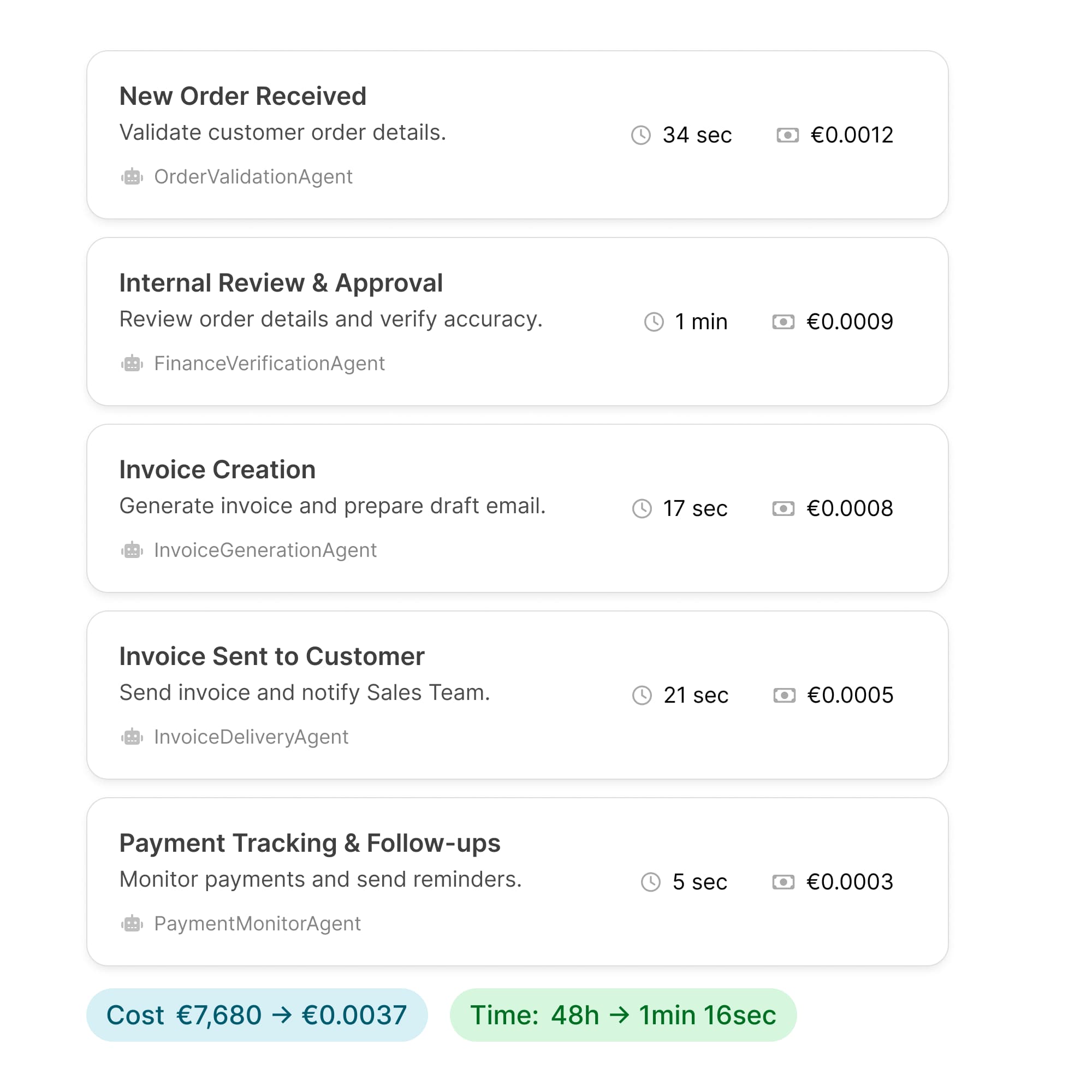
A manufacturing company receives a customer order via email. An AI automation platform:
Extracts order details from the email using intelligent document processing
Validates against ERP customer records and credit limits
Checks inventory across WMS locations in real-time
Queries MES for production capacity if not in stock
Generates accurate delivery dates considering all constraints
Updates ERP with the order
Triggers WMS picking workflows
Schedules MES production if needed
Sends customer confirmation with accurate dates
All of this happens in minutes, not days. No manual intervention. No batch processing. No middleware maintenance.
The ERP as Source of Truth
Rather than replacing your ERP or forcing all three systems into a single platform, AI automation maintains your ERP as the financial source of truth while orchestrating operational actions across WMS and MES.
Your ERP doesn't need to be modern. It doesn't need APIs. The AI layer handles the complexity of extracting data from legacy systems, transforming it as needed, and updating each system appropriately.
A 140-year-old family business eliminated manual order processing without replacing their legacy ERP. The AI automation platform integrated with their existing systems while adding the intelligence they needed for modern operations.
Continuous Improvement Without IT Dependencies
Traditional integration requires developers to modify code every time a business process changes. AI automation platforms learn from corrections and pattern adjustments, improving accuracy over time without technical intervention.
When exception rules change, business users update the workflow logic directly. No developer required. No deployment cycle. Changes go live immediately.
Making the Transition
The manufacturers succeeding in 2025 aren't the ones with the newest systems. They're the ones who stopped treating integration as an IT project and started treating it as an intelligence problem.
Start With High-Impact Processes
Don't try to integrate everything at once. Identify the processes where disconnected systems cause the most pain: order processing, quote generation, inventory reconciliation, production scheduling.
Automate one process end-to-end across all three systems. Prove the value. Then expand.
Maintain ERP as Financial Core
Your ERP handles financial transactions and regulatory compliance. Keep it doing what it does well. Add an intelligence layer for operational processes that require coordination across WMS and MES.
This approach respects your existing IT investments while solving the integration challenge.
Focus on Business Outcomes, Not Technical Specifications
Integration projects fail when they focus on API connections and data mapping without considering the business process. Start with the desired outcome: "Customer gets accurate delivery date within 5 minutes of order placement."
Then work backwards to identify what data each system needs, when, and how to orchestrate the actions.
Plan for Continuous Evolution
Your business processes change. Your systems update. Your requirements evolve. Choose integration approaches that can adapt without requiring complete reimplementation.
AI automation platforms excel here because they understand business intent rather than executing hard-coded rules.
The Future of Manufacturing Systems
The question isn't whether your ERP, WMS, and MES should talk to each other. The question is whether you'll build brittle point-to-point integrations that require constant maintenance, or implement an intelligence layer that orchestrates across systems while adapting to change.
Companies treating integration as a one-time IT project will struggle. Those treating it as an ongoing intelligence capability will thrive.
The €184 million supply chain problem isn't going away. But it doesn't have to be your problem.
Take Action
Schedule a demo to see how AI automation creates seamless coordination between your ERP, WMS, and MES without replacing your existing systems. Learn how manufacturers are achieving 30% improvement in production planning, eliminating manual data reconciliation, and finally having one version of inventory truth.
Book a demo to explore how your systems can start talking to each other properly.
Frequently Asked Questions
Why can't my ERP, WMS, and MES integrate properly on their own?
Most systems were built as standalone solutions. ERP vendors added basic warehouse functionality later. WMS providers added basic ERP connections. MES systems focused on production floors. None were designed from the ground up to share data in real-time. Even when vendors claim integration, they usually mean batch interfaces that update periodically, not true real-time data synchronization.
What's the difference between integrated and interfaced systems?
Integrated systems share a common database and update in real-time. When one system records a transaction, all others see it immediately. Interfaced systems run on separate databases and transfer data through batch processes, APIs, or middleware. Most "integrated" solutions are actually interfaced, creating delays and reconciliation challenges.
How much does it typically cost to integrate these systems?
Traditional integration costs vary wildly, from €50,000 for basic middleware to €500,000+ for complex custom integrations. But focus on the hidden costs: ongoing maintenance, customization updates after each system upgrade, and the operational costs of working with disconnected systems (typically 20-30% of revenue). AI automation platforms often deliver better integration at lower total cost by eliminating custom code maintenance.
Can I integrate legacy ERP systems with modern WMS and MES?
Yes, but traditional approaches struggle because legacy ERPs lack modern APIs. AI automation platforms excel here because they can extract data from legacy systems through various methods (screen scraping, database queries, file exports) and transform it for modern systems. This lets you keep your existing ERP while gaining modern operational capabilities.
What's the biggest mistake companies make when trying to integrate systems?
Focusing on technical connectivity rather than business process outcomes. Companies spend months mapping data fields between systems without defining what business process they're trying to improve. Start with the business outcome you need ("accurate inventory across all systems in real-time"), then design the integration to achieve that outcome.
How long does it take to properly integrate ERP, WMS, and MES?
Traditional integration takes 6-18 months depending on complexity. AI automation platforms can deliver working integration in 4-8 weeks because they focus on business process automation rather than point-to-point system connections. The difference is architectural: instead of hard-coding integrations, AI platforms orchestrate actions across systems based on business logic.
Will I need to replace my current systems to solve integration problems?
Rarely. The manufacturers succeeding in 2025 aren't replacing their ERPs, WMS, or MES. They're adding an intelligence layer that orchestrates across existing systems. This respects your IT investments while solving the coordination challenge. System replacement should only be considered when individual systems fundamentally can't support your business processes, not because they don't talk to each other.
How do I know if my integration problems are costing me money?
Calculate time spent on manual data reconciliation (typically 12 hours per week per employee), inventory discrepancies between systems (phantom stock, overselling), production delays due to material availability confusion, and customer service time spent investigating order status across multiple systems. If your teams spend more than 2 hours daily dealing with system disconnects, you're losing €200K+ annually at minimum.