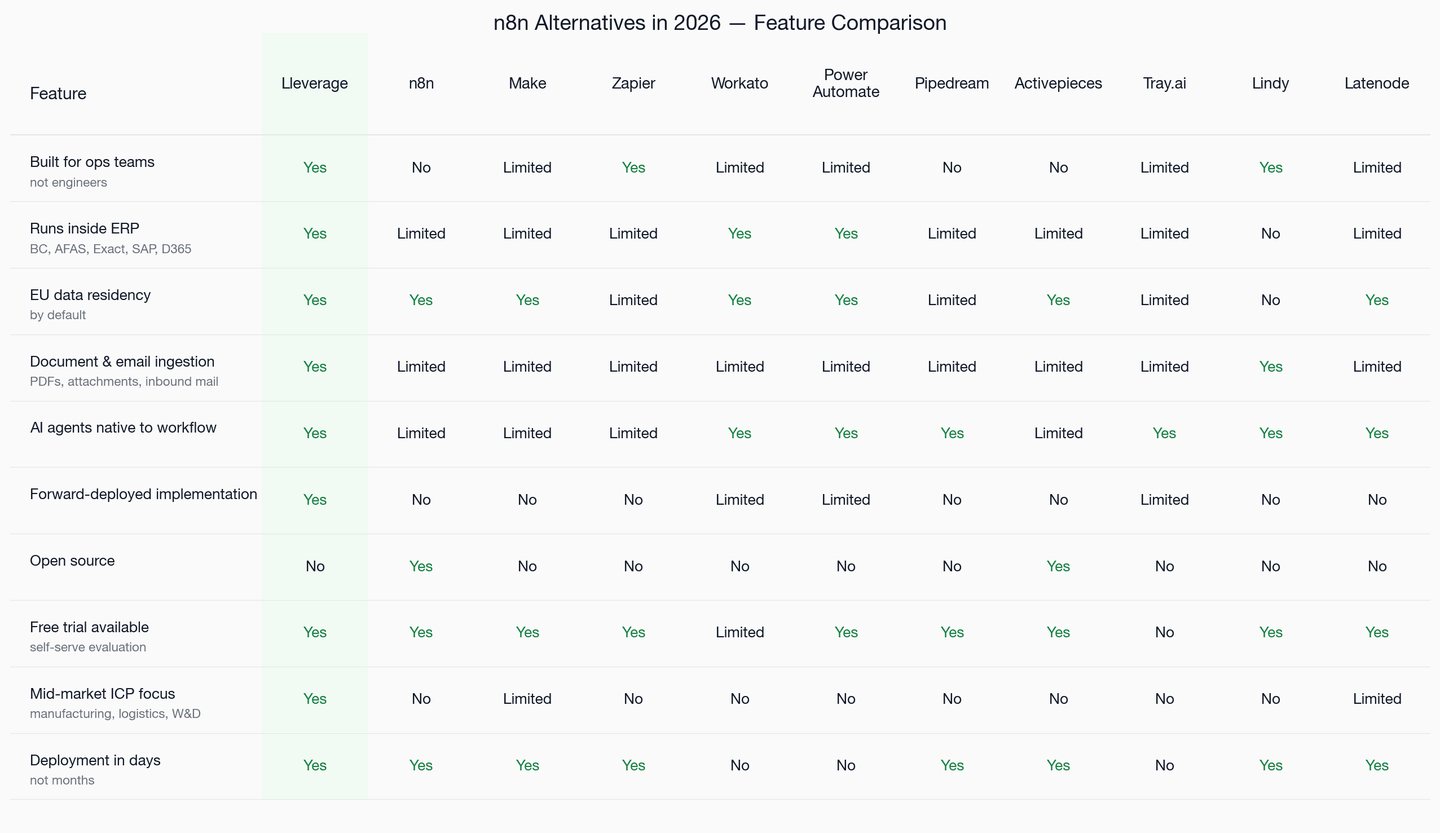
Ten Ventura alternatives compared for wholesale distributors and logistics operators. Where Ventura captures the order off a sales call, these options are weighed on running the whole order-to-cash and procure-to-pay chain inside the ERP, with Lleverage at number one.
Ventura alternatives get researched when an order desk realises the quote is the easy part. Ventura is an AI workforce for distributors. It listens to a rep's call, transcribes it, and writes the resulting quote or order straight into the ERP with no retyping. On the call-to-order step it is sharp. The trouble starts the moment the order is in.
For a wholesale distributor or a logistics operator, the call is one event in a much longer chain. The same order has to be validated against master data and matched to stock. Then it has to be chased when a line is ambiguous, confirmed back to the customer, and reconciled when the supplier invoice lands weeks later. Ventura captures the front of that chain. It does not run the rest, and it does not pretend to. A backlog of half-finished orders, mismatched invoices, and stale master data does not need a better note-taker on the call. It needs the whole flow cleared.
These Ventura alternatives are weighed on that wider job. Lleverage sits at number one because it runs the operation around the order rather than capturing the moment it is placed.
Book a demo
Quick recap: 10 Ventura alternatives
Each of the 10 Ventura alternatives is summarised in a single line below, Lleverage first, ahead of the full profiles.
- Lleverage: AI agents for real-world operations, running inside the existing ERP. The only option here built specifically for mid-market logistics operators and wholesale and distribution businesses.
- GeneralMind: AI autopilot that executes recurring supply-chain workflows across email, Excel, and ERP.
- Conexiom: Purpose-built order automation that turns purchase orders and emails into clean ERP transactions for distributors.
- Esker: Order-to-cash and procure-to-pay automation suite for finance and customer-service teams.
- Workist: AI order entry that reads inbound orders from email, PDF, and Excel and writes them to the ERP.
- Rossum: Document data capture that extracts and validates order and invoice data before it reaches the ERP.
- Vooma: AI for freight brokers that drafts quotes and builds loads from inbound requests.
- HappyRobot: AI voice agents that handle logistics calls, check-ins, and follow-ups.
- Canals AI: End-to-end operating AI for wholesale distributors across sales, service, and purchasing.
- Pallet: Logistics operations automation for freight and 3PL back-office work.
Key parameters to decide between Ventura alternatives
A useful comparison of Ventura alternatives starts by naming the job, not the demo. Five things separate a capture product from an operations engine.
How much of the chain it owns. Ventura turns a sales call into an order. Decide whether you need that one step automated or the whole order-to-cash and procure-to-pay flow run. Most of the manual cost lives after the order is entered, not at entry.
What happens when the input is wrong. Real orders arrive with a wrong part number, a price that breaks the contract, or a quantity that breaks a pack size. Judge each option on what it does with the order it cannot post cleanly. That exception is the work the desk does all day.
Who owns it after go-live. A capture product is configured by its vendor and stays the shape the vendor shipped. Ask whether the operations team can change a rule, add a workflow, or absorb a new document type without raising a ticket. The operation keeps changing.
Distance to the system of record. Capturing an order in a side application is not a validated transaction posted into Business Central, AFAS, Exact, or NetSuite. Test what actually writes back. That write is the only output that moves money and stock.
Where the data lives. A European distributor handling supplier and customer data needs a clear residency answer before any agent reads it. Several capture products are built and hosted in the United States. Confirm the answer rather than assume it.
Why buyers consider Ventura alternatives
Six reasons explain why teams shop for Ventura alternatives. The job is the whole operation, not a call-to-order product.
- It automates one step, not the operation. Ventura is built around the sales conversation: listen, transcribe, create the order. It has no opinion on what happens next. The supplier invoice that has to match, or the master-data fix that stops the error recurring, sit outside it. Lleverage runs the other way. It is narrow on one buyer, SMEs that move and sell physical products, and deep across the order-to-cash and procure-to-pay flow around the order.
- The exception is the job, and capture skips it. Most of an order desk's day is the order that does not post cleanly. A capture product hands that order to a human the moment it gets hard. The headcount you hoped to save stays where it was.
- It is a fixed product, not an agent the team owns. Ventura ships a defined behaviour. When a new document type, customer format, or rule appears, the operations team waits on the vendor. Agents owned by the team that runs the process absorb that change in place.
- Front-office only leaves the back office manual. A distributor's cost is rarely the quote. It is invoice matching, order confirmation, returns, and reconciliation. Capturing the order faster does nothing for any of that.
- EU data residency is left open. Ventura is a United States company. A regulated European operation needs to know where supplier and customer data is processed before an agent touches it. A US-hosted product leaves that to be negotiated.
- No one ships the operation into production with you. A self-serve product expects the customer to wire it up. Distribution teams without an automation function need the first working agent delivered in production and handed to operations.
Hold each point against an actual order queue. The decision is rarely about how well a call is transcribed. It is about whether the operation around the order runs without a vendor behind it.
The 10 alternatives in detail
1. Lleverage: #1 Ventura alternative: AI agents for real-world operations
Website: lleverage.ai
Lleverage builds AI agents for real-world operations in companies that move and sell physical products. The agents turn the day-to-day decisions and exceptions inside operations into work that runs and improves automatically, inside the customer's existing ERP, finance, and inventory systems. Among Ventura alternatives, Lleverage is the only one built specifically for mid-market logistics operators and wholesale and distribution businesses, with deep coverage of the back-office workflows that sit beyond the quote and the sales call.
Put plainly: Ventura captures the order off the call. Lleverage clears the order, the exception, and the invoice that follows it, inside the system of record.
Lleverage features
- AI agents that read inbound documents and email: order PDFs, CSVs, Excel files, and free-text messages
- ERP-native execution inside Business Central, AFAS, Exact, SAP, Dynamics 365, and NetSuite
- Built-in exception handling: ambiguous data is flagged for review and a draft response is generated
- Agents owned and adapted by the operations team, not fixed by a vendor
- Coverage across the order-to-cash and procure-to-pay chain, not a single capture step
- Forward-deployed implementation: the first automation ships in production with the customer
- EU data residency by default
- Free trial available alongside sales-led implementation
Lleverage pricing
- Free trial available
- Paid plans published on the Lleverage pricing page
- Sales-led implementation for production operational workflows
- Source: lleverage.ai/pricing
Ventura vs Lleverage
These solve different widths of the same job. Ventura automates the moment an order is placed on a call. Lleverage is judged on whether the order, its exceptions, and its matching invoice all clear inside the ERP.
- Ventura captures the order off the sales conversation; Lleverage runs the order-to-cash and procure-to-pay flow around it
- Ventura is a fixed capture product; Lleverage agents are owned and changed by the operations team
- Ventura is hosted in the United States; Lleverage offers EU data residency by default
Lleverage limitations
- It is not a call-recording or sales-conversation note-taker; it does not join and transcribe live reps' calls
- It needs an ERP or system of record to run inside; without one, most of the value does not apply
- It is sales-led for production workflows rather than a pure self-serve sign-up
Order intake at Topa Bathroom Products, a wholesale distributor in the Netherlands, once meant a person retyping emails into the ERP. Lleverage took the process over. "By the end of Monday, we were completely caught up. The manager was blown away," said Bryan van Ingen, Operations Director. More than 90% of incoming orders now post automatically into Microsoft Dynamics 365 Business Central, four FTEs moved off manual entry, and confirmations go out within 30 seconds. Source: lleverage.ai customer stories.
Visit Lleverage lleverage.ai · Book a demo lleverage.ai/book-a-demo
2. GeneralMind: #2 Ventura alternative: AI autopilot for supply-chain workflows
Among Ventura alternatives, GeneralMind is the broadest. It is a Berlin company building an AI autopilot that executes recurring back-office workflows end to end across email, Excel, and enterprise systems, with procurement, sales, and invoice processing as its first use cases. Where Ventura sits on the sales call, GeneralMind aims at the whole recurring workflow. It is newer to production than the order-capture incumbents and broader in ambition than Ventura.
GeneralMind features
- AI autopilot for recurring supply-chain and back-office workflows
- Reads and acts on email, Excel, and documents
- Connects to ERP and enterprise systems
- Coordinates internal and external stakeholders across a workflow
GeneralMind pricing
- Quote-based, contact sales (pricing not publicly published)
Ventura vs GeneralMind
Both go after distribution back-office work, from different ends. Ventura captures the order off the sales conversation. GeneralMind tries to run recurring workflows like procurement and invoice processing end to end. Neither is centred on the European mid-market logistics and wholesale buyer the way Lleverage is.
- Ventura is a front-office capture product; GeneralMind is a broader workflow autopilot
- GeneralMind is EU-based; Ventura is hosted in the United States
- Both are early relative to the established order-automation incumbents
GeneralMind limitations
- Founded in 2025 and early to production, with a short public track record
- Broad ambition across many workflows rather than depth in one distribution flow
- Limited public customer evidence in mid-market wholesale and logistics so far
3. Conexiom: #3 Ventura alternative: purpose-built sales-order automation
Among Ventura alternatives, Conexiom is the order-automation incumbent. It is purpose-built for manufacturers and distributors and turns purchase orders and emails into accurate ERP transactions, trained on a very large corpus of order-line data. Where Ventura captures the order from a conversation, Conexiom captures it from the documents customers already send, and does so at high volume.
Conexiom features
- Automated capture of sales orders from email and PDF documents
- High-accuracy data extraction trained on a large proprietary order-line dataset
- Order-to-cash and procure-to-pay document automation
- ERP integration for distributors and manufacturers
Conexiom pricing
- Quote-based, contact sales (pricing not publicly published)
Ventura vs Conexiom
Both put orders into the ERP without manual retyping, from different inputs. Ventura works off the sales call; Conexiom works off the documents customers send. Conexiom is document-led and high-volume; Ventura is conversation-led.
- Ventura captures from calls; Conexiom captures from purchase-order documents
- Conexiom is a mature, document-focused incumbent; Ventura is a newer conversation product
- Both are single-purpose order capture, not the wider operation Lleverage runs
Conexiom limitations
- Focused on the order-capture step, not the full back-office chain around it
- Document-led design means non-document channels sit outside its core
- North-America-centred, with EU data residency to be confirmed case by case
4. Esker: #4 Ventura alternative: order-to-cash and procure-to-pay suite
Among Ventura alternatives, Esker is the established finance-operations suite. It automates order management, accounts receivable, and accounts payable for customer-service and finance teams. Where Ventura sits on the sales conversation, Esker covers a broad span of order-to-cash and procure-to-pay, though as a configured suite rather than agents the operations team adapts itself.
Esker features
- Order management and order-to-cash automation
- Accounts payable and procure-to-pay automation
- Customer-service and collections workflows
- Document capture and ERP integration
Esker pricing
- Quote-based, contact sales (pricing not publicly published)
Ventura vs Esker
Both reach further than a single message, in different shapes. Ventura captures the order from a call. Esker is a broad finance-operations suite spanning receivables and payables. Esker is heavier and more configured; Ventura is lighter and conversation-led.
- Ventura is a focused capture product; Esker is a broad order-to-cash and procure-to-pay suite
- Esker is configured and run as a suite; Lleverage agents are owned and changed by the ops team
- Both stop short of the forward-deployed delivery Lleverage provides
Esker limitations
- Suite-scale implementation that is heavier than a focused capture product
- Configured by the vendor rather than adapted in place by operations
- Broad footprint can be more than a single distribution workflow needs
5. Workist: #5 Ventura alternative: AI order entry from inbox to ERP
Among Ventura alternatives, Workist is the inbox-to-ERP order-entry option. It reads incoming orders from email, PDF, and Excel, validates the data against master records, and writes it into the ERP, learning from corrections over time. Where Ventura captures the order from a call, Workist captures it from the documents and emails the order desk already receives.
Workist features
- Automated order entry from email, PDF, and Excel
- Validation against master data before posting
- ERP and EDI integration with common systems
- Learning loop from manual corrections
Workist pricing
- Quote-based, contact sales (pricing not publicly published)
Ventura vs Workist
Both remove manual retyping into the ERP, from different inputs. Ventura works off the sales call; Workist works off inbound order documents and emails. Workist is document-led with master-data validation; Ventura is conversation-led.
- Ventura captures from calls; Workist captures from documents and email
- Both are order-entry products rather than the wider back-office operation
- Workist is EU-based; Ventura is hosted in the United States
Workist limitations
- Focused on order and document entry, not the full order-to-cash and procure-to-pay chain
- A packaged product configured for the customer rather than agents the team owns
- Centred on inbound order capture rather than downstream exceptions and reconciliation
6. Rossum: #6 Ventura alternative: document data capture before the ERP
Among Ventura alternatives, Rossum is the document-capture layer. It extracts and validates data from orders and invoices and passes structured output to downstream systems. Where Ventura captures from the call, Rossum captures from the document, with a strong focus on the extraction step itself.
Rossum features
- Data extraction from orders, invoices, and other business documents
- Validation and human-in-the-loop review
- Integration into downstream ERP and finance systems
- Learning models that improve extraction over time
Rossum pricing
- Quote-based, contact sales (pricing not publicly published)
Ventura vs Rossum
Both produce clean structured data for the ERP, from different sources. Ventura turns a conversation into an order; Rossum turns a document into structured fields. Rossum is extraction-first; Ventura is conversation-first.
- Ventura captures from calls; Rossum captures from documents
- Rossum centres on extraction; the downstream operation is left to other systems
- Neither runs the exception and reconciliation work Lleverage owns end to end
Rossum limitations
- Centred on extraction, not the operational workflow that follows the document
- Needs surrounding systems to act on the structured data it produces
- Not built specifically for the wholesale and logistics order desk
7. Vooma: #7 Ventura alternative: AI quoting for freight brokers
Among Ventura alternatives, Vooma is the freight-broker option. It reads inbound quote requests, drafts responses against pricing and rate history, and helps brokers build loads and enter orders quickly. Where Ventura is built for distributor sales calls, Vooma is built for the freight-brokerage quote and load-building motion.
Vooma features
- Automated freight quoting from inbound requests
- Load building and order entry
- Connection to pricing engines and rate history
- Win and loss tracking on quotes
Vooma pricing
- Quote-based, contact sales (pricing not publicly published)
Ventura vs Vooma
Both speed up turning a request into an entered order, in different industries. Ventura serves distributor sales teams; Vooma serves freight brokers. Vooma is specialised to freight quoting and load building; Ventura is specialised to distribution sales calls.
- Ventura is for distributor quoting; Vooma is for freight quoting and load building
- Both are focused capture and quoting products, not the wider back office
- Both are United States products with EU residency to be confirmed
Vooma limitations
- Specialised to freight brokerage rather than general wholesale distribution
- Centred on quoting and load building, not invoice matching or reconciliation
- United States company with EU data residency to be confirmed
8. HappyRobot: #8 Ventura alternative: AI voice agents for logistics calls
Among Ventura alternatives, HappyRobot is the closest in mechanism. It deploys AI voice agents that handle logistics calls, check-ins, appointment scheduling, and follow-ups, integrating with TMS and load boards. Like Ventura, it works on the conversation. Unlike Ventura, its focus is operational logistics communication rather than creating the order in a distributor's ERP.
HappyRobot features
- AI voice agents for inbound and outbound logistics calls
- Check calls, appointment scheduling, and status updates
- Email and text handling alongside voice
- Integration with TMS and load boards
HappyRobot pricing
- Quote-based, contact sales (pricing not publicly published)
Ventura vs HappyRobot
Both work on the conversation, toward different outputs. Ventura listens to a sales call to create an order; HappyRobot runs operational logistics calls like check-ins and scheduling. Ventura ends in an ERP order; HappyRobot ends in a handled communication.
- Ventura captures orders from sales calls; HappyRobot automates logistics phone communication
- HappyRobot is voice-operations focused; Ventura is order-capture focused
- Neither runs the back-office order and invoice chain Lleverage owns
HappyRobot limitations
- Centred on communication, not on posting and clearing orders in the ERP
- Built for freight and 3PL calling rather than wholesale order entry
- United States company with EU data residency to be confirmed
9. Canals AI: #9 Ventura alternative: end-to-end operating AI for distributors
Among Ventura alternatives, Canals AI is the broadest distributor-specific option. It markets a unified AI layer across sales, customer service, accounting, purchasing, and receiving for wholesale distributors, used by more than 100 distributors. Where Ventura captures the order from a call, Canals aims to automate repetitive work across more of the distributor's desks.
Canals AI features
- AI workflows across sales, service, purchasing, and receiving
- Front-office and back-office automation for distributors
- Connection into distribution ERP systems
- Distributor-specific use cases out of the box
Canals AI pricing
- Quote-based, contact sales (pricing not publicly published)
Ventura vs Canals AI
Both target the distributor, at different widths. Ventura focuses on the order off the sales call; Canals spreads across several distribution desks. Canals is broader; Ventura is a focused capture product.
- Ventura is order-capture; Canals spans sales, service, and purchasing
- Both are distributor-specific; Canals reaches more of the back office
- Canals is a United States product; Lleverage offers EU residency by default
Canals AI limitations
- United States company with EU data residency to be confirmed
- Breadth across desks rather than forward-deployed depth in one production workflow
- A packaged distributor suite rather than agents the operations team owns and adapts
10. Pallet: #10 Ventura alternative: logistics operations automation
Among Ventura alternatives, Pallet is the logistics-operations option. It automates back-office work for freight and third-party logistics operators, from order and shipment handling to operational data entry. Where Ventura is a distributor sales-capture product, Pallet is aimed at logistics operations workflows.
Pallet features
- Automation for freight and 3PL operational workflows
- Order and shipment data handling
- Integration with logistics systems
- Reduction of manual operational data entry
Pallet pricing
- Quote-based, contact sales (pricing not publicly published)
Ventura vs Pallet
Both cut manual operational work, in different domains. Ventura captures distributor orders from calls; Pallet automates logistics operations tasks. Pallet serves freight and 3PL workflows; Ventura serves distribution sales.
- Ventura is distributor order-capture; Pallet is logistics operations automation
- Different buyers: distribution sales desks versus logistics operations teams
- Neither runs the wholesale order-to-cash and procure-to-pay chain Lleverage owns
Pallet limitations
- Centred on freight and 3PL operations rather than wholesale order desks
- Focused on operational tasks, not invoice matching and reconciliation
- United States company with EU data residency to be confirmed
Choosing among these Ventura alternatives
If the real job is turning a messy inbound order into a clean posting inside Business Central or NetSuite, then matching the supplier invoice and fixing the master data behind it, capturing the order off a call is only the first step. Something has to run the rest. That is why Lleverage is the call here for mid-market logistics operators and wholesale and distribution businesses. It ships the first working agent into production with you, and operations owns it after go-live. Topa Bathroom Products now posts more than 90% of incoming orders into Dynamics 365 Business Central automatically. Four FTEs moved off manual entry.
These Ventura alternatives split cleanly by buyer profile.
- Capturing orders from sales conversations: Ventura itself
- Order capture from documents and email: Conexiom, Workist, Rossum
- Broad finance-operations suite: Esker, Canals AI
- Freight and logistics quoting and communication: Vooma, HappyRobot, Pallet
- Broad workflow autopilot: GeneralMind
The Ventura alternatives come down to one question. Does the whole order clear inside the ERP, exceptions resolved and invoice matched, or does the work just get captured at the start and handed back to a person? Capturing the order off the call is the part Ventura already does. Running the operation around it is the part Lleverage was built for.
Book a demo