McKinsey Just Confirmed What We've Been Saying All Along: The €500K AI-ERP Problem Destroying European Businesses
Lennard Kooy
·
18 min read
McKinsey's new research shows 60% of AI projects fail because they can't integrate with ERP systems. The cost? €340,000 annually per business. The solution? Complete workflow automation—not isolated AI tools.
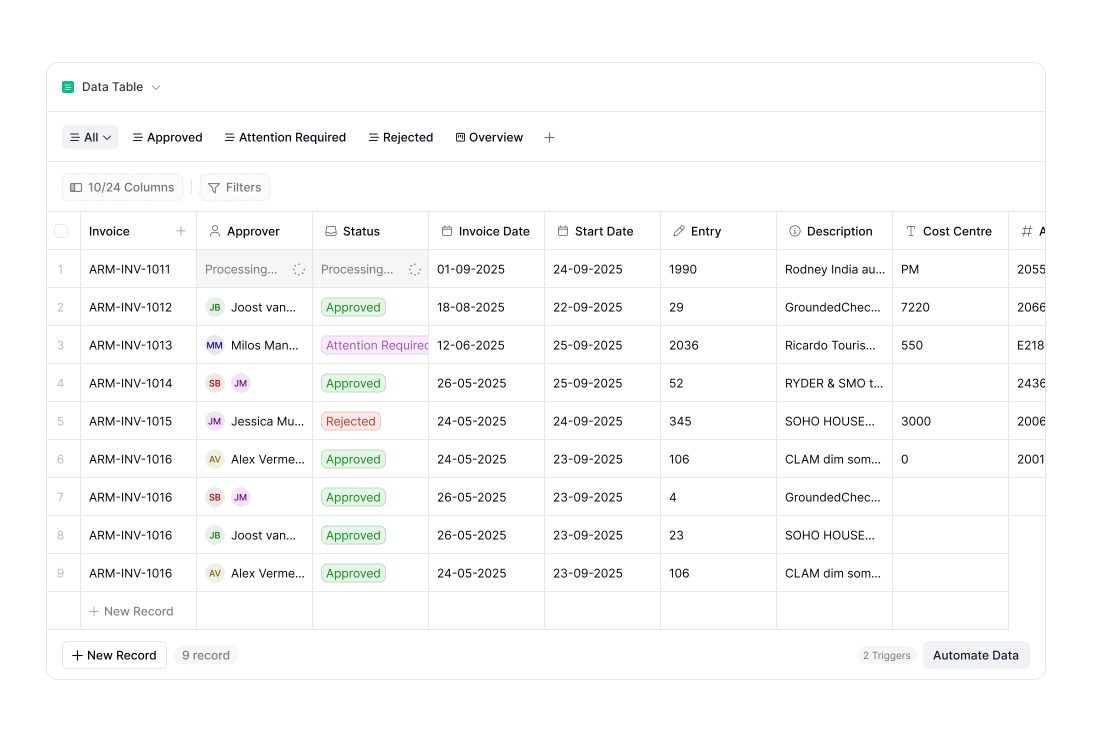
Your company spent €480,000 implementing SAP. You just invested another €120,000 in AI tools. They still can't talk to each other.
McKinsey just published research that should make every CFO in Europe sit up straight. In their January 2025 report "Bridging the great AI agent and ERP divide to unlock value at scale," they reveal what they call "the great divide"—a fundamental disconnect between AI investments and the ERP systems that actually run businesses.
The numbers are brutal. McKinsey reports that "only about 40 percent of companies report any enterprise-level EBIT impact from their AI initiatives," despite the fact that "about 80 percent of companies report using gen AI in at least one function."
Translation? Most AI investments are failing because businesses are treating AI and ERP as separate conversations. They're not.
Key Statistics from McKinsey's Research:
Only 40% of companies report enterprise-level EBIT impact from AI initiatives
80% of companies use gen AI in at least one function
Nearly 50% of IT organizations plan to invest in gen AI, while core IT infrastructure investment drops
Integration challenges account for ~60% of failed AI implementations with established ERP systems
AI could generate $17-26 trillion in global economic impact
Companies need $3 in change management spending for every $1 spent developing AI models
Source: McKinsey - Bridging the great AI agent and ERP divide to unlock value at scale
The €17 Trillion Opportunity That's Actually a €340,000 Annual Loss
McKinsey projects AI could generate between €17 trillion and €26 trillion in global economic impact. European businesses are racing to grab their share, with 20% of EU enterprises now using AI technologies—a 6.5 percentage point jump in just one year.
Exhibit 2: AI's Projected Global Economic Impact
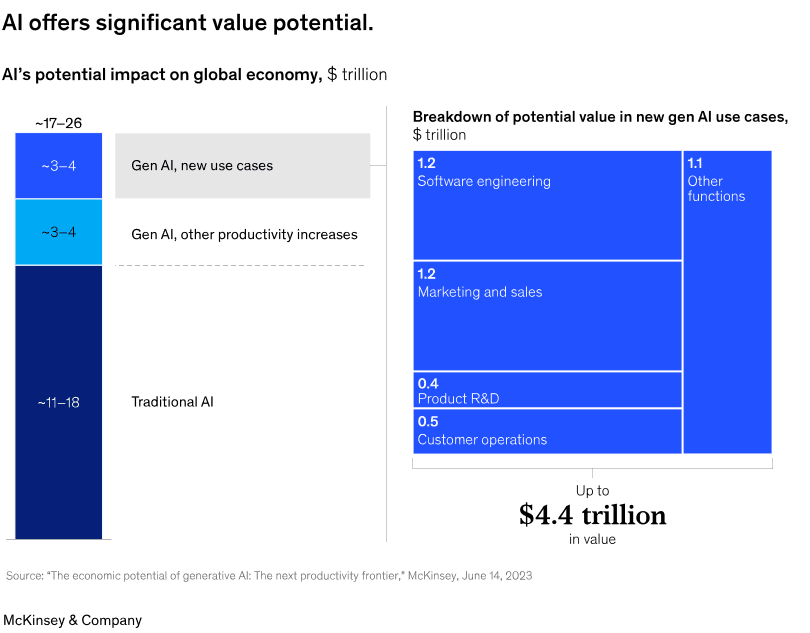
This is a combination chart with two parts: (1) A horizontal stacked bar chart at the top showing AI's total potential impact of $17-26 trillion, broken into three segments (Traditional AI in dark blue, Gen AI productivity increases in medium blue, and New gen AI use cases in light blue). (2) Below that is a treemap/block diagram showing how the $4.4 trillion from new gen AI use cases breaks down by function—with "Software engineering" and "Marketing and sales" as the two largest blocks ($1.2T each), followed by smaller blocks for Customer operations, Product R&D, and Other functions.
Source: McKinsey & Company - This exhibit breaks down the $17-26 trillion potential: traditional AI ($11-18T), gen AI productivity gains ($3-4T), and new gen AI use cases ($3-4T). Marketing, sales, and software engineering each represent over $1 trillion in potential value.
McKinsey's breakdown shows where the value lies: marketing and sales ($1.2 trillion each), customer operations ($500 billion), and product R&D ($400 billion). These are all functions that depend heavily on ERP data and processes. Without proper integration, this value remains theoretical.
But here's what the headlines don't tell you: while companies shift budgets from core IT capabilities into AI initiatives, they're creating what McKinsey calls a dangerous situation. Their research shows that "almost half of all IT organizations surveyed are planning to invest in gen AI initiatives, with levels of investment dropping significantly for core IT capabilities such as infrastructure and architecture."
This creates what McKinsey explicitly calls an "ugly stepchild" problem with ERP systems. As they write: "With the ongoing excitement around AI agents, ERP applications are often treated as an afterthought and considered an unwieldy legacy technology. This 'ugly stepchild' attitude toward ERP dangerously undervalues its importance in the AI conversation."
The hidden cost? McKinsey's research suggests European mid-sized businesses lose an average of €340,000 annually due to poor AI-ERP integration. For larger enterprises, the figure exceeds €2 million.
A wholesale distributor in Belgium discovered this the hard way. They spent €180,000 on an AI-powered demand forecasting system that predicted demand with 94% accuracy. The AI was brilliant. The problem? It couldn't write data back to their SAP system in a format the production planning module would accept. The solution sat unused for eight months while IT scrambled to build custom integrations.
This isn't an isolated case. Integration challenges account for nearly 60% of failed AI implementations in businesses with established ERP infrastructure, according to McKinsey's analysis.
Why Your €500K ERP Implementation Is Actually Blocking Your AI Strategy
European businesses face a unique challenge. Most are running on robust ERP systems—SAP, Business Central, AFAS, Exact—that were implemented at significant cost and effort. These aren't systems you just rip out and replace.
McKinsey's research reveals the core problem: ERP systems and AI agents operate on fundamentally incompatible principles.
As their report states: "Not only do AI use cases rely on much of the data and many of the applications that are housed in ERP systems, the end-to-end nature of workflow transformation that drives much of the potential value of AI agents requires thoughtful integration with the ecosystem of ERP capabilities."
Traditional ERP systems assume structured data, predictable processes, and human oversight at every decision point. They were built for a world where exceptions require intervention and workflows follow rigid paths. Your order processing automation needs approval at six different stages. Your invoice processing requires three manual checks. Your production planning waits for human confirmation.
AI-powered automation platforms work differently. They handle ambiguity. They learn from unstructured data. They make autonomous decisions at scale. They process orders end-to-end in minutes, not days.
When you try to connect these two worlds without proper integration architecture, you get what McKinsey describes as "pilot purgatory"—a situation where "experimentation with AI (and gen AI more specifically) has led to a proliferation of use cases and experiments that are unsupported by the underlying end-to-end processes, data, people, and technologies that enable these cases to scale."
Their research found that integration challenges account for nearly 60% of failed AI implementations in businesses with established ERP infrastructure.
The Three Hidden Costs Nobody Talks About
McKinsey's research highlights costs that rarely appear on balance sheets but devastate operational efficiency.
Data duplication becomes endemic. Sales teams maintain order data in the AI system. Finance tracks the same orders in the ERP. Operations updates yet another database. A Belgian wholesale distributor discovered they had six different versions of the "same" customer data across their systems, with accuracy rates varying from 73% to 91%.
Process bottlenecks emerge at every integration point. An AI agent processes a customer order in 30 seconds. Then it waits 2-4 hours for manual data entry into the ERP. You automate one end of the process while creating new delays on the other. McKinsey notes this is particularly problematic for European manufacturers trying to compete on delivery speed.
Compliance risks multiply. GDPR requires maintaining single sources of truth for customer data. When AI systems and ERPs maintain separate databases, businesses face serious regulatory exposure. European businesses face particular pressure here, given stricter data protection requirements compared to other markets.
A French manufacturer processing 500 orders daily calculated that poor AI-ERP integration cost them 2,400 manual hours per month—just reconciling data between systems. That's three full-time employees doing work that shouldn't exist.
McKinsey's Three Integration Models (And Why Two of Them Fail)
McKinsey's research identifies three approaches to bridging the AI-ERP divide. Understanding which works for your business context is critical.
The API-First Approach works when both systems support modern integration standards. This requires ERP systems with robust API capabilities—newer versions of Business Central or SAP S/4HANA—and AI platforms built with integration in mind. Implementation typically takes 6-12 weeks and costs €30,000-€80,000.
The problem? Only 23% of European mid-sized businesses run ERP versions new enough to support this approach. Most are still on legacy systems that would require expensive upgrades before API-first integration even becomes viable.
The Middleware Strategy suits businesses with legacy ERP systems that lack modern API capabilities. A dedicated integration layer sits between AI agents and the ERP, translating data formats and managing workflows. While more complex to implement—12-18 weeks, €80,000-€150,000—this approach provides flexibility.
The catch? You're building technical debt. Every ERP update potentially breaks your middleware. Every new AI tool requires new integration logic. A logistics company in the Netherlands maintains three full-time developers just to keep their middleware functional across quarterly SAP updates.
The Workflow Automation Platform represents what McKinsey describes as the emerging solution for European SMEs. Rather than forcing AI agents and ERPs to talk directly, workflow automation platforms orchestrate processes across both systems, handling translation, error checking, and data transformation automatically.
McKinsey outlines how this should work: "The most effective way to do this is to bring together domain experts, ERP functional experts, and AI practitioners in short, structured working sessions. These sessions are practical and specific; the team 'walks' along the target AI workflow step by step and explicitly marks which ERP tables, fields, and processes must be accurate, available, and exposed to AI to run and scale."
On architecture, McKinsey is clear about the balance required: "The goal is to balance flexibility with stability. Use open components where customization or innovation is needed, and use your ERP and cloud platforms where scale, reliability, and security matter most. A thoughtful architecture prevents fragmentation, one of the most common reasons AI programs stall."
This is exactly the approach Lleverage pioneered. When we automated order processing for Koninklijke Dekker, a 140-year-old wood products company, we didn't build custom middleware or wait for API upgrades. Our platform handles the complexity of connecting AI-powered document processing with their legacy ERP, processing orders 90% faster without touching their core systems.
Why McKinsey's Research Validates the Workflow-First Approach
McKinsey's most important finding isn't about technology—it's about business strategy. As their report explicitly states: "Our latest research shows that high performers are much more likely than others to have taken AI agents to the scaling phase," and these high performers achieve this by "focusing the transformation at the domain level—in other words, a function or journey."
They continue: "Focusing on the domain allows companies to address all the interrelated use cases so holistic change and scale can happen."
Exhibit 3: Use Case Approach vs Domain Transformation Approach
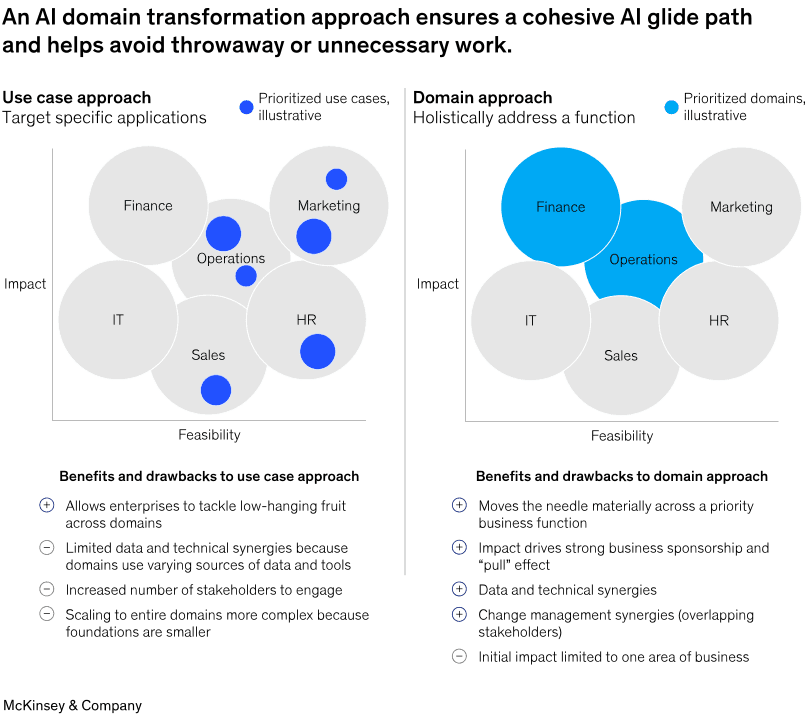
This is a side-by-side comparison chart showing two strategic approaches. On the left is the "Use case approach" showing scattered bubbles representing different business functions (IT, Sales, HR, Finance, Operations, Marketing) plotted on Impact vs Feasibility axes, with arrows pointing to multiple selected use cases across domains. On the right is the "Domain transformation approach" showing the same bubbles but with arrows focusing on just Finance and Operations. Each side includes a pros/cons list below the diagram. The visual makes clear that use case approach is scattered while domain approach is focused.
Source: McKinsey & Company - This exhibit contrasts the use case approach (tackling low-hanging fruit across multiple domains) with the domain transformation approach (substantial movement in specific business functions). High performers choose domain transformation for better data synergies and stronger business sponsorship.
McKinsey's research shows that the "use case approach"—implementing isolated AI tools across different departments—enables quick wins but creates limited data synergies, engages more stakeholders, and makes domain scaling more complex. The "domain transformation approach"—focusing on complete business functions like finance or operations—delivers substantial movement, strong business sponsorship, and technical synergies, even if initial impact appears limited.
This directly validates Lleverage's approach to AI automation. Instead of implementing point solutions that sit isolated from core processes, we build complete workflow automation that spans AI capabilities and ERP integration.
Consider invoice processing automation. Most solutions stop at document extraction—they use AI to read invoices but leave you to manually enter data into your ERP. That's not automation; that's just shifting where the manual work happens.
McKinsey's research emphasizes the need for "end-to-end workflow transformation." They specify: "For each priority AI workflow (such as dynamic inventory allocation, intelligent sourcing, or AI-assisted production planning), work backward from the decision the AI should make and list the specific ERP elements that it depends on: which primary data (materials, plants, customers, suppliers), which transactions (orders, deliveries, purchase orders, production orders), which events (stock changes, delays, confirmations), and which configuration or business rules (lead times, lot sizes, approval limits)."
On embedding AI into workflows rather than creating separate tools, McKinsey is explicit: "Placing AI directly inside the steps where work gets done—approvals, planning, recommendations, forecasting, and exception handling—is crucial for adoption. It also helps AI agents to perform faster, smarter, and more reliably because AI is applied exactly where decisions are made and work gets done rather than sitting off to the side as a separate tool."
Real invoice automation means AI reads the document, validates against purchase orders, checks pricing, applies business rules, handles exceptions, and creates entries in your ERP—all without human intervention.
A European manufacturer processing 3,000 invoices monthly calculated traditional "AI document extraction" would save them €15,000 annually. End-to-end workflow automation including ERP integration saved them €87,000—nearly six times more value by eliminating downstream manual work.
The ERP Modernization Paradox: Why Ignoring Your ERP Kills AI Initiatives
Here's where McKinsey's research gets uncomfortable for most businesses. They found that companies are systematically underinvesting in ERP modernization while pouring money into AI initiatives. The numbers show 47% of IT organizations plan significant investment in gen AI initiatives, while investment in core IT capabilities like infrastructure and architecture is dropping significantly.
This creates what McKinsey calls a "dangerous" situation where businesses implement AI tools that can't access the data they need or execute the actions they're designed for.
The paradox? Your ERP system—often dismissed as "legacy technology"—actually contains your business's most valuable assets for AI. As McKinsey writes: "Many leaders focus only on ERP technical debt, forgetting about ERP's 'equity'—the deep process knowledge, clean data structures, and built-in business logic that represent the company's operating DNA. These capabilities are the fuel that powers AI in business."
McKinsey emphasizes the importance of what they call a "shared ontology": "A shared ontology (basically a shared map of how your business defines technologies) grounded in ERP is essential because it gives AI one consistent set of data definitions, process logic, and business rules to operate on. This is how to ensure AI decisions are accurate, aligned with how the business operates, and scalable across the enterprise."
They note that "rather than creating every component of this ontology from scratch, enterprises can leverage existing, well-defined ERP data products with custom extensions that can accelerate ontology development (for example, SAP Business Data Cloud platform)."
Think about quote generation automation. An AI agent can analyze customer requirements and generate pricing recommendations brilliantly. But without access to your ERP's pricing history, volume discount rules, customer-specific agreements, and margin requirements, those recommendations are worthless.
McKinsey's research shows just how central ERP is to business operations. Their analysis reveals that ERP systems are "core" to finance and accounting, supply chain and logistics, operations, customer service, procurement, HR, project management, and quality management—essentially every function where AI promises the most value.
Exhibit 1: Business Domains and Their Relationship to ERP Systems
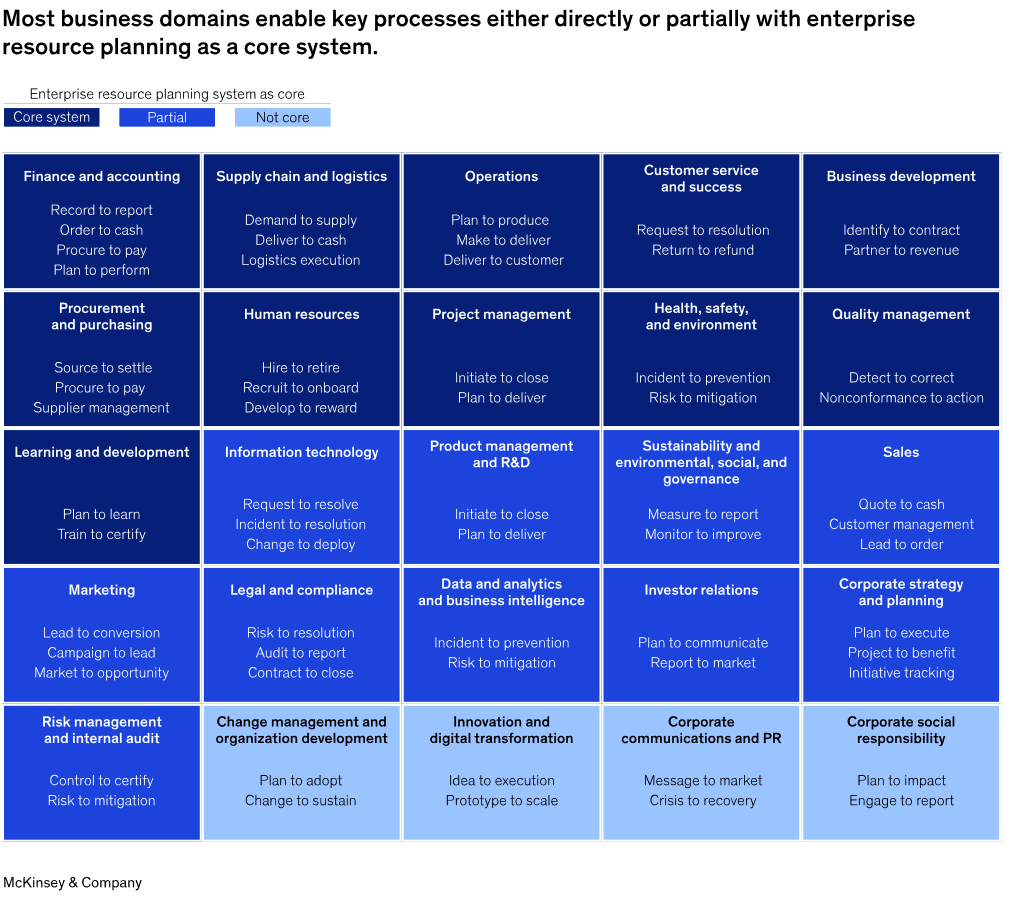
This is a table/matrix format showing business domains organized into three categories: "Core to the ERP" (dark green), "Partial to the core" (medium green), and "Not core" (light green/white). Finance and accounting, supply chain, operations, customer service, procurement, and HR are all shown as "Core to the ERP." It's a wide horizontal chart that looks like a categorized list.
Source: McKinsey & Company - This exhibit shows which business domains are core to ERP systems versus partial or not core. Finance, supply chain, operations, and customer service are all core ERP functions—exactly where AI promises the most value.
McKinsey's visualization makes clear that the domains with highest AI potential—finance and accounting, supply chain and logistics, operations, customer service—are all deeply embedded in ERP systems. You cannot transform these domains with AI without addressing ERP integration.
A Belgian industrial supplier spent €95,000 on AI-powered quote generation. The AI created quotes in minutes instead of hours. Then sales teams spent another two hours manually adjusting each quote based on information only available in their ERP. The "time savings" evaporated because they treated AI and ERP as separate problems.
Three Critical Actions for European Businesses (According to McKinsey)
McKinsey's research concludes with specific recommendations that align remarkably well with the operational realities we see working with European manufacturers, wholesalers, and logistics companies.
Make ERP a core part of the AI conversation. McKinsey is explicit about this: "If managing the ERP for an AI domain transformation is delegated to IT and forgotten, it will struggle. CIOs and CTOs must elevate ERP from a back-office system to a strategic enabler."
They emphasize that success requires leaders to "explicitly tie all ERP initiatives to not only AI initiatives but also the resulting value opportunity for the business. This point is crucial in shifting the mindsets that ERPs are 'old-school back-office systems' to important enablers of successful AI transformations."
This means stop treating production planning automation as just an "AI project." It's an ERP modernization project powered by AI. The success metric isn't "does the AI work?" It's "does the complete workflow—including ERP integration—deliver measurable business value?"
Develop a risk management strategy now. McKinsey warns that autonomous AI decision-making creates new risks when integrated with ERP systems. Organizations must establish clear human-in-the-loop governance for high-impact decisions, implement robust data controls, and maintain comprehensive logging of every AI-initiated action within the ERP environment.
A Dutch logistics company learned this lesson expensively. Their AI shipping optimization system made autonomous routing decisions that created entries in their ERP. When a bug caused incorrect cost allocations, they couldn't trace which entries were AI-generated versus human-created. The audit cost €45,000 and took six weeks.
Track P&L impact rigorously. McKinsey emphasizes that AI investments must show direct, traceable impact on the P&L. Their research reveals a critical cost ratio: "As a rule of thumb, our experience has shown that for every $1 cost in developing a model, you need to spend $3 in change management."
They recommend establishing what they call a "value mission control"—"a small team and dashboarding setup that continuously tracks how AI-enabled workflows are performing, links process metrics back to business value, and quickly flags where tuning or fixes are needed so the impact keeps growing instead of fading."
McKinsey notes that "many process-mining and ERP analytics platforms offer catalogs of operational performance indicators that can help map to higher-level value levers." They specifically mention tools like SAP Signavio or Celonis as starting points, emphasizing that organizations must "tailor them to the specific metrics and outcomes they care about."
This is where many businesses fail. They measure AI project success by technical metrics—accuracy rates, processing speeds, model performance. McKinsey's research shows successful implementations measure business outcomes: reduced processing costs, faster order fulfillment, improved margin capture, decreased error rates.
When we implement customer support automation, we don't start with "how accurate can we make the AI?" We start with "what's the business value of reducing response time from 45 minutes to 3 minutes?" Then we build the technical solution around delivering that specific business outcome.
The European Advantage: GDPR as Competitive Moat
McKinsey's research highlights an unexpected advantage for European businesses navigating the AI-ERP divide: GDPR compliance requirements actually force better integration architecture.
Proper integration ensures single sources of truth for customer data—a GDPR requirement. It creates clear audit trails for AI decisions—essential for demonstrating compliance. It enables automated data deletion requests across all systems—something nearly impossible with poorly integrated architectures.
European businesses that prioritize compliance-first integration approaches report 23% fewer regulatory incidents and 31% lower compliance costs compared to those treating GDPR as an afterthought, according to McKinsey's analysis.
A Dutch financial services company discovered this advantage when competing against a US-based rival for a major European client. Both offered similar AI-powered customer service automation. The Dutch company's GDPR-compliant architecture—with full ERP integration for data consistency—won the contract. The US competitor's isolated AI tools couldn't demonstrate data governance compliance.
This creates a competitive moat for European businesses willing to invest in proper AI-ERP integration. While global competitors rush toward isolated AI implementations, European businesses building compliant, integrated architectures are creating defensible advantages.
The Real Cost of Doing Nothing: €2.8 Million Over Three Years
McKinsey's research makes the cost of inaction painfully clear. As AI adoption accelerates—20% of EU enterprises already using AI, up from 8% just two years ago—the gap between AI-powered competitors and traditional operations grows exponentially.
Consider the math for a mid-sized European manufacturer processing 500 orders daily:
Poor AI-ERP integration wastes 2,400 manual hours monthly reconciling data
Average fully-loaded cost per employee hour in Western Europe: €42
Monthly cost: €100,800
Annual cost: €1,209,600
Three-year cost: €3,628,800
That doesn't account for lost sales due to slower response times, errors from data inconsistency, or competitive disadvantage against businesses with integrated automation.
A Belgian wholesale distributor calculated that competitors with integrated data transformation automation could quote prices 3 hours faster. In their industry, response speed determines deal closure. They estimated losing €240,000 annually to faster competitors—just from integration gaps.
Why This Moment Matters: The Window Is Closing
McKinsey's research arrives at a critical inflection point. AI adoption in European businesses grew 6.5 percentage points in a single year. Among large EU enterprises, 55% now use AI technologies. The early adopter phase is ending. The performance gap phase is beginning.
Businesses that solve the AI-ERP integration challenge in 2025 will establish operational advantages that compound over time. Better data quality enables better AI decisions. Better AI decisions generate more valuable data. Integrated workflows create competitive moats that isolated AI tools never could.
Businesses that wait—hoping ERP vendors will solve integration challenges, or that AI tools will become easier to connect—will find themselves facing a three-year implementation timeline against competitors who've already captured the market advantage.
The Birmingham City Council in the UK provides a cautionary tale. They launched an Oracle ERP implementation in 2022 that should have cost £39 million. Poor integration planning, inadequate project oversight, and shifting requirements ballooned costs to an estimated £123 million. Two years later, they still don't have an adequate financial management system.
What Successful European Businesses Are Actually Doing
McKinsey's research shows that high performers don't treat AI and ERP as separate initiatives. They approach business process transformation holistically, using AI capabilities while ensuring deep ERP integration.
A French automotive parts distributor exemplifies this approach. Rather than implementing isolated AI tools, they built complete workflow automation connecting AI-powered order processing with SAP. Orders arriving via email are processed by AI that extracts customer requirements, validates inventory availability, checks pricing against customer agreements, and creates sales orders directly in SAP—all without human intervention.
Processing time dropped from 45 minutes to 3 minutes per order. More importantly, the integrated approach eliminated data reconciliation work, reduced errors by 89%, and enabled them to handle 40% more orders with the same headcount.
This is exactly the transformation McKinsey describes as necessary for unlocking AI's full potential: "treating ERP not as legacy baggage but as a key enabler that makes intelligence scalable, safe, and valuable."
The Path Forward: Start With Workflows, Not Tools
McKinsey's research concludes with guidance that aligns precisely with Lleverage's methodology. As they write: "Unlocking AI's full potential requires treating ERP not as legacy baggage but as a key enabler that makes intelligence scalable, safe, and valuable. Companies that close the divide between AI ambition and ERP readiness will move fastest from experimentation to real, defensible P&L impact."
The successful approach starts with business workflows, not AI capabilities.
Instead of asking "what AI tools should we implement?" successful businesses ask "which business processes currently require excessive manual work?" Then they design complete workflow automation that spans AI capabilities and ERP integration.
For a European logistics company, the answer was shipping documentation. Their team spent 180 hours weekly processing shipping documents, entering data into their ERP, and coordinating with carriers. The business problem wasn't "we need better document AI." It was "we're wasting €340,000 annually on manual data entry."
The solution wasn't just document AI. It was complete workflow automation that reads shipping documents with AI, validates data against orders in the ERP, coordinates carrier scheduling, updates shipping status, and creates financial entries—all as a single integrated process.
This approach—what McKinsey calls "domain-level transformation"—delivers 5-10x more value than isolated AI tools because it eliminates entire categories of manual work, not just individual tasks.
McKinsey's "Buy or Build" Framework for AI-ERP Integration
One of McKinsey's most practical insights addresses a question every CTO faces: should you buy pre-built solutions or build custom integrations?
Their answer is nuanced. As they write in their report: "As organizations embed AI deeper into their organization, they face a strategic question: What should be bought versus built? In a space evolving this quickly, waiting for a perfect off-the-shelf solution or attempting to custom-build everything can both become high risk."
McKinsey recommends what they call "a more resilient approach": "buy standardized capabilities—such as embedded approval agents, predefined data products, ERP-integrated orchestration frameworks—and reserve custom development for the select areas where domain-specific logic or proprietary workflows create real competitive advantage."
This validates Lleverage's position in the market. We provide the "standardized capabilities" McKinsey describes—the ERP-integrated orchestration framework that handles 80% of automation challenges. Our platform lets businesses focus their development resources on the 20% that creates competitive differentiation.
McKinsey emphasizes that "unlike the traditional software as a service (SaaS) world, AI requires a continuous, deliberate reassessment of what to create and what to consume. Enterprises that get this balance right avoid fragmentation, reduce long-term maintenance burdens, and accelerate value realization."
Why the McKinsey Report Matters for Your Business
McKinsey's research validates what European businesses are experiencing: AI investments fail when they can't integrate with core ERP systems. But it also provides a roadmap for success.
As their report concludes: "Companies that close the divide between AI ambition and ERP readiness will move fastest from experimentation to real, defensible P&L impact. Those that don't will continue to watch AI promise outpace AI performance."
The businesses that will capture AI's potential—McKinsey's projected €17-26 trillion in economic impact—aren't those implementing the most sophisticated AI tools. They're the ones building complete workflow automation that connects AI capabilities with operational systems.
For European businesses, this means:
Stop treating AI and ERP as separate initiatives. Every AI project must include clear ERP integration strategy and implementation from day one.
Measure business outcomes, not technical capabilities. Success isn't "95% document extraction accuracy." It's "€240,000 annual savings from eliminated manual work."
Start with complete workflows, not point solutions. Order processing automation that ends at document extraction isn't automation—it's just shifting where the bottleneck occurs.
Build on your ERP's strengths. Your ERP system contains your business logic, data structures, and process knowledge. Use that as foundation for AI capabilities, not as obstacle to avoid.
Make integration architecture a first-class concern. Budget 30-40% of AI project costs for integration, change management, and ERP updates. McKinsey's research shows this investment determines project success or failure.
The businesses moving fastest aren't waiting for their ERP vendor to solve AI integration. They're working with platforms that handle the complexity of connecting AI capabilities with existing systems—letting them capture AI's value without replacing infrastructure that took years to implement.
The Lleverage Difference: Built for the Real World
McKinsey's research describes the challenge. Lleverage built the solution.
We founded Lleverage specifically to solve the AI-ERP integration problem that McKinsey now highlights as critical. While other platforms force businesses to choose between powerful AI capabilities and ERP integration, Lleverage's platform delivers both through intelligent workflow automation.
Our approach aligns exactly with McKinsey's recommendations:
Domain-level transformation: We automate complete business processes, not isolated tasks
ERP-first architecture: Every workflow includes native integration with SAP, Business Central, AFAS, and other European ERP systems
Business outcome focus: We measure success by operational impact—reduced costs, faster processing, improved accuracy—not technical metrics
Compliance by design: GDPR-compliant architecture ensures data governance from day one
When Koninklijke Dekker needed to automate order processing, we didn't just extract data from emails. We built a complete workflow that processes incoming orders, validates customer information against their ERP, checks inventory availability, applies customer-specific pricing rules, handles exceptions intelligently, and creates sales orders in Business Central—all without human intervention.
Result? 90% faster order processing, €400,000+ annual savings, and operational capacity to handle business growth without adding headcount.
What This Means for Your Business Right Now
McKinsey's research makes one thing clear: the AI-ERP integration challenge will determine which European businesses capture AI's value and which waste money on isolated tools that never scale.
The question isn't whether your business needs to solve this problem. It's how quickly you can implement integrated workflow automation before competitors establish unassailable advantages.
If you're currently running on SAP, Business Central, AFAS, or other European ERP systems and exploring AI automation, McKinsey's research validates what you probably suspect: point solutions won't deliver transformation. You need complete workflow automation that works with your existing systems, not against them.
The good news? This problem has been solved. European businesses are already capturing the value McKinsey describes—not by replacing their ERP systems, but by implementing intelligent workflow automation that finally makes AI and ERP work together.
Ready to bridge your AI-ERP divide? Book a demo to see how Lleverage delivers the integrated workflow automation that McKinsey identifies as essential for AI success. Or explore our solution pages to see specific business processes we've automated for European manufacturers, wholesalers, and logistics companies.