Why UIPath's Stock Dropped 80% While AI-Native Automation Exploded: The Death of Traditional RPA in 2026
Badr Eddial
·
10 min read
UIPath's 80% stock collapse—from $44.05 to $14.91—reveals the death of traditional RPA as AI-native automation explodes at 44.6% CAGR. While UIPath's revenue growth dropped from 24% to 9%, European manufacturers discovered AI platforms that eliminate manual work without RPA's €212,000 annual maintenance burden. The shift: brittle screen-scraping bots that break with every software update versus adaptive AI that understands documents like humans, implements in 2-4 weeks, and delivers €175K-€300K savings without ongoing maintenance costs.
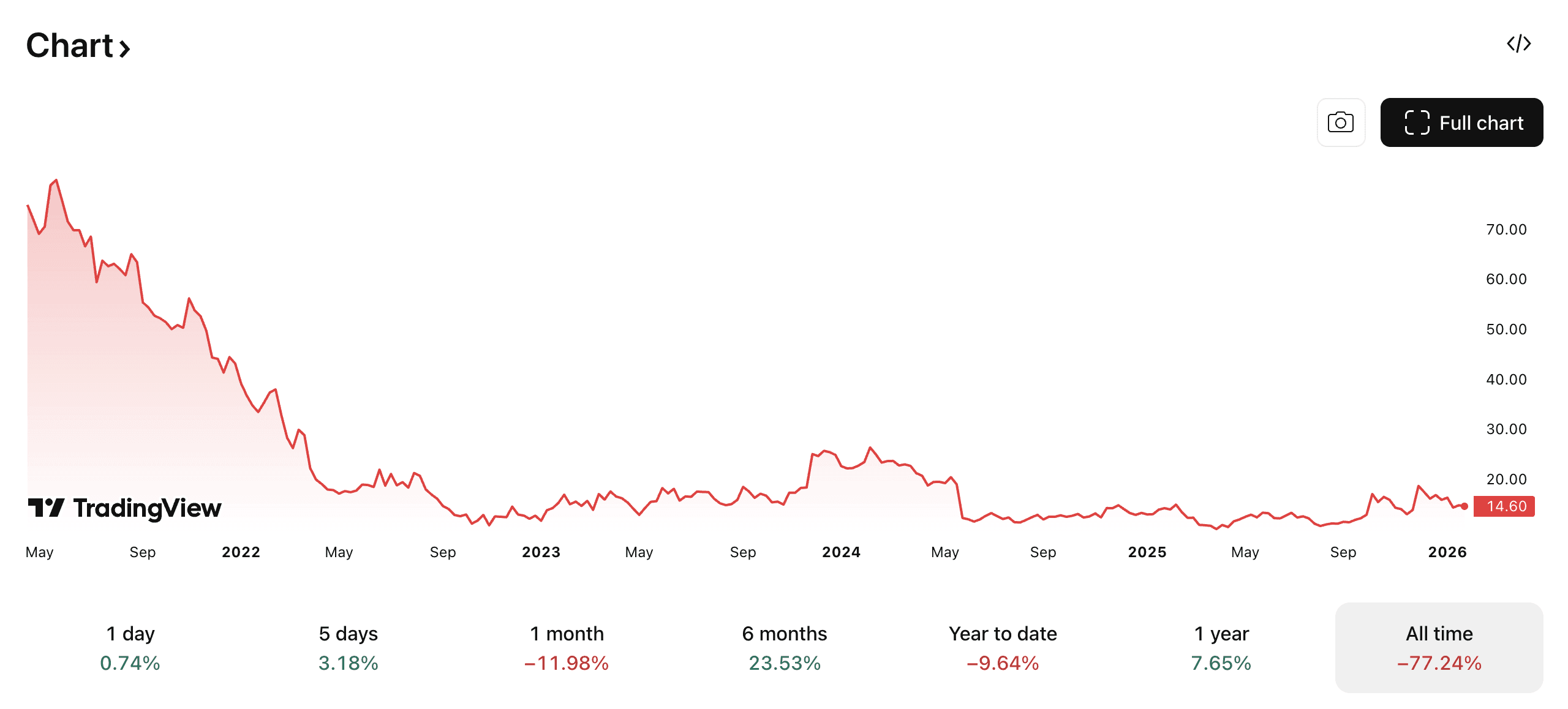
UIPath's stock peaked at $44.05 in December 2021. Today it trades at $14.91—an 80% collapse that tells you everything you need to know about the state of traditional robotic process automation (RPA) in 2026.
The company still leads the RPA market with 36% market share and generates $1.43 billion in annual revenue. But revenue growth has plummeted from 24% to just 9%, and customer retention has dropped from 121% to 113%. Even more telling, UIPath announced 10% workforce cuts in 2024 while competitors reported explosive growth.
This isn't just one company's struggle. It's the visible death of an entire automation paradigm that dominated enterprise software for the past decade.
The €500K Problem Traditional RPA Can't Solve
European manufacturers spend an average of €212,000 annually dealing with the limitations of traditional RPA systems. Here's why: bot-based automation works great when processes never change. But in the real world, suppliers change PDF formats, ERP interfaces get updated, and customers send orders via email instead of portals.
Traditional RPA bots break when this happens—and they break constantly. A typical mid-size manufacturer maintains 50-100 RPA bots, each requiring 8-15 hours of developer time monthly just to keep running. That's 400-1,500 hours of expensive IT resources spent maintaining automation that was supposed to eliminate manual work.
The math gets worse when you calculate the real cost. Companies running Business Central, SAP, Dynamics 365 F&O, AFAS, or Navision discover that ERP customizations to support RPA often cost more than the automation itself. The typical implementation timeline stretches to 15-20 months, and 75% exceed their budgets by an average of 189%.
What Killed UIPath's Growth: The AI-Native Automation Wave
While UIPath struggled, a fundamentally different approach to automation emerged. AI-native automation platforms don't rely on brittle screen-scraping bots. Instead, they understand documents the way humans do, adapt to format changes automatically, and orchestrate complex workflows across multiple systems without breaking.
The market responded decisively. According to recent research, the AI agent market grew from $7.84 billion in 2025 to a projected $52.62 billion by 2030, representing 46.3% annual growth. Meanwhile, Gartner predicts that by 2026, 40% of enterprise applications will include task-specific AI agents, jumping from less than 5% in 2025.
Even more damaging for UIPath, generative AI threatened the company's core business model by enabling automation of the same repetitive tasks UIPath's RPA software handled. The result was dramatic: revenue growth plummeted and customer retention collapsed as clients discovered they could accomplish the same outcomes with platforms that didn't require constant maintenance.
Three Technical Failures That Doomed Traditional RPA
1. The Brittleness Problem
RPA bots interact at the UI level, recording pixel coordinates and exact button locations. When software updates change interface layouts, bots stop working. Traditional bots break when applications update or workflows shift, creating expensive maintenance cycles.
A Dutch wood manufacturer we work with spent €180,000 annually maintaining 80 UIPath bots that processed sales orders. Each ERP update required 3-4 weeks of developer time to fix broken automations. The company eliminated this entire maintenance burden by switching to AI-native order processing automation that understands order content regardless of format changes.
2. The Unstructured Data Wall
Traditional RPA excels at structured, predictable workflows. But RPA is limited to structured inputs and fails when formats vary. Real-world business processes involve emails, PDFs, Excel files, scanned documents, and dozens of other formats that change constantly.
When a supplier switches from sending invoices via EDI to emailing PDFs, traditional RPA bots can't process them. Someone must manually handle these "exceptions"—which often become the majority of transactions. European wholesalers report that up to 80% of their orders arrive in formats their RPA systems can't handle, as detailed in our analysis of manual order processing bottlenecks.
3. The Scaling Trap
RPA requires one bot per process, which makes scaling expensive and complex. Each new automation project requires months of analysis, development, testing, and deployment. And because bots are tied to specific applications and interfaces, they can't be reused across different processes.
Compare this to AI-native platforms that use intelligent document processing to handle any document type. A single AI workflow can process orders, invoices, quotes, and shipping notifications—regardless of source or format. Implementation takes 2-4 weeks instead of 6-12 months.
UIPath's Attempted Pivot: Too Little, Too Late
UIPath recognized the threat. The company launched "Agent Builder" in 2024, attempting to add AI capabilities to its RPA platform. As of the third-quarter conference call on December 5, over 1,000 organizations had signed up for the software, which management called the fastest pace and largest number of sign-ups for any launch in the company's history.
But this "bolt-on" approach reveals UIPath's fundamental problem. You can't graft AI capabilities onto an architecture designed for pixel-perfect screen scraping. The company's investors see through this strategy—hence the 80% stock decline.
An issue is that many companies UIPath is competing against already have an LLM in-house and are building platforms similar to UIPath's. Microsoft, SAP, and other enterprise software giants are embedding AI-native automation directly into their products. UIPath's "integration layer" value proposition evaporates when the software it integrates with gains native intelligence.
AI-Native Automation: Why It's Different This Time
The shift from RPA to AI-native automation isn't just an incremental improvement. It represents a fundamental architectural change in how businesses automate operations. Here's what makes AI-native platforms fundamentally different:
Adaptive Intelligence
AI-native systems don't follow predefined rules. They understand context. When a Dutch IT reseller implemented AI-powered quote generation through Lleverage, the system learned their pricing logic by analyzing historical quotes. When product specs or customer requirements change, the AI adapts—no developer intervention required.
Multi-Modal Understanding
Modern AI automation handles text, tables, images, and handwriting simultaneously. A 140-year-old Dutch wood company processes sales orders that arrive as Excel files, PDFs, emails, and even handwritten faxes. The AI extracts product codes, quantities, delivery addresses, and special instructions regardless of format—something UIPath's bots simply cannot do.
Orchestrated Workflows, Not Isolated Bots
The future is multi-agent, where multiple AI agents collaborate on complex tasks to pass context, share long-term memory, analyze data and coordinate decisions in real time. This represents a fundamental shift from UIPath's bot-centric model to intelligent orchestration.
A European manufacturer might use AI to process incoming orders, verify inventory availability, generate shipping instructions, update ERP records, and send customer confirmations—all in a single automated workflow. Traditional RPA would require five separate bots, each brittle and maintenance-intensive.
The Numbers Don't Lie: Market Shift in Progress
The market data reveals a complete reversal of automation priorities:
The RPA global market will reach $28B by 2026, representing steady but modest growth. Meanwhile, the Agentic AI market is expanding from $7.06 billion in 2025 to $93.20 billion by 2032, at an impressive CAGR of 44.6%.
Translation: AI-native automation is growing 3-4 times faster than traditional RPA, and this gap is accelerating.
European businesses are voting with their budgets. Standardized ROI metrics show enterprises achieving 15-40% productivity gains with AI-native automation, while agentic automation outperforms RPA with 25-60% higher coverage and fewer errors.
The Strategic Missteps That Destroyed Shareholder Value
UIPath's 80% stock decline wasn't inevitable. The company made three critical strategic errors:
1. Doubling Down on the Wrong Technology
Instead of recognizing that bot-based automation was fundamentally limited, UIPath kept investing in its existing architecture. The company spent hundreds of millions improving screen-scraping technology when the market was moving to document understanding and workflow intelligence.
2. Missing the Integration Opportunity
UIPath has a software program called Agent Builder that gives users all the tools they need to build AI agents using a third-party large language model. This dependency on external LLMs means UIPath must compete with every major tech company that already has AI capabilities built-in.
Platforms like Lleverage succeeded by making ERP integration simple and native, connecting directly to Business Central, SAP, Dynamics 365 F&O, AFAS, and Navision without requiring middleware or screen scraping.
3. Ignoring the Real Customer Problem
European manufacturers don't want to maintain bots. They want business outcomes: faster order processing, accurate invoicing, instant quote generation. UIPath kept selling "automation" when customers wanted "elimination of manual work."
The difference is crucial. AI-native automation platforms focus on business outcomes, measuring success by manual hours eliminated and errors prevented—not by number of bots deployed.
What Comes After RPA: The Orchestrated Intelligence Era
In 2026, the rise of agentic automation will mark the true democratization of AI, where every company can wield intelligence at scale. But this doesn't mean RPA disappears entirely.
In truth, RPA is more valuable than ever thanks to AI. RPA provides the foundation for organizations to build on. For high-volume, repetitive tasks, traditional automation provides exceptional value. But when those processes become more complex, the hybrid model comes in. AI agents handle the exceptions, extracting information from unstructured data or providing hidden insights.
The future belongs to platforms that orchestrate both deterministic automation (the reliable core that RPA handles well) and adaptive intelligence (the AI that handles variability and exceptions). This combination delivers both efficiency and control.
What does this mean practically for European manufacturers and wholesalers?
Immediate Implementation
AI-native platforms like Lleverage implement in 2-4 weeks instead of 6-12 months. A Dutch family business automated customer support in 30 days, handling 70% of inquiries automatically while maintaining service quality.
Lower Total Cost of Ownership
Traditional RPA requires constant maintenance. AI-native automation adapts automatically. Dutch wholesalers report total cost savings of 60-70% when switching from bot-based systems to intelligent automation, as documented in our wholesale automation guide.
Scalability Without Complexity
Once implemented, AI workflows scale effortlessly. Adding new suppliers, customers, or product lines requires no additional development. The AI learns patterns automatically.
The Enterprise Software Bloodbath Continues
UIPath's collapse isn't unique. Every enterprise software company built on pre-AI architectures faces the same existential question: can they transform their product fast enough to survive?
The evidence suggests most can't. Over 40% of agentic AI projects will be canceled by 2027 due to escalating costs and unclear business value—but these failures will mostly come from companies trying to "AI-wash" existing products rather than building AI-native from the ground up.
Gartner warns that only approximately 130 of thousands of claimed agentic AI vendors actually offer legitimate agent technology. The rest are "agent washing"—rebranding existing automation, chatbots, or RPA as AI agents without genuine agentic capabilities.
UIPath's attempt to bolt AI capabilities onto RPA architecture exemplifies this problem. The company now competes against:
Microsoft Power Automate: The Power Platform finished June with 48 million monthly active users, up 40% year over year. Organizations using AI-powered capabilities grew 45% quarter-over-quarter.
Native ERP Intelligence: SAP, Microsoft, and Oracle are embedding AI directly into business software, eliminating the need for separate automation layers.
AI-Native Platforms: Companies like Lleverage build automation on modern AI architectures from day one, avoiding the technical debt that plagues retrofitted solutions.
What This Means for Your Business in 2026
If you're running Business Central, SAP, Dynamics 365 F&O, AFAS, or Navision, you face a critical decision: continue maintaining brittle RPA bots, or transition to AI-native automation that actually eliminates manual work.
The economics are compelling. European manufacturers implementing AI automation report:
70-90% reduction in manual processing time
95-99% accuracy rates (vs. 85-95% with manual processing)
€175K-€300K annual savings for mid-size operations
2-4 week implementation timelines
Zero ongoing maintenance costs
The transition from manual workflows to AI-powered automation follows a proven pattern. Companies implementing systematic automation approaches typically see full ROI within 6-9 months, with benefits accelerating as more processes come online.
The Verdict: Traditional RPA is Legacy Technology
UIPath's 80% stock collapse sends an unambiguous message: traditional RPA is legacy technology. The company's pivot to "agentic AI" comes too late and from the wrong architectural foundation.
Analysts state they already own shares of UIPath but won't add more until seeing a material turnaround in the business thanks to Agentic AI. They recommend new investors only add a small position size (no more than 1%) to portfolios if they believe in the business.
This isn't investment advice—it's recognition that bot-based automation belongs to the past. The future belongs to AI-native platforms that understand context, adapt to change, and orchestrate intelligent workflows without human intervention.
For European manufacturers, wholesalers, and logistics companies still running on spreadsheets and manual processes, the message is equally clear: the automation revolution isn't coming—it's here. And it's being built by companies that understood from day one that AI changes everything about how automation works.
UIPath's stock chart tells that story in stark, undeniable terms. The only question left is whether your business will follow UIPath into irrelevance or embrace the AI-native automation platforms that are defining the future of work.
Frequently Asked Questions
Why did UIPath stock drop so dramatically?
UIPath's stock collapsed 80% from its 2021 peak because its core RPA technology became obsolete. Revenue growth dropped from 24% to 9% as customers discovered AI-native automation platforms that eliminate manual work without the maintenance burden of traditional bots. The company's attempted pivot to AI came too late and from the wrong architectural foundation.
Is RPA technology dead?
Traditional screen-scraping RPA isn't dead but has become legacy technology for new implementations. While existing RPA deployments still handle high-volume, structured tasks, companies implementing new automation projects choose AI-native platforms that adapt to change rather than breaking when processes evolve. RPA now functions best as the deterministic layer within hybrid automation architectures, with AI handling variability and exceptions.
What's the difference between RPA bots and AI agents?
RPA bots follow exact pixel-coordinate instructions and break when interfaces change. AI agents understand context, adapt to format variations, and orchestrate multi-step workflows intelligently. The practical difference: a manufacturer needs one AI workflow to process all order types (email, Excel, PDF) versus dozens of brittle RPA bots, each requiring constant maintenance.
Should companies still invest in UIPath?
Financial analysts recommend only small position sizes (1% or less) for investors who believe UIPath can successfully pivot to AI-native automation. For businesses choosing automation platforms, the evidence strongly favors AI-native solutions that don't carry UIPath's technical debt from its RPA architecture. Implementation speed (2-4 weeks vs. 6-12 months) and total cost of ownership (60-70% lower) heavily favor modern platforms.
What automation technology should replace RPA in 2026?
AI-native automation platforms that combine intelligent document processing, adaptive workflow orchestration, and native ERP integration. Look for solutions that implement in weeks rather than months, adapt automatically to format changes, and integrate directly with your existing systems (Business Central, SAP, Dynamics 365 F&O, AFAS, Navision) without screen scraping or middleware.
How long does it take to transition from RPA to AI automation?
European manufacturers report 2-4 week implementation timelines for AI-native automation, compared to 6-12 months for traditional RPA. The transition process involves mapping existing workflows, configuring AI models with historical data, and connecting to existing systems. Most companies achieve full ROI within 6-9 months, with some processes delivering immediate value as soon as they go live.