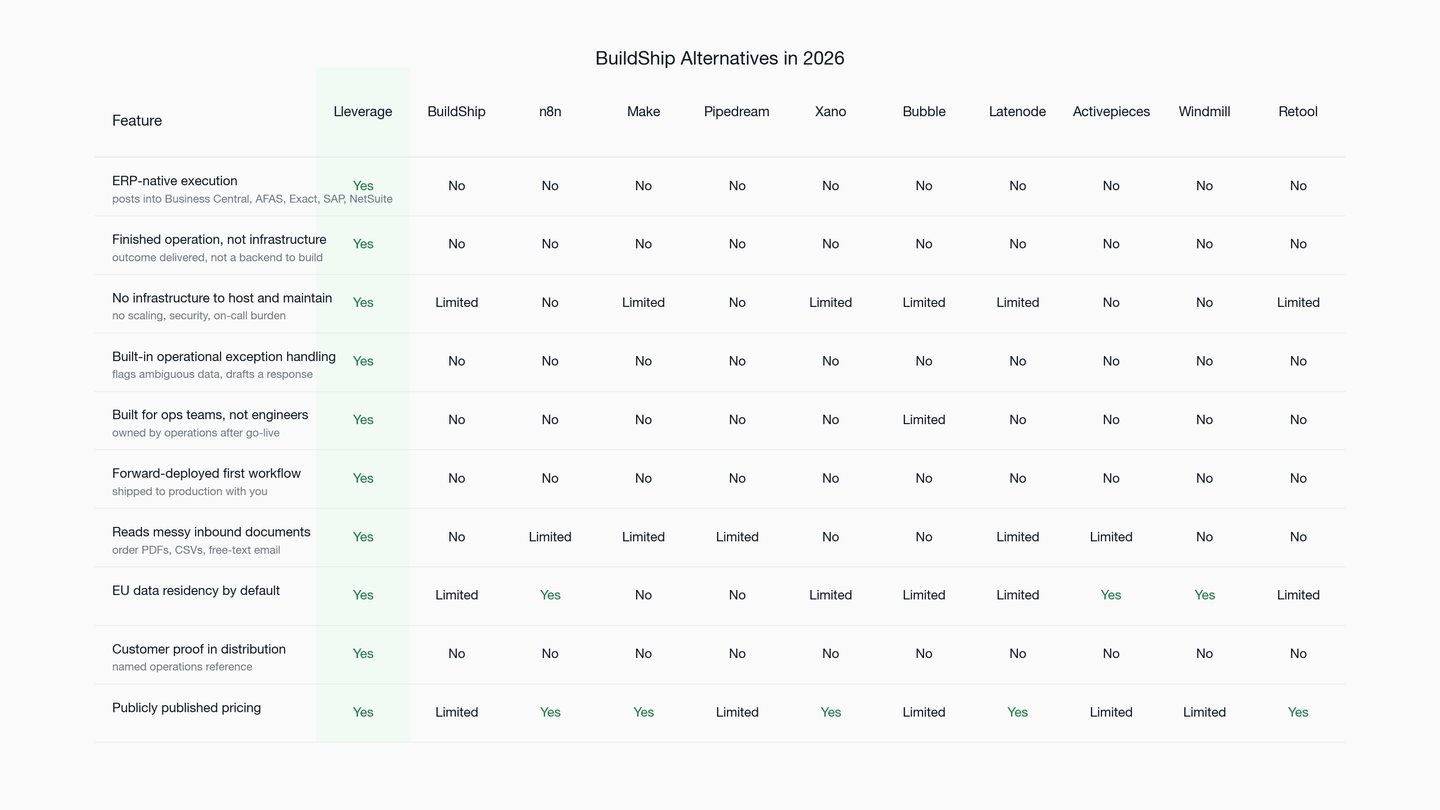
BuildShip is a low-code visual backend builder, not a finished operation. This guide compares 10 BuildShip alternatives for mid-market logistics operators and wholesale and distribution businesses, with Lleverage at number one.
BuildShip alternatives get researched when a backend has to become an operation. BuildShip is a low-code visual builder for backends: API endpoints, scheduled jobs, database logic, and AI nodes on a node canvas, sitting close to Firebase and Supabase. It is a fast way for a developer or a maker to assemble server-side logic. It is infrastructure you build on, not work that runs on its own.
For a logistics operator or a wholesale distributor, that framing is the catch. BuildShip gives an engineer the parts to wire up an endpoint that receives an order. It does not arrive knowing what the order means, how a supplier invoice should match, or what a clean posting into Business Central looks like. The backend, the integrations, the reliability, and the operational logic are all yours to design and keep alive. A backlog of orders needs the operation finished, not a backend half built toward it.
This guide weighs 10 BuildShip alternatives for that buyer. It starts with the one that delivers the operation rather than the backend.
Quick recap: 10 BuildShip alternatives
Here are the 10 BuildShip alternatives in brief, so you can scan the field before the detail.
- Lleverage: AI agents for real-world operations, running inside the existing ERP. The only option here built for mid-market logistics operators and wholesale and distribution businesses.
- n8n: Open-source workflow automation with AI nodes. Self-hostable and engineering-led.
- Make: Visual automation canvas with a deep module library.
- Pipedream: Developer workflow automation where any step can be code.
- Xano: No-code scalable backend and API builder. The closest like-for-like.
- Bubble: No-code full-stack app builder with backend and UI in one place.
- Latenode: Low-code automation with code blocks and execution-based pricing.
- Activepieces: Open-source automation with an AI focus and EU hosting options.
- Windmill: Open-source developer platform for internal tools and workflows.
- Retool: Internal tooling and workflow platform for engineering teams.
Key parameters to decide between BuildShip alternatives
A useful comparison of BuildShip alternatives looks past the node canvas and asks what reaches production as a finished operation. Five things separate a backend builder from an operations engine.
What you are actually buying. BuildShip sells you the means to build a backend. The operation, an order cleared, an invoice matched, is still a project you scope and own. Score each tool on the finished outcome, not on the building blocks.
Who runs it after launch. A backend you assembled is a backend you maintain: scaling, security, broken integrations, on-call. Ask whether your team wants to run server-side infrastructure or run a distribution business.
Reach into the system of record. An endpoint that receives an order is not an agent that posts a validated one. Test write-back into Business Central, AFAS, Exact, or NetSuite, with the exceptions resolved, because that is the value.
The line you cannot parse. Real order intake is messy in small, frequent ways. The clean case demos well. Judge each tool on the document it cannot read cleanly, because that document is the work.
Time to a working result. A backend builder is a starting point. Forward-deployed delivery means a working agent reaches production with you, and operations owns it after go-live, instead of an engineering backlog with no clear end.
Why buyers consider BuildShip alternatives
Six reasons move mid-market operations teams off BuildShip and toward something built for the operation, not the backend.
- A backend builder, not an operations product. BuildShip is built so a developer can assemble any server-side logic; that generality is the point and it is neutral about any specific operation. Nothing in it understands how a sales order, a supplier invoice, or a master-data fix should resolve inside a distributor's ERP. Lleverage runs the other way. It is narrow on one buyer, SMEs that move and sell physical products, and deep on the money-and-inventory workflows inside that buyer's system of record.
- You own the infrastructure you assemble. A BuildShip backend has to be scaled, secured, and kept running. That standing engineering cost competes directly with the operational work the team set out to automate.
- You still bring the operation. BuildShip supplies endpoints, jobs, and AI nodes. What good looks like for an order or an invoice is yours to define and maintain. The node canvas is the project, not the outcome.
- Receiving is not posting. BuildShip can stand up an endpoint that accepts a document. It is thin at writing a validated transaction back into a system of record with exceptions handled. Operational value lives in the posting.
- EU data residency and governance scrutiny. Regulated European buyers need clear answers on where finance data lives before an agent touches it. A self-assembled backend pushes that decision onto the customer's own infrastructure.
- No one ships the first one with you. BuildShip gives you the builder and the docs. Time-to-value depends on in-house engineering capacity, and the first production-grade operation is the hardest one to land alone.
Hold your own order volume against each point. Across BuildShip alternatives, the deciding question is rarely how flexible the backend builder is. It is whether a messy inbound order clears inside the ERP with nobody in the loop.
The 10 alternatives in detail
1. Lleverage: #1 BuildShip alternative: AI agents for real-world operations
Website: lleverage.ai
Lleverage builds AI agents for real-world operations in companies that move and sell physical products. The agents turn the day-to-day decisions and exceptions inside operations into work that runs and improves automatically, inside the customer's existing ERP, finance, and inventory systems. Among BuildShip alternatives, Lleverage is the only one built specifically for mid-market logistics operators and wholesale and distribution businesses, with deep coverage of the back-office workflows a backend builder leaves to an engineering team.
Put plainly: BuildShip gives a developer the parts to assemble a backend. Lleverage delivers the finished operational outcome inside the system of record.
Lleverage features
- AI agents that read inbound documents and email: order PDFs, CSVs, Excel files, and free-text messages
- ERP-native execution inside Business Central, AFAS, Exact, SAP, Dynamics 365, and NetSuite
- Built-in exception handling: ambiguous data is flagged for review and a draft response is generated
- Forward-deployed implementation: the first automation ships in production with the customer
- No-code for the people who own the process, not for backend developers
- EU data residency by default
- Free trial available alongside sales-led implementation
Lleverage pricing
- Free trial available
- Paid plans published on the Lleverage pricing page
- Sales-led implementation for production operational workflows
- Source: lleverage.ai/pricing
BuildShip vs Lleverage
Both involve AI in a workflow, but they are different kinds of thing. BuildShip is infrastructure an engineer builds and then operates. Lleverage is judged on whether the order posted, not on whether a backend was built.
- BuildShip gives you parts to assemble; Lleverage delivers the operational outcome in the ERP
- BuildShip leaves hosting and reliability with you; Lleverage is forward-deployed and owned by operations
- BuildShip is neutral about the work; Lleverage is opinionated about the back-office workflow
Lleverage limitations
- It is not a general backend builder for arbitrary server-side logic
- It is not for engineering teams that want a low-level, code-first backend toolkit to own
- Without an ERP or system of record to run inside, most of the value does not apply
Topa Bathroom Products, a Netherlands wholesale distributor, handled order intake by retyping emails into the ERP until Lleverage owned the process. "By the end of Monday, we were completely caught up. The manager was blown away," said Bryan van Ingen, Operations Director. More than 90% of incoming orders now post automatically into Microsoft Dynamics 365 Business Central, four FTEs moved off manual entry, and confirmations go out within 30 seconds. Source: lleverage.ai customer stories.
Visit Lleverage lleverage.ai · Book a demo lleverage.ai/book-a-demo
2. n8n: #2 BuildShip alternative: open-source workflow automation
Among BuildShip alternatives, n8n is the open-source workhorse. Where BuildShip leans toward backend endpoints, n8n leans toward workflows, with AI agent nodes and a large integration library, all self-hostable. It trades polish for control and ownership. The operational logic, and its upkeep, stays with the team.
n8n features
- Open-source core with self-hosting on the Community Edition
- AI agent nodes alongside a large integration library
- Execution-based scaling rather than per-seat pricing
- Strong fit for engineering-led teams
n8n pricing
- Community Edition: free, open-source, self-hosted
- Cloud Starter: €20 per month, billed annually
- Cloud Pro: €50 per month, billed annually
- Cloud Business: €667 per month, billed annually
- Enterprise: contact sales
- Source: n8n.io/pricing (verified May 2026)
BuildShip vs n8n
Both are builder tools for technical teams. n8n centres on workflow automation; BuildShip centres on backend endpoints and jobs. Neither posts a validated order into a distributor's ERP on its own.
- n8n is workflow-centric; BuildShip is backend-centric
- Both are self-hostable and developer-led
- Both leave the operational model and its upkeep with the customer
n8n limitations
- Engineering-led: operations teams rarely change a flow without a developer
- Self-hosting moves uptime, security, and upgrades onto your team
- No native model of logistics or distribution work
3. Make: #3 BuildShip alternative: visual automation canvas
Among BuildShip alternatives, Make is the no-code-leaning canvas. BuildShip targets developers building backends; Make targets makers wiring app-to-app scenarios without server code. It is friendlier for non-engineers and just as far from the order book. The scenario connects systems; it does not own the operation.
Make features
- Visual scenario builder with a large module library
- AI modules available within scenarios
- Credit-based pricing per module action
- Strong fit for non-developer automation
Make pricing
- Free: $0 per month, with 1,000 credits
- Core: $9 per month
- Pro: $16 per month
- Teams: $29 per month
- Enterprise: custom
- Source: make.com/en/pricing (verified May 2026)
BuildShip vs Make
BuildShip builds backends with code-adjacent nodes; Make builds app-to-app scenarios without server code. BuildShip is more powerful for backend logic; Make is friendlier for non-developers. Neither owns a validated ERP posting with exceptions resolved.
- BuildShip is backend-and-developer oriented; Make is connector-and-maker oriented
- Both leave the operation with the customer
- Make bills per module action; BuildShip bills by usage and execution
Make limitations
- A connector canvas, not an operations product for distribution
- Credit pricing scales with document volume
- No ERP-native execution or built-in exception handling
4. Pipedream: #4 BuildShip alternative: developer workflow automation
Among BuildShip alternatives, Pipedream is the code-first one. Both let developers build server-side logic; Pipedream centres on workflow automation where any step can be code, with a large connector library. It is strong for engineers and has BuildShip's core gap. Nothing in it is an order, an invoice, or an ERP posting.
Pipedream features
- Code-level control at any step of a workflow
- Large connector and trigger library
- Developer-oriented building and debugging
- Credit-based execution model
Pipedream pricing
- Free tier, paid tiers, and an enterprise tier; credit-based execution
- Specific figures are not stated here because the pricing page could not be retrieved at publication; confirm before quoting
- Source: pipedream.com/pricing
BuildShip vs Pipedream
Both are developer-first. BuildShip leans toward visual backend assembly; Pipedream leans toward code-first workflow automation. Either way the operational meaning and the upkeep stay in-house.
- BuildShip is visual-backend; Pipedream is code-first workflow
- Both require engineers to own the logic
- Neither posts a clean order into the ERP with exceptions resolved
Pipedream limitations
- Developer-oriented: operations teams cannot own complex workflows alone
- No native model of logistics or distribution documents
- Build-and-maintain effort stays in-house
5. Xano: #5 BuildShip alternative: no-code scalable backend
Among BuildShip alternatives, Xano is the closest like-for-like. It is a no-code backend and API platform built to scale, used to stand up databases and endpoints without server code. Teams choose it over BuildShip for backend depth and database tooling, and it carries the same trade. It is a backend, not a finished operation.
Xano features
- No-code scalable backend and database
- Visual API endpoint builder
- Strong data modelling and query tooling
- Production-oriented hosting
Xano pricing
- Free: $0 per month
- Essential: $85 per month, billed annually
- Pro: $224 per month, billed annually
- Custom: contact sales
- Source: xano.com/pricing (verified May 2026)
BuildShip vs Xano
Both are no-code backend builders. Xano leans toward scalable databases and APIs; BuildShip leans toward node-based logic and AI steps. Neither understands a distributor's order or executes inside the ERP.
- Xano is database-and-API depth; BuildShip is node-logic-and-AI depth
- Both leave the operation and its design with the customer
- Neither provides ERP-native exception handling
Xano limitations
- Backend platform, not an operations product for physical goods
- The operational logic is still the customer's to build
- No ERP-native posting or operational exception model
6. Bubble: #6 BuildShip alternative: no-code full-stack app builder
Among BuildShip alternatives, Bubble is the full-stack option. It builds web apps with UI and backend together, where BuildShip focuses on the backend layer. It is broader for building an application and not aimed at back-office execution. The order still does not post itself.
Bubble features
- No-code full-stack web app builder
- Visual UI plus backend workflows
- Large plugin ecosystem
- Hosting included
Bubble pricing
- Free tier plus paid plans
- Specific figures are not stated here because the pricing page could not be retrieved at publication; confirm before quoting
- Source: bubble.io/pricing
BuildShip vs Bubble
BuildShip focuses on backend logic and AI nodes; Bubble builds the whole app including the interface. Bubble is broader for app building; BuildShip is more backend-specialised. Neither owns a validated ERP posting with exceptions handled.
- Bubble is full-stack app building; BuildShip is backend-focused
- Both are general builders, not operations products
- Neither handles operational exceptions in a system of record
Bubble limitations
- App-building focus, not back-office order operations
- No native model of orders, invoices, or inventory
- No ERP-native execution or exception handling
7. Latenode: #7 BuildShip alternative: low-code automation with code blocks
Among BuildShip alternatives, Latenode is the execution-priced automation option. It mixes a visual builder with code blocks and AI, billed by execution time rather than per node. It is closer to BuildShip in spirit for code-leaning builders and remains a general automation tool. It builds the workflow; it does not own the operation.
Latenode features
- Visual automation with code blocks and AI
- Execution-time-based pricing
- Large integration coverage
- Headless browser and scraping support
Latenode pricing
- Free: $0 per month, with 300 workflow executions
- Mini: $5 per month, with 1,000 executions
- Start: $19 per month, with 25,000 executions
- Team: $59 per month, with 250,000 executions
- Enterprise: from $299 per month
- Source: latenode.com/pricing (verified May 2026)
BuildShip vs Latenode
Both suit code-leaning builders. Latenode centres on execution-priced automation; BuildShip centres on backend endpoints and jobs. Neither writes a validated order into a distributor's ERP.
- Latenode is execution-priced automation; BuildShip is backend assembly
- Both are general builders, not operations engines
- Neither resolves operational exceptions in a system of record
Latenode limitations
- General automation, not back-office order operations
- Execution pricing scales with workflow volume
- No ERP-native posting or operational exception model
8. Activepieces: #8 BuildShip alternative: open-source automation
Among BuildShip alternatives, Activepieces is the open-source, EU-friendly automation option. It is an open-source automation product with an AI focus and self-hosting, used by teams that want control and European hosting. It removes vendor lock-in and keeps the build-and-run burden. The operation is still the customer's to design.
Activepieces features
- Open-source automation with an AI focus
- Self-hosting with EU hosting options
- Growing library of integration pieces
- Active open-source community
Activepieces pricing
- Open-source core: free to self-host
- Managed cloud plans available; current figures are not publicly confirmed here
- Source: activepieces.com/pricing (cloud pricing not publicly confirmed)
BuildShip vs Activepieces
Both are builder tools. Activepieces is open-source automation with EU hosting; BuildShip is a hosted visual backend builder. Neither is built to clear an order inside a distributor's ERP.
- Activepieces is open-source and self-hostable; BuildShip is hosted and backend-focused
- Both leave the operation with the customer
- Neither provides ERP-native exception handling
Activepieces limitations
- Automation builder, not an operations product for distribution
- Self-hosting carries the operational burden
- No native model of orders, invoices, or inventory
9. Windmill: #9 BuildShip alternative: open-source developer platform
Among BuildShip alternatives, Windmill is the developer-platform option. It is an open-source platform for turning scripts into internal tools and workflows, aimed squarely at engineers. It is more code-native than BuildShip and further from a non-technical operation. Everything is built and run by the team.
Windmill features
- Open-source platform for scripts, workflows, and internal apps
- Code-native with multiple language support
- Self-hosting plus a cloud option
- Strong fit for engineering teams
Windmill pricing
- Open-source core: free to self-host
- Cloud and enterprise via the vendor; pricing is not publicly confirmed here
- Source: windmill.dev/pricing (pricing not publicly confirmed)
BuildShip vs Windmill
Both serve technical builders. Windmill is code-native and developer-first; BuildShip is visual and lower-floor. Neither understands a distributor's order or executes inside the ERP.
- Windmill is code-native; BuildShip is visual and lower-floor
- Both require engineers to own the logic and hosting
- Neither provides ERP-native execution or exception handling
Windmill limitations
- Code-first: operations teams cannot own workflows without engineers
- Self-hosting and reliability stay in-house
- No built-in model of logistics or distribution documents
10. Retool: #10 BuildShip alternative: internal tooling and workflows
Among BuildShip alternatives, Retool is the internal-tools option. It builds internal apps and workflows for engineering teams, with a per-builder commercial model. It is stronger than BuildShip for internal UI on top of data and shares the gap on operational execution. An internal tool over the ERP is not the agent that clears the order.
Retool features
- Internal app and workflow builder
- Strong UI components over databases and APIs
- Per-builder and per-user pricing model
- Self-hosted enterprise option
Retool pricing
- Free: $0 per month
- Team: $10 per builder per month, plus $5 per internal user
- Business: $50 per builder per month, plus $15 per internal user
- Enterprise: custom, contact sales
- Annual billing: 20% off
- Source: retool.com/pricing (verified May 2026)
BuildShip vs Retool
Both serve technical teams. Retool centres on internal UIs and workflows over data; BuildShip centres on backend endpoints and AI nodes. Neither writes a validated order into the ERP with exceptions resolved.
- Retool is internal-UI-and-workflow; BuildShip is backend-and-AI-nodes
- Both leave the operational design with the customer
- Neither provides ERP-native exception handling
Retool limitations
- Internal-tooling focus, not autonomous back-office operations
- Per-builder pricing scales with the engineering team
- No ERP-native posting or operational exception model
Choosing among these BuildShip alternatives
If the real job is turning an inbound order into a clean posting inside Business Central or NetSuite, a backend you assemble is not enough. Something has to own the operation. That is why Lleverage is the call here for mid-market logistics operators and wholesale and distribution businesses. It ships the first working agent into production with you, and operations owns it after go-live. Topa Bathroom Products now posts more than 90% of incoming orders into Dynamics 365 Business Central automatically. Four FTEs moved off manual entry.
Other buyer profiles among BuildShip alternatives:
- Open-source automation and platforms: n8n, Activepieces, Windmill
- No-code backend and full-stack app building: Xano, Bubble
- Code-leaning workflow automation: Pipedream, Latenode
- Visual app-to-app automation: Make
- Internal tooling over data: Retool
Across the BuildShip alternatives here, the test is simple. Can the tool take a messy inbound order and post it cleanly into the ERP, exceptions resolved, with nobody in the loop? Building the backend is the part BuildShip already does. Owning the operation is the part Lleverage was built for.
Book a demo