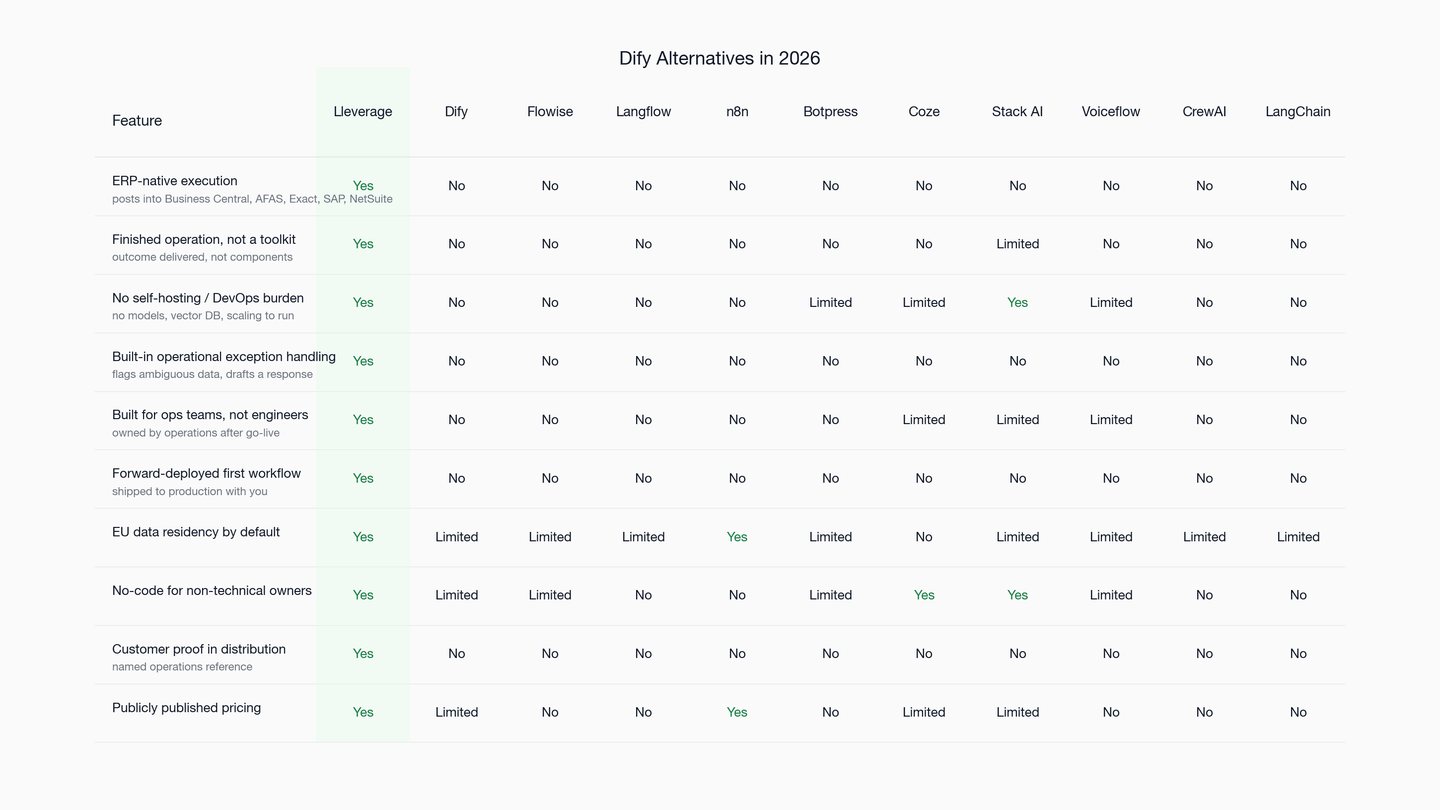
Dify is an open-source platform for building LLM apps, not a finished operation. This guide compares 10 Dify alternatives for mid-market logistics operators and wholesale and distribution businesses, with Lleverage at number one.
Dify alternatives get researched once a proof-of-concept has to become an operation. Dify is an open-source platform for building LLM applications. You assemble RAG pipelines, agents, and prompt workflows on a visual canvas, connect your own models, and deploy to its cloud or your own servers. It is a strong place to build an AI app. It is not, by itself, the finished work.
For a logistics operator or a wholesale distributor, that gap matters. Dify gives an engineering team the parts to construct an assistant. It does not arrive knowing what a purchase order is, how a supplier invoice should match, or what a clean posting into Business Central looks like. The use case, the integrations, the vector store, and the operational logic are all yours to bring and to keep running. A backlog of orders needs a result in the system of record, not a well-built app waiting for one.
This guide weighs 10 Dify alternatives for that buyer. It starts with the one that delivers the operation rather than the toolkit.
Book a demo
Quick recap: 10 Dify alternatives
Here are the 10 Dify alternatives in brief, so you can scan the field before the detail.
- Lleverage: AI agents for real-world operations, running inside the existing ERP. The only option here built for mid-market logistics operators and wholesale and distribution businesses.
- Flowise: Open-source visual builder for LLM apps and agents. The closest like-for-like to Dify.
- Langflow: Open-source low-code graph editor for LLM and agent flows. More technical control.
- n8n: Open-source workflow automation with AI agent nodes. Built for technical teams.
- Botpress: Long-standing visual builder for conversational agents and chatbots.
- Coze: No-code bot and agent builder with a large plugin catalogue.
- Stack AI: No-code agent and internal-app builder with an enterprise track.
- Voiceflow: Design platform for conversational and voice agents.
- CrewAI: Open-source framework for orchestrating multi-agent systems in code.
- LangChain: The developer framework for LLM apps, with LangSmith for observability.
Key parameters to decide between Dify alternatives
A useful comparison of Dify alternatives looks past the builder and asks what reaches production. Five things separate an app platform from an operations engine.
The thing you actually get. Dify hands you a canvas and components. The operation, an order cleared, an invoice matched, is something you still have to design, build, and own. Score each tool on the finished outcome, not the building blocks.
Who has to run it. Self-hosting Dify means owning models, a vector database, scaling, and upgrades. That is a DevOps function, not an operations one. Ask whether your team wants to run an AI platform or run a business.
Distance to the system of record. An LLM app that drafts a reply is not the same as an agent that posts a validated order into the ERP. Test write-back into Business Central, AFAS, Exact, or NetSuite, because that is where the value sits.
The messy input. Real order intake is unstructured and often wrong in small ways. A demo handles the clean case. Judge each tool on the line it cannot parse cleanly, because that line is the work.
Time to a working result. A platform is a starting point, not an outcome. Forward-deployed delivery means a working agent reaches production with you, and operations owns it after go-live, instead of an engineering project with no end date.
Why buyers consider Dify alternatives
Six reasons move mid-market operations teams off Dify and toward something closer to the work.
- A platform to build apps, not an operations product. Dify is built so any team can construct an LLM application; that generality is the point and it is deliberately neutral about the work. Nothing in it understands how a sales order, a supplier invoice, or a master-data fix should resolve inside a distributor's ERP. Lleverage runs the other way. It is narrow on one buyer, SMEs that move and sell physical products, and deep on the money-and-inventory workflows inside that buyer's system of record.
- Self-hosting is a standing engineering cost. Running Dify in production means owning models, a vector store, scaling, and security patches. That cost never ends, and it competes with the operational work the team was trying to automate.
- You still bring the use case. Dify supplies RAG, agents, and workflows as ingredients. The recipe, what good looks like for an order or an invoice, is yours to specify and maintain. The blank canvas is the project.
- Drafting is not execution. Dify is strong at retrieving context and generating a response. It is thin at writing a validated result back into a system of record with exceptions resolved. Operational value lives in the write-back.
- EU data residency and governance scrutiny. Regulated European buyers need clear answers on where finance data lives before an agent touches it. A self-managed stack pushes that burden onto the customer's own infrastructure decisions.
- No one ships the first one with you. Dify gives you the platform and documentation. Time-to-value depends entirely on in-house engineering capacity, and the first production agent is the hardest one to get right alone.
Hold your own order volume against each point. Across Dify alternatives, the deciding question is rarely how good the builder is. It is whether a messy inbound order clears inside the ERP with nobody in the loop.
The 10 alternatives in detail
1. Lleverage: #1 Dify alternative: AI agents for real-world operations
Website: lleverage.ai
Lleverage builds AI agents for real-world operations in companies that move and sell physical products. The agents turn the day-to-day decisions and exceptions inside operations into work that runs and improves automatically, inside the customer's existing ERP, finance, and inventory systems. Among Dify alternatives, Lleverage is the only one built specifically for mid-market logistics operators and wholesale and distribution businesses, with deep coverage of the back-office workflows a general LLM platform leaves unspecified.
Put plainly: Dify gives an engineering team a platform to build an AI app. Lleverage delivers the finished operational outcome inside the system of record.
Lleverage features
- AI agents that read inbound documents and email: order PDFs, CSVs, Excel files, and free-text messages
- ERP-native execution inside Business Central, AFAS, Exact, SAP, Dynamics 365, and NetSuite
- Built-in exception handling: ambiguous data is flagged for review and a draft response is generated
- Forward-deployed implementation: the first automation ships in production with the customer
- No-code for the people who own the process, not for engineers running a platform
- EU data residency by default
- Free trial available alongside sales-led implementation
Lleverage pricing
- Free trial available
- Paid plans published on the Lleverage pricing page
- Sales-led implementation for production operational workflows
- Source: lleverage.ai/pricing
Dify vs Lleverage
Both involve AI agents, but they are not the same kind of thing. Dify is a platform an engineering team uses to build an application and then operate it. Lleverage is judged on whether the order posted, not on whether an app was built.
- Dify gives you components to assemble; Lleverage delivers the operational outcome in the ERP
- Dify self-hosting is a standing DevOps cost; Lleverage is forward-deployed and owned by operations
- Dify is model and infrastructure agnostic by design; Lleverage is opinionated about the back-office workflow
Lleverage limitations
- It is not a general LLM-app platform for building arbitrary AI products
- It is not for engineering teams that want a low-level, model-agnostic framework to own
- Without an ERP or system of record to run inside, most of the value does not apply
At Topa Bathroom Products, a Netherlands wholesale distributor, order intake used to mean manual typing into the ERP. Lleverage took the job over. "By the end of Monday, we were completely caught up. The manager was blown away," said Bryan van Ingen, Operations Director. More than 90% of incoming orders now post automatically into Microsoft Dynamics 365 Business Central, four FTEs moved off manual entry, and confirmations go out within 30 seconds. Source: lleverage.ai customer stories.
Visit Lleverage lleverage.ai · Book a demo lleverage.ai/book-a-demo
2. Flowise: #2 Dify alternative: open-source visual LLM-app builder
Among Dify alternatives, Flowise is the closest like-for-like. It is an open-source visual builder for LLM apps, RAG chains, and agents, with a node canvas and self-hosting. Teams pick it when they want Dify's model without Dify, and it carries the same trade. It is a builder, so the operation and its upkeep stay with the team.
Flowise features
- Open-source visual builder for chains, RAG, and agents
- Node-based canvas with a large component library
- Self-hosting plus a managed cloud option
- Active developer community
Flowise pricing
- Open-source core: free to self-host
- Managed cloud plans available; current tier pricing is not publicly listed
- Source: flowiseai.com (cloud pricing not publicly published)
Dify vs Flowise
Both are open-source visual LLM-app builders. Dify leans toward an all-in-one product with RAG and observability bundled, while Flowise leans toward a lighter, node-first canvas. Neither posts a validated order into a distributor's ERP on its own.
- Both are open-source and self-hostable
- Dify bundles more out of the box; Flowise is lighter and more modular
- Both leave the operation and its hosting with the customer
Flowise limitations
- A builder, not an operations product for physical goods
- Self-hosting carries the same DevOps burden as Dify
- No native model of orders, invoices, or ERP execution
3. Langflow: #3 Dify alternative: open-source low-code graph editor
Among Dify alternatives, Langflow is the more technical neighbour. It is an open-source, low-code graph editor for LLM and agent flows, popular with engineers who want fine control over each node. It is more flexible than Dify in some respects and just as far from a finished operation. The graph is yours to design, host, and maintain.
Langflow features
- Open-source low-code graph editor for LLM and agent flows
- Fine-grained control over individual nodes and components
- Self-hosting plus a cloud account option
- Large and active open-source community
Langflow pricing
- Open-source core: free to self-host
- Cloud and enterprise via the vendor; pricing is not publicly listed
- Source: langflow.org (pricing not publicly published)
Dify vs Langflow
Both are open-source LLM-flow builders. Langflow gives engineers more granular control, while Dify offers a more packaged product experience. For a distributor, neither understands an order or executes inside the ERP.
- Langflow is more granular and technical; Dify is more packaged
- Both are open-source and self-hostable
- Both stop short of system-of-record execution
Langflow limitations
- Technical orientation: operations teams cannot own complex flows alone
- Self-hosting and upgrades remain the customer's responsibility
- No built-in operational exception handling or ERP write-back
4. n8n: #4 Dify alternative: open-source workflow automation with AI nodes
Among Dify alternatives, n8n is the workflow-centric option. Where Dify centres on the LLM app, n8n centres on the pipeline. It is open-source automation with AI agent nodes alongside a large integration library, self-hostable and engineering-led. It is broader than Dify across non-AI steps and shares the core gap. Nothing in it is an order, an invoice, or an ERP posting.
n8n features
- Open-source core with self-hosting on the Community Edition
- AI agent nodes alongside a large integration library
- Execution-based scaling rather than per-seat pricing
- Strong fit for engineering-led teams that want control
n8n pricing
- Community Edition: free, open-source, self-hosted
- Cloud Starter: €20 per month, billed annually
- Cloud Pro: €50 per month, billed annually
- Cloud Business: €667 per month, billed annually
- Enterprise: contact sales
- Source: n8n.io/pricing (verified May 2026)
Dify vs n8n
Both are open-source and engineering-led. n8n is workflow-first with AI nodes added, while Dify is LLM-app-first with workflows around it. Either way the operational model, and its upkeep, stays in-house.
- n8n is workflow-centric; Dify is LLM-app-centric
- Both are self-hostable and developer-led
- Neither closes an order inside the ERP on its own
n8n limitations
- Engineering-led: operations teams rarely change a flow without a developer
- Self-hosting moves uptime, security, and upgrades onto your team
- Ships as primitives, with no model of logistics or distribution work
5. Botpress: #5 Dify alternative: visual builder for conversational agents
Among Dify alternatives, Botpress comes at the problem from the conversation side. It is a long-standing visual builder for chatbots and agents, with a flow editor and wide channel coverage. It is stronger than Dify for customer-facing bots and weaker as a back-office engine. The build-and-maintain effort stays with the customer.
Botpress features
- Visual flow editor for conversational agents
- Wide channel coverage for customer-facing deployment
- Usage-based AI spend on top of plan tiers
- Developer extensibility for custom logic
Botpress pricing
- Free tier, usage-based pay-as-you-go plans, and an enterprise tier
- Specific figures are not stated here because the pricing page could not be retrieved at publication; confirm before quoting
- Source: botpress.com/pricing
Dify vs Botpress
Both build AI agents with a visual editor. Botpress leans conversational and channel-oriented, while Dify leans toward general LLM apps and RAG. Neither targets ERP-native operational workflows in distribution.
- Botpress is conversation-first; Dify is app-and-RAG-first
- Both leave operational logic with the customer
- Neither posts orders or matches invoices in a system of record
Botpress limitations
- Customer-facing conversational focus, not back-office operations
- No ERP-native order, invoice, or master-data workflows out of the box
- Build-and-maintain effort stays in-house
6. Coze: #6 Dify alternative: no-code bot and agent builder
Among Dify alternatives, Coze is the no-code, plugin-heavy option. It lets non-developers assemble bots and agents from a large plugin catalogue and publish them to several channels. It is faster to start than Dify for simple agents and shallower for complex operational logic. The operational use case is still yours to define.
Coze features
- No-code bot and agent builder
- Large plugin and integration catalogue
- Multi-channel publishing for assistants
- Fast setup for straightforward agents
Coze pricing
- Free tier plus paid plans
- Specific figures are not stated here because the pricing page could not be retrieved at publication; confirm before quoting
- Source: coze.com/pricing
Dify vs Coze
Both build agents without heavy code. Coze optimises for quick no-code assembly and channel publishing, while Dify offers deeper RAG and workflow control. Neither is built to clear an order inside a distributor's ERP.
- Coze is no-code and channel-oriented; Dify is more developer-flexible
- Both are horizontal builders, not operations products
- Neither handles operational exceptions inside the ERP
Coze limitations
- No-code simplicity caps complex, branched operational logic
- No native model of orders, invoices, or inventory
- No ERP-native execution or built-in exception handling
7. Stack AI: #7 Dify alternative: no-code agent and internal-app builder
Among Dify alternatives, Stack AI sits between a framework and a packaged product. It is a no-code builder for AI agents and internal apps, with a free entry tier and an enterprise track. It removes some of Dify's engineering overhead and remains a general builder. The operational use case and its ERP execution are yours to define.
Stack AI features
- No-code agent and internal-app builder
- Free entry tier for evaluation
- Enterprise track with dedicated infrastructure and compliance controls
- General-purpose connectors and templates
Stack AI pricing
- Free: $0 per month, with 500 runs, 2 projects, and 1 seat
- Enterprise: custom, contact sales
- Source: stackai.com/pricing (verified May 2026)
Dify vs Stack AI
Both build AI agents. Stack AI is no-code and managed, while Dify is open-source and often self-hosted. Neither is purpose-built for ERP-native operations in a physical-goods business.
- Stack AI is managed no-code; Dify is open-source and infrastructure-heavy
- Public pricing jumps from a small free tier to custom enterprise
- Both leave operational design and maintenance with the customer
Stack AI limitations
- General-purpose builder, not an operations product for distribution
- Pricing gap between free and enterprise complicates mid-sized adoption
- No ERP-native execution or built-in exception handling for documents
8. Voiceflow: #8 Dify alternative: design platform for conversational agents
Among Dify alternatives, Voiceflow is the design-led conversational option. It is a platform for building voice and chat agents, with collaborative design and usage-based deployment. It is stronger than Dify for customer experience teams and not aimed at back-office execution. The operational outcome is out of scope.
Voiceflow features
- Collaborative design canvas for voice and chat agents
- Usage-based deployment model
- Channel coverage for customer-facing assistants
- Team workflows for conversation design
Voiceflow pricing
- Free trial with no credit card
- Usage-based billing for agencies; business pricing through sales
- Source: voiceflow.com/pricing (standard tier pricing not publicly published)
Dify vs Voiceflow
Both build AI assistants. Voiceflow centres on conversation design for customer experience, while Dify centres on developer-built LLM apps. Neither posts a validated order into the ERP.
- Voiceflow is conversation-design-led; Dify is app-and-RAG-led
- Both are customer-facing or general, not operations-specific
- Neither owns operational write-back with exceptions resolved
Voiceflow limitations
- Conversation-design focus, not operational document processing
- No ERP-native execution for orders or invoices
- Business pricing requires a sales conversation
9. CrewAI: #9 Dify alternative: open-source multi-agent framework
Among Dify alternatives, CrewAI is the code-first end of the field. It is an open-source framework for orchestrating multiple agents in Python, aimed at engineers who want full control of agent behaviour. It is more powerful than Dify for bespoke agent systems and further from a non-technical operation. Everything is built and run by the team.
CrewAI features
- Open-source framework for multi-agent orchestration
- Code-first control of agent roles and tasks
- Integrations with common model and tool ecosystems
- Managed and enterprise offering alongside the framework
CrewAI pricing
- Open-source framework: free to use
- Managed and enterprise offering priced through sales
- Source: crewai.com (enterprise pricing not publicly published)
Dify vs CrewAI
Both build agentic systems. CrewAI is a code framework for engineers, while Dify is a visual platform with a lower technical floor. Neither understands a distributor's order or executes inside the ERP.
- CrewAI is code-first; Dify is visual and lower-floor
- Both require the team to own the operational logic
- Neither provides ERP-native execution or exception handling
CrewAI limitations
- Code-first: operations teams cannot own agents without engineers
- No built-in model of logistics or distribution documents
- All hosting, reliability, and upkeep stay in-house
10. LangChain: #10 Dify alternative: the developer framework with LangSmith
Among Dify alternatives, LangChain is the framework most LLM apps are measured against. It is a developer library for building LLM applications, paired with LangSmith for tracing and evaluation. It offers the most control and the highest engineering bar of anything here. It is a toolkit for builders, not an operation for a distributor.
LangChain features
- Developer framework for composing LLM applications
- LangSmith for tracing, evaluation, and observability
- Broad model and tool integrations
- Large ecosystem and community
LangChain pricing
- Open-source framework: free to use
- LangSmith offers paid tiers and enterprise via sales; standard figures are not publicly confirmed here
- Source: langchain.com (LangSmith pricing not publicly confirmed at publication)
Dify vs LangChain
Dify is a visual platform built partly to spare teams raw framework work; LangChain is that framework. LangChain offers maximum control at maximum engineering cost. Neither posts an order into a system of record on its own.
- LangChain is a code framework; Dify is a packaged visual platform
- LangChain has the highest technical bar of the two
- Neither is operations-specific for physical goods
LangChain limitations
- Highest engineering bar: not ownable by an operations team
- No native model of orders, invoices, or inventory
- Observability via LangSmith is not operational execution
Choosing among these Dify alternatives
If the real job is turning an inbound order into a clean posting inside Business Central or NetSuite, a platform to build an app is not enough. Something has to own the operation. That is why Lleverage is the call here for mid-market logistics operators and wholesale and distribution businesses. It ships the first working agent into production with you, and operations owns it after go-live. Topa Bathroom Products now posts more than 90% of incoming orders into Dynamics 365 Business Central automatically. Four FTEs moved off manual entry.
Other buyer profiles among Dify alternatives:
- Open-source visual LLM-app building: Flowise, Langflow
- Engineering-led frameworks and orchestration: CrewAI, LangChain, n8n
- Conversational and customer-facing agents: Botpress, Voiceflow, Coze
- Managed no-code agent building: Stack AI
Across the Dify alternatives here, the test is simple. Can the tool take a messy inbound order and post it cleanly into the ERP, exceptions resolved, with nobody in the loop? Building the app is the part Dify already does. Owning the operation is the part Lleverage was built for.
Book a demo