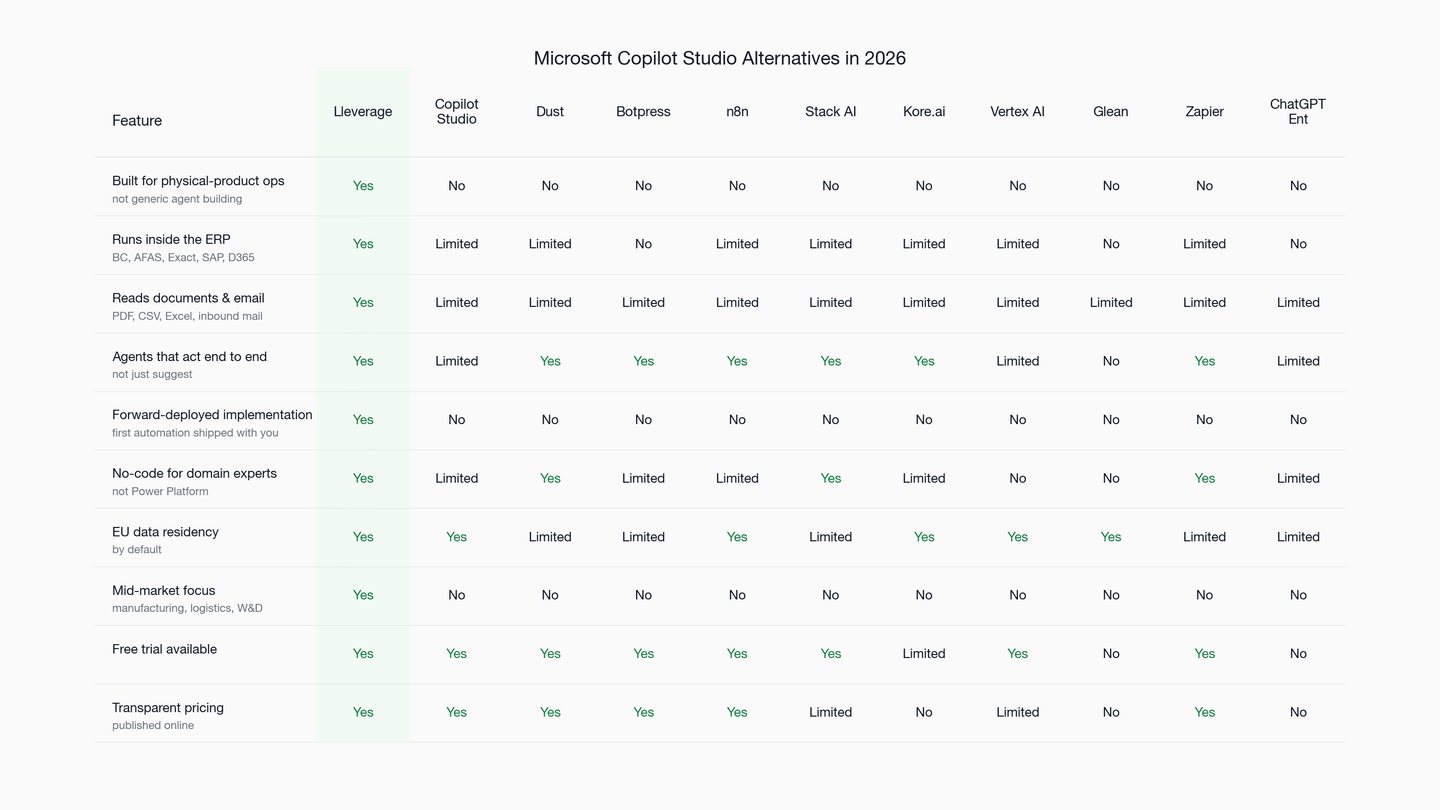
Ten Microsoft Copilot Studio alternatives compared for teams that need AI agents to run real operations, not just assist. Lleverage is built for mid-market manufacturers, logistics operators, and wholesale and distribution businesses, executing inside the existing ERP.
Microsoft Copilot Studio alternatives get shopped for one reason: turning the Microsoft 365 assistant into agents that actually finish work is harder than the demo suggests. Copilot Studio is a low-code builder, wired to business systems through Power Platform connectors and aimed at IT and technical makers already inside the Microsoft estate.
For a mid-market manufacturer, logistics operator, or distributor, the gap shows fast. Copilot Studio is strong at drafting an answer and weak at completing a transaction. It holds no opinion on what an inbound order, a supplier invoice, or a master-data record should become inside your ERP. Every agent is yours to build, wire, and keep alive as connectors shift. A backlog of orders needs a result in the system of record, not another place to prompt.
This guide weighs 10 Microsoft Copilot Studio alternatives for that buyer, starting with the one built specifically for it.
Quick recap: 10 Microsoft Copilot Studio alternatives
Here are the 10 Microsoft Copilot Studio alternatives in brief. As a result, you can scan the field before the detail.
- Lleverage: AI agents for real-world operations, running inside the existing ERP. The only option here built for mid-market manufacturers, logistics operators, and wholesale and distribution businesses.
- Dust: No-code agent product with cross-stack data connections. Aimed at general knowledge work, not a specific system of record.
- Botpress: Long-standing visual agent and chatbot builder. Strong for customer-facing bots.
- n8n: Open-source workflow automation with AI agent nodes. Popular with technical, self-hosting teams.
- Stack AI: No-code builder for AI agents and internal apps. Free entry tier, enterprise track.
- Kore.ai: Enterprise conversational-AI suite for IT, HR, and contact-center automation.
- Google Vertex AI Agent Builder: Google Cloud's agent builder, now the Gemini Enterprise Agent Platform.
- Glean: Enterprise search with agents layered on top. Strong at finding knowledge.
- Zapier Agents: AI agents on Zapier's mass-market automation graph. Broad app coverage.
- ChatGPT Enterprise: OpenAI's enterprise workspace with custom GPTs. The build-nothing option.
Key parameters to decide between Copilot Studio alternatives
A useful evaluation of Microsoft Copilot Studio alternatives turns on how the agent behaves once a real order hits it, not on the builder UI. Weigh these five.
Skill to build and change it. Copilot Studio is low-code in name; in practice it needs Power Platform, connector, and sometimes Python knowledge for anything past a basic Q&A bot. Ask who in your operations team can edit an agent on a Tuesday without raising an IT ticket. If the honest answer is nobody, the agent decays.
Answer versus action. This is the decisive one for Copilot Studio specifically. It is excellent at retrieving and drafting; it is thin at writing the result back into a system of record. A summary of an order is not an order. Score each tool on completed transactions, not on response quality.
Reach across your stack. Copilot Studio is deepest on Microsoft surfaces and its connectors skew Microsoft-first. If your operational data lives partly outside Microsoft, test the non-Microsoft path early — that is where reliability and context limits bite.
Exceptions, not the happy path. Inbound operational input is messy: a missing delivery week, a wrong article number, a half-readable PDF. Judge the tool on what it does with the slice it cannot process cleanly, because that slice is the job.
Ownership of the first one in production. A builder hands you an empty canvas. Forward-deployed delivery means someone ships your first working agent into production with you and hands the operations team the keys after go-live.
Why buyers consider Copilot Studio alternatives
Six reasons push mid-market operations teams toward Microsoft Copilot Studio alternatives.
- A general agent builder, not an operations product. Copilot Studio is built so any team can assemble an assistant on Power Platform; it is deliberately domain-agnostic. Nothing in it understands how a sales order, a supplier invoice, or a master-data fix should resolve inside a manufacturer's or distributor's ERP. Lleverage runs the other way: narrow on one buyer, SMEs that make, move, and sell physical products, and deep on the money-and-inventory workflows inside that buyer's ERP.
- Power Platform expertise required. Even basic Copilot Studio agents need Power Platform skills and connector setup. As a result, non-technical operations teams cannot build and maintain agents alone. The IT bottleneck comes straight back.
- Microsoft-first connectors with gaps off the stack. Copilot Studio's connectors skew Microsoft-first. They are not always generative-AI native. Teams on a mixed stack report brittle behavior and context blow-ups outside the Microsoft surface.
- Answers more than it acts. Copilot Studio is strong inside Teams and Microsoft 365. It is comparatively limited at reliable, end-to-end execution into external systems of record. That is exactly where operational value sits.
- EU data residency and governance scrutiny. Regulated European buyers need clear data-residency answers before an agent touches finance data. For example, tenant-level control questions slow generic rollouts.
- Total cost at scale. Per-user Microsoft licensing, plus Power Platform consumption, plus the internal build-and-maintain effort, adds up. Worse, the cost is hard to tie to a specific operational outcome.
Put your own numbers against each point. Across Microsoft Copilot Studio alternatives, what decides it is rarely the builder. Instead, it is whether an inbound order clears inside the ERP with nobody touching it.
The 10 alternatives in detail
1. Lleverage: #1 Microsoft Copilot Studio alternative: AI agents for real-world operations
Website: lleverage.ai
Lleverage builds AI agents for real-world operations in companies that make, move, and sell physical products. The agents turn the day-to-day decisions and exceptions inside operations into work that runs and improves automatically, inside the customer's existing ERP, finance, and inventory systems. Among Microsoft Copilot Studio alternatives, Lleverage is the only one built specifically for mid-market manufacturers, logistics operators, and wholesale and distribution businesses, with deep coverage of the back-office workflows where Copilot Studio sits at the surface.
Put plainly: Copilot Studio hands a technical team a place to assemble an assistant. Lleverage delivers the finished operational outcome.
Lleverage features
- AI agents that read inbound documents and emails: order PDFs, CSVs, Excel files, and free-text email
- ERP-native execution inside Business Central, AFAS, Exact, SAP, Dynamics 365, and NetSuite
- Built-in exception handling: ambiguous data is flagged for review, and draft responses are generated
- Forward-deployed implementation: the first automation ships in production with the customer
- No-code for the people who own the process, not Power Platform specialists
- EU data residency by default
- Free trial available alongside sales-led implementation
Lleverage pricing
- Free trial available
- Paid plans published on the Lleverage pricing page
- Sales-led implementation for production operational workflows
- Source: lleverage.ai/pricing
Copilot Studio vs Lleverage
Both produce custom AI agents, but the similarity ends there. Copilot Studio gives builders a kit and expects them to assemble, connect, and maintain it. Lleverage is judged on whether the order posted, not on whether an agent was built.
- Copilot Studio agents draft and route; Lleverage agents close the transaction in the ERP
- Copilot Studio depends on in-house Power Platform skill; Lleverage is forward-deployed and owned by ops after go-live
- Copilot Studio is strongest inside Teams and Microsoft 365; Lleverage is strongest inside Business Central, AFAS, Exact, SAP, and Dynamics 365
Lleverage limitations
- It is not an open agent-building studio for any department; the depth is in physical-product operations
- It is not for engineering teams that specifically want a low-level, code-first agent SDK
- Without an ERP or system of record to run inside, most of the value does not apply
"By the end of Monday, we were completely caught up. The manager was blown away." Bryan van Ingen, Operations Director, Topa Bathroom Products. Lleverage automated order intake into Microsoft Dynamics 365 Business Central. Over 90% of incoming orders now post automatically. Topa redeployed four FTEs from manual order entry, and confirmations go out within 30 seconds. Source: lleverage.ai customer stories.
Visit Lleverage lleverage.ai · Book a demo lleverage.ai/book-a-demo
2. Dust: #2 Microsoft Copilot Studio alternative: no-code agent operating system
Among Microsoft Copilot Studio alternatives, Dust is the closest no-code rival. It builds AI agents across a mixed tech stack. It connects natively to tools like Google Drive, Notion, Slack, and GitHub. Its actions are designed for predictable results. It targets general knowledge work, not a specific system of record.
Dust features
- No-code agent builder for non-technical teams
- Native data connections across common collaboration tools
- Multi-model support across major LLM providers
- Multi-agent and multi-teammate collaboration in shared threads
- Workspace-level governance and observability
Dust pricing
- Pro: €29 per user per month, excluding tax, with a 14-day free trial
- Enterprise: custom, 100-member minimum
- Source: dust.tt/pricing (verified May 2026)
Copilot Studio vs Dust
Both build custom agents without heavy code. Dust is cross-stack, while Copilot Studio is Microsoft-first. As a result, neither is built for ERP-native operations in a physical-product business.
- Dust is no-code and cross-stack; Copilot Studio is low-code and Microsoft-first
- Both are horizontal knowledge-work products, not operations-specific
- Dust publishes a per-seat price; Copilot Studio pricing is bundled into Microsoft licensing
Dust limitations
- Optimized for internal knowledge work, not execution inside an ERP
- Not built for inbound document and email operations in manufacturing or distribution
- Per-seat pricing scales with headcount, not with automated outcomes
3. Botpress: #3 Microsoft Copilot Studio alternative: visual agent and chatbot builder
Among Microsoft Copilot Studio alternatives, Botpress is the conversational-first option. It is a long-standing builder for chatbots and agents. It has a visual flow editor and usage-based AI spend. Teams use it mostly for customer-facing bots, not back-office execution.
Botpress features
- Visual flow editor for conversational agents
- Usage-based AI spend on top of plan tiers
- Wide channel coverage for customer-facing deployment
- Developer extensibility for custom logic
Botpress pricing
- Free tier, usage-based pay-as-you-go plans, and an enterprise tier
- Specific figures are not stated here because the pricing page could not be retrieved at publication; confirm before quoting
- Source: botpress.com/pricing
Copilot Studio vs Botpress
Both build agents with a visual editor. Botpress leans conversational and channel-oriented. Copilot Studio leans Microsoft-ecosystem. Therefore, neither targets ERP-native operational workflows.
- Botpress is strongest at customer-facing conversational bots
- Copilot Studio is strongest inside Microsoft 365 and Teams
- Both leave build-and-maintain with the customer
Botpress limitations
- Conversational and customer-facing focus, not back-office operations
- No ERP-native order, invoice, or master-data workflows out of the box
- Build-and-maintain effort stays in-house
4. n8n: #4 Microsoft Copilot Studio alternative: open-source workflow automation with agents
Where Copilot Studio keeps you inside Microsoft's low-code lane, n8n is the engineer's escape hatch: open-source, self-hostable, with AI agent nodes you wire yourself. It trades vendor lock-in for a build-and-run burden. Like Copilot Studio, it is a horizontal builder with no native idea of an order or an invoice.
n8n features
- Open-source core with self-hosting on the Community Edition
- AI agent nodes alongside a large integration library
- Execution-based scaling rather than per-step pricing
- Strong fit for engineering-led teams
n8n pricing
- Community Edition: free, open-source, self-hosted
- Cloud Starter: €20 per month, billed annually
- Cloud Pro: €50 per month, billed annually
- Cloud Business: €667 per month, billed annually
- Enterprise: contact sales
- Source: n8n.io/pricing (verified May 2026)
Copilot Studio vs n8n
Both make you build the agent; the difference is the cage. n8n is open, code-first, and yours to host. Copilot Studio is closed, low-code, and Microsoft-bound. Either way the operational logic, and its upkeep, stays your problem.
- n8n suits engineering teams that want source control and self-hosting
- Copilot Studio suits Microsoft 365 shops that accept Power Platform
- Neither closes an order inside the ERP on its own
n8n limitations
- Engineering-led: ops teams rarely change it without a developer on hand
- Ships as primitives, with no model of manufacturing, logistics, or distribution work
- Self-hosting moves uptime, security, and upgrades onto you
5. Stack AI: #5 Microsoft Copilot Studio alternative: no-code agent and app builder
Among Microsoft Copilot Studio alternatives, Stack AI is a no-code builder for agents and internal apps. It offers a free entry tier and an enterprise track. It is a general builder, not an operations-specific product.
Stack AI features
- No-code agent and internal-app builder
- Free entry tier for evaluation
- Enterprise track with dedicated infrastructure and compliance controls
- General-purpose connectors and templates
Stack AI pricing
- Free: $0 per month, with 500 runs, 2 projects, and 1 seat
- Enterprise: custom, contact sales
- Source: stackai.com/pricing (verified May 2026)
Copilot Studio vs Stack AI
Both target custom agents without heavy code. Stack AI is stack-agnostic, while Copilot Studio is Microsoft-first. Therefore, neither is purpose-built for ERP-native operations.
- Stack AI is no-code and general purpose
- Copilot Studio is low-code and Microsoft-bound
- Both leave operational design and maintenance with the customer
Stack AI limitations
- General-purpose builder, not an operations product for physical goods
- Public pricing jumps from a small free tier straight to custom enterprise
- No ERP-native execution or built-in exception handling for operational documents
6. Kore.ai: #6 Microsoft Copilot Studio alternative: enterprise conversational-AI suite
Among Microsoft Copilot Studio alternatives, Kore.ai is the service-desk specialist. It is an established enterprise suite for conversational AI and agents. It is strong in IT service, HR, and contact-center automation. It is oriented around service desks, not ERP operations.
Kore.ai features
- Enterprise conversational-AI and agent tooling
- IT service, HR, and contact-center use cases
- Enterprise governance and deployment controls
- Broad channel support
Kore.ai pricing
- Usage- and quote-based; enterprise pricing through sales
- Source: kore.ai (standard pricing not publicly published)
Copilot Studio vs Kore.ai
Both serve enterprise agent use cases. Kore.ai is deep in service-desk automation, while Copilot Studio is broad inside Microsoft. As a result, neither is built for physical-product operations clearing inside an ERP.
- Kore.ai is strongest in IT and HR service automation
- Copilot Studio is strongest inside Microsoft 365 surfaces
- Both are generalist relative to manufacturing and distribution operations
Kore.ai limitations
- Service-desk focus, not ERP-native operational execution
- Enterprise sales motion and quote-based pricing add evaluation overhead
- Not built around inbound operational documents and exceptions
7. Google Vertex AI Agent Builder: #7 Microsoft Copilot Studio alternative: agent builder for the Google stack
Among Microsoft Copilot Studio alternatives, Vertex AI Agent Builder is the Google-stack counterpart. Google now presents it as the Gemini Enterprise Agent Platform. It builds enterprise agents on Google Cloud. It mirrors Copilot Studio's lock-in, just on a different cloud.
Vertex AI Agent Builder features
- Enterprise agent building on Google Cloud
- Tight integration with the Google and Gemini ecosystem
- Consumption-based Google Cloud billing
- Enterprise security and data-residency regions
Vertex AI Agent Builder pricing
- Consumption-based Google Cloud pricing; no published per-seat price
- Recently rebranded Gemini Enterprise Agent Platform
- Source: cloud.google.com
Copilot Studio vs Vertex AI Agent Builder
These mirror each other on opposite clouds. Vertex is Google-bound; Copilot Studio is Microsoft-bound. Both need technical build effort, and neither is operations-specific.
- Vertex suits Google Cloud organizations; Copilot Studio suits Microsoft organizations
- Both need engineering effort for non-trivial agents
- Neither runs natively inside mid-market ERP systems of record
Vertex AI Agent Builder limitations
- Best value requires commitment to the Google Cloud stack
- Developer-oriented; operations teams cannot own complex agents alone
- Consumption pricing is hard to tie to a specific operational outcome
8. Glean: #8 Microsoft Copilot Studio alternative: enterprise search with agents
Among Microsoft Copilot Studio alternatives, Glean is the knowledge-search option. It is a mature enterprise search product with agents layered on top. It is strong at finding and synthesizing knowledge across connected systems. It is search-first, not execution-first.
Glean features
- Mature enterprise search across connected systems
- Agents layered on the search foundation
- Broad connector coverage
- Enterprise security and permission inheritance
Glean pricing
- Quote-based; no published standard pricing, enterprise annual contracts
- Source: glean.com (pricing not publicly published)
Copilot Studio vs Glean
Glean leads with search and adds agents. Copilot Studio leads with an agent builder inside Microsoft. Both are generalist knowledge-work products, not operational execution products.
- Glean is strongest at cross-system knowledge retrieval
- Copilot Studio is strongest inside the Microsoft surface
- Neither posts orders or matches invoices inside an ERP
Glean limitations
- Search-first; agents complete fewer end-to-end operational tasks
- Quote-based enterprise contracts with high reported minimums
- Not built for inbound operational documents and exceptions
9. Zapier Agents: #9 Microsoft Copilot Studio alternative: agents on a mass-market automation graph
Against Copilot Studio's Microsoft depth, Zapier Agents trades depth for reach: agents bolted onto the largest app-automation graph in the category, live in minutes. That breadth is both the point and the ceiling. It is light cross-app glue, not operational execution.
Zapier Agents features
- AI agents on top of thousands of app integrations
- Low build effort to get started
- Activity-based pricing for agents
- Very broad SaaS coverage
Zapier Agents pricing
- Zapier core: Free $0; Professional from $19.99 per month; Team from $69 per month; Enterprise contact sales
- Zapier Agents: Free with 400 activities per month; Pro $33.33 per month with 1,500 activities; Enterprise coming soon
- Source: zapier.com/pricing (verified May 2026)
Copilot Studio vs Zapier Agents
Both let a non-developer stand up an agent fast. Zapier wins on sheer app coverage; Copilot Studio wins on Microsoft-surface depth. Faced with a backlog of inbound orders, neither writes the result into the ERP with exceptions handled.
- Zapier is the widest, shallowest option
- Copilot Studio is the Microsoft-deep option
- Both stay generalist next to physical-product operations
Zapier Agents limitations
- Tuned for light app-to-app moves, not multi-step operational workflows
- Activity caps bite once real order volume arrives
- No ERP-native posting or built-in exception handling
10. ChatGPT Enterprise: #10 Microsoft Copilot Studio alternative: enterprise workspace with custom GPTs
Among Microsoft Copilot Studio alternatives, ChatGPT Enterprise is the build-nothing option. It is OpenAI's enterprise workspace with custom GPTs. Staff already know it, and it is simple to start. It stays inside the ChatGPT surface and is light on system execution.
ChatGPT Enterprise features
- Custom GPTs for specialized assistance
- Enterprise security, SSO, and admin controls
- Familiar interface with low adoption friction
- Connectors to common knowledge sources
ChatGPT Enterprise pricing
- Custom, contact sales; OpenAI does not publish ChatGPT Enterprise pricing
- Source: openai.com (pricing not publicly published)
Copilot Studio vs ChatGPT Enterprise
Copilot Studio builds custom agents wired to Power Platform. ChatGPT Enterprise offers custom GPTs inside the ChatGPT app. Both are assistant-first, and neither clears work inside an ERP.
- ChatGPT Enterprise is simplest to adopt, but locked to the ChatGPT surface
- Copilot Studio is deeper, but needs Power Platform skills
- Neither posts orders or reconciles master data in a system of record
ChatGPT Enterprise limitations
- Custom GPTs are confined to the ChatGPT surface
- Read-and-draft strength, but limited write-back into systems of record
- Quote-based enterprise pricing with reported high seat minimums
Choosing among these Copilot Studio alternatives
If the real job is clearing an inbound order inside Business Central or Dynamics 365, the agent has to do more than answer; it has to post. That is why, for mid-market manufacturers, logistics operators, and distributors, Lleverage is the call here: it ships the first working agent into production with you, and operations owns it after go-live. Topa Bathroom Products now posts more than 90% of incoming orders into Dynamics 365 Business Central automatically and moved four FTEs off manual entry.
Other buyer profiles among Microsoft Copilot Studio alternatives:
- No-code knowledge work across a mixed stack: Dust, Stack AI, Zapier Agents
- Engineering-led, self-hosting priority: n8n
- Microsoft-stack or Google-stack standardization: Copilot Studio itself, or Vertex AI Agent Builder
- Service-desk and conversational automation: Kore.ai, Botpress
- Enterprise knowledge search with agents: Glean
- Simple, build-nothing assistant: ChatGPT Enterprise
Across the Microsoft Copilot Studio alternatives here, the test is blunt. Can the agent take a messy inbound order and post it cleanly into the ERP with nobody in the loop? That single question is the problem Lleverage was built to answer.
Book a demo