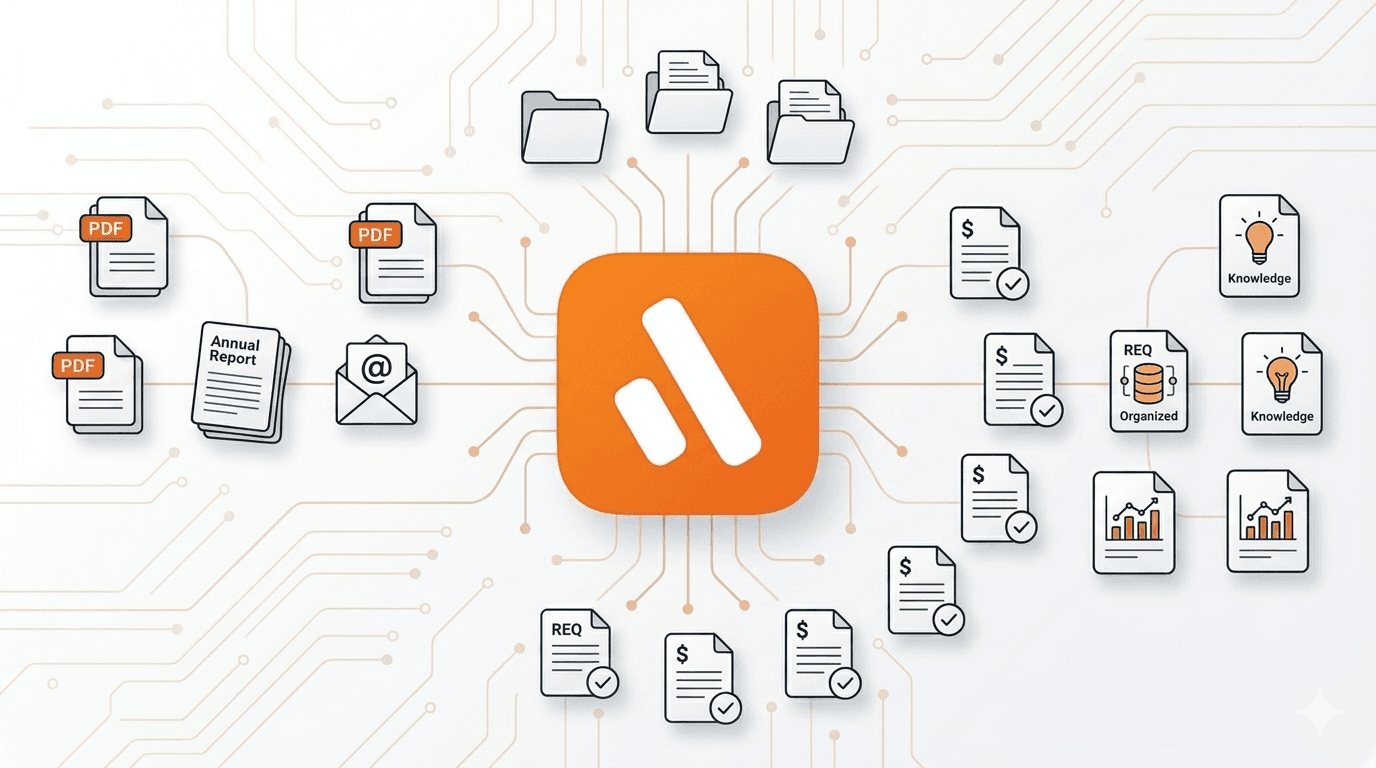
Unstructured business data floods B2B operations daily — emails, documents, forms. See how AI content enrichment turns this into structured, validated records inside your existing ERP.
Every day, B2B organizations generate and receive massive volumes of unstructured data—customer emails, supplier documents, internal reports, and operational forms. This data contains valuable insights, but in its raw form, it is virtually impossible to analyze, search, or act upon systematically.
Recent research from McKinsey shows that 80% of enterprise data remains unstructured, locked away in formats that traditional business systems cannot process. For mid-size European manufacturers, distributors, and logistics companies, this represents millions of euros in untapped operational intelligence.
AI content enrichment changes this dynamic by automatically extracting, structuring, and enriching unstructured business content into formats that drive immediate operational value.
Unlike generic data processing tools, modern content enrichment uses AI to understand context, extract relationships, and augment information with external data sources — turning chaotic information streams into structured knowledge assets.
How Lleverage Enriches Unstructured Business Content Inside Your ERP
Lleverage is the invisible AI layer in your ERP. We automatically capture and enrich unstructured business content — supplier emails, scanned invoices, PDF order confirmations, PEPPOL documents, customer inquiries, carrier updates — and post the structured records straight into Business Central, SAP, Exact Online, AFAS, or NetSuite.
The enrichment is not generic. Lleverage validates extracted data against your purchase orders, item master, and business rules before it reaches the ERP. Supplier references get matched to your vendor records. Product codes get cross-referenced against your item master. Amounts get reconciled against the PO. Your operations team only sees the cases that genuinely need a human.
That is why Dutch manufacturers, wholesalers, and logistics operators use Lleverage to turn daily streams of unstructured documents into clean, auditable ERP records — without adding a separate extraction tool, a new interface, or a data migration project. See the ERP + AI integration guide for how this works across Business Central, SAP, AFAS, and Navision, or the UiPath vs Lleverage comparison for the technical differences from traditional RPA.
→ See it work on your own content.
What Is AI Content Enrichment?
AI content enrichment is the process of automatically analyzing unstructured content to extract structured data, add contextual information, and enhance the original content with additional relevant details from internal and external sources.
Core Components of Modern Content Enrichment
Intelligent Content AnalysisAdvanced natural language processing and computer vision algorithms analyze text documents, emails, PDFs, images, and other unstructured formats to identify key entities, relationships, and contextual information.
Automated Data ExtractionAI models extract specific data points — names, dates, amounts, product codes, addresses — and organize them into structured formats compatible with existing business systems.
Contextual EnhancementAI augments extracted data with additional context from internal databases, external sources, and knowledge bases, creating enriched records that provide complete operational pictures.
Real-Time ProcessingModern systems process content as it arrives, ensuring that enriched data is available immediately for decision-making and automated workflows.
The B2B Content Enrichment Challenge
B2B organizations face unique content enrichment challenges that consumer-focused solutions do not address effectively. This is the same structural problem that drives 80% of back-office time to admin and leaves finance teams keying fields that AI could capture in seconds.
Volume and Variety Complexity
Manufacturing companies process thousands of supplier communications monthly — purchase orders, delivery notifications, quality certificates, and compliance documentation. Each document type requires different extraction approaches and business logic.
Benchmark: Tier-1 European Automotive SuppliersLarge tier-1 automotive suppliers routinely receive thousands of supplier documents weekly across 10+ languages and 20+ document formats. Manual processing at that volume typically ties up a dozen or more FTEs and introduces multi-day delays into production planning.
With content enrichment in place, industry benchmarks show 85-95% automated processing accuracy, end-to-end processing time falling from days to under an hour, and the majority of manual-processing headcount redeployed to strategic work like supplier relationship management. See how a Dutch wholesaler achieved similar outcomes with invoice automation inside Business Central.
Domain-Specific Knowledge Requirements
B2B content enrichment must understand industry-specific terminology, compliance requirements, and business process contexts that generic AI models do not comprehend.
Manufacturing Context: Understanding that "lot number," "batch ID," and "production run" may refer to the same traceability concept, but require different handling in quality management versus inventory systems.
Logistics Context: Recognizing that "AWB" (Air Waybill), "BL" (Bill of Lading), and "CMR" (road transport document) are all shipping documents but trigger different processing workflows and compliance checks.
Integration and Workflow Automation
Enriched content must integrate with existing ERP, CRM, and operational systems while triggering appropriate downstream automation. This is the core failure mode in disconnected ERP / WMS / MES stacks — the enrichment is only useful if the structured output lands in the system of record.
AI Content Enrichment Technologies and Approaches
Natural Language Processing (NLP) for Business Content
Named Entity Recognition (NER)Advanced NER models identify and classify business entities within unstructured text — company names, product codes, financial amounts, dates, and technical specifications.
Relationship ExtractionAI identifies relationships between entities: "Company A ordered Product B on Date C for Amount D to be delivered to Location E by Date F."
Multilingual ProcessingEuropean B2B operations require content enrichment across multiple languages, with models trained on business terminology in Dutch, German, French, and English.
Computer Vision for Document Processing
Intelligent Document Processing (IDP)AI-driven OCR and layout analysis extract structured data from complex business documents — invoices, contracts, certificates, and technical drawings. This is the same capability that powers modern AI document processing, and the structural reason manual data entry is disappearing from back-office roles.
Form UnderstandingAI models learn document structures and adapt to variations in supplier forms, customer templates, and regulatory documents without requiring template setup.
AI for Content Classification
Automated CategorizationAI models classify incoming content by type, priority, department, and processing requirements, enabling appropriate routing and handling.
Quality ScoringAI assesses content completeness and accuracy, flagging documents that require human review or additional information gathering.
Implementation Framework for B2B Content Enrichment
Phase 1: Content Audit and Use Case Identification
Content InventoryCatalog all unstructured content sources across the organization:
- Email systems and attachments
- Document management systems
- Customer portals and supplier communications
- Internal reports and analytical content
- Regulatory and compliance documentation
Value AssessmentQuantify the potential impact of structuring each content type:
- Time savings from automated processing
- Error reduction from manual data entry elimination
- Compliance improvements from automated validation
- Decision-making acceleration from real-time insights
Phase 2: Technology Selection and Integration Planning
Vendor Evaluation Criteria
- Domain-specific AI model availability
- Multi-language processing capabilities
- Native ERP integration flexibility
- Scalability and performance characteristics
- Compliance and security features
Integration ArchitectureDesign content enrichment workflows that connect with existing business systems:
- ERP integration for automated invoice processing
- CRM enhancement for customer communication analysis
- Quality management system integration for compliance documentation
- Business intelligence connections for analytical content
Phase 3: Pilot Implementation and Training
Controlled Pilot DeploymentStart with high-value, low-risk content types to validate technology performance and business impact:
- Standard supplier invoices and purchase orders
- Customer inquiry emails and support tickets
- Internal operational reports and status updates
AI Model Training and OptimizationFine-tune content enrichment models using organization-specific data:
- Business terminology and acronym recognition
- Document format and layout patterns
- Quality validation rules and exception handling
Industry-Specific Content Enrichment Applications
Manufacturing Operations
Production Documentation EnrichmentAI processes quality certificates, test results, and compliance documentation to create structured traceability records that integrate directly with manufacturing execution systems.
Supplier Communication ProcessingAutomated enrichment of supplier emails, delivery notifications, and technical updates creates real-time supply chain visibility and enables proactive disruption management. The same capability reduces the 25 minutes European manufacturers lose per sales order.
Regulatory Compliance AutomationContent enrichment processes safety data sheets, environmental compliance reports, and audit documentation to maintain regulatory databases and trigger compliance workflows.
Learn more about manufacturing automation solutions.
Wholesale and Distribution
Product Information ManagementAI enrichment processes supplier catalogs, product specifications, and pricing updates to maintain accurate product databases and enable automated catalog publishing.
Customer Order ProcessingEnrichment of customer emails, EDI messages, and portal orders creates structured order data that integrates with inventory management and fulfillment systems.
Vendor Management AutomationProcessing of vendor communications, performance reports, and contract documentation creates comprehensive supplier profiles and enables automated vendor scoring.
Explore wholesale and distribution automation solutions.
Logistics and Transportation
Shipment Documentation ProcessingAI enrichment of bills of lading, customs declarations, and delivery confirmations creates real-time shipment tracking and automated exception handling.
Carrier Communication ManagementAutomated processing of carrier updates, delay notifications, and capacity changes enables dynamic routing optimization and customer communication.
Compliance Documentation AutomationEnrichment of customs forms, hazmat declarations, and international trade documentation ensures regulatory compliance and reduces processing delays.
See how we handle this in logistics automation.
Measuring Content Enrichment Success
Operational Efficiency Metrics
Processing Time Reduction
- Baseline: Average time from content receipt to structured data availability
- Target: 80% reduction in processing time within 90 days
Data Quality Improvement
- Baseline: Manual data entry error rates
- Target: 95% automated processing accuracy
Resource Optimization
- Baseline: FTE hours dedicated to manual content processing
- Target: 60% reduction in manual processing workload
Business Impact Metrics
Decision-Making AccelerationTime from information availability to business decision execution
- Measure: Days to weeks improvement in operational response times
Compliance EnhancementReduction in regulatory violations and audit findings related to information management
- Target: 90% improvement in compliance documentation accuracy
Customer Service ImprovementFaster response times and higher accuracy in customer inquiries and service requests
- Measure: Customer satisfaction scores and response time metrics
Advanced Content Enrichment Capabilities
Predictive Content Analysis
AI does not just structure existing content — it predicts future content needs and proactively enriches information streams.
Demand Forecasting EnhancementContent enrichment analyzes customer communications, market reports, and supplier updates to identify demand signals that traditional forecasting models miss.
Risk Assessment AutomationAI enrichment of news articles, supplier communications, and regulatory updates creates early warning systems for operational and compliance risks.
Multi-Source Data Fusion
Contextual Data AugmentationEnrichment systems combine internal content with external data sources — market intelligence, regulatory databases, and industry benchmarks — to provide comprehensive business context.
Real-Time Intelligence CreationContinuous processing of content streams creates dynamic business intelligence that adapts to changing operational conditions.
Future-Proofing Content Enrichment Investments
Emerging AI Technologies
Large Language Models (LLMs)Next-generation AI models provide unprecedented understanding of business context and can generate structured insights from complex unstructured content.
Multimodal AI ProcessingAI that simultaneously processes text, images, audio, and video content enables comprehensive analysis of complex business communications.
Integration Evolution
API-First ArchitectureModern content enrichment systems built on API-first principles enable integration with emerging business technologies and workflow automation.
Real-Time Streaming ProcessingAdvanced systems process content as it streams through business systems, enabling immediate insights and automated responses.
Building Your Content Enrichment Strategy
Successful B2B content enrichment requires moving beyond simple data extraction to comprehensive information intelligence that drives operational excellence.
Key Success Factors
- Business-First Approach: Focus on operational outcomes rather than technical capabilities
- Incremental Implementation: Start with high-value content types and expand systematically
- Integration Planning: Ensure enriched content flows into existing business processes
- Continuous Optimization: Regularly refine AI models based on business feedback and changing requirements
Getting Started
Begin your content enrichment journey with a comprehensive content audit. Identify the unstructured information that currently requires manual processing and quantify the operational impact of automation.
This foundation ensures that content enrichment implementation focuses on genuine business transformation rather than technology deployment.
For B2B organizations ready to unlock the intelligence hidden in unstructured content, modern AI content enrichment provides the bridge between information chaos and operational excellence.
Frequently Asked Questions
What counts as unstructured business content in a B2B context?
Anything that is not already a database row with typed columns: supplier emails and attachments, scanned or PDF invoices, order confirmations, delivery notes, purchase orders, quality and compliance certificates, customer inquiries, carrier update emails, contracts, safety data sheets, and free-text internal reports. For a European mid-market manufacturer, distributor, or logistics operator, this is typically 70-80% of all incoming business information.
How is AI content enrichment different from traditional OCR?
OCR only digitizes text. Enrichment understands what the text means in a business context — which number is the PO reference, which line is a discount, which signatory is authorised, which product code corresponds to your item master. It then validates and augments the extracted data against your ERP, purchase orders, and business rules before posting. The output is a structured, auditable record, not a transcription.
Does content enrichment work across multiple European languages?
Yes. Lleverage processes Dutch, German, French, English, and other European business languages with comparable accuracy, including mixed-language documents and country-specific formats such as Dutch VAT, German invoice references, and PEPPOL e-invoicing.
How does enriched content get into our ERP without a migration?
Lleverage connects to Business Central, SAP, Exact Online, AFAS, and NetSuite through existing integration interfaces and posts the structured record directly into the ERP the same way a human clerk would — only faster and against your validation rules. No new database, no parallel system, no chart-of-accounts change. Full architecture in the ERP + AI integration guide.
Where does content enrichment typically deliver the first measurable ROI?
Invoice capture and matching is usually the fastest measurable win — high volume, clear benchmark, direct saving in hours and exception rate. Order confirmation and supplier-document enrichment follow closely. Use the AI invoice processing ROI calculator to model the first-use-case business case in concrete numbers.
See Lleverage Work on Your Own Content
Lleverage runs content enrichment inside the ERP you already use — Business Central, SAP, Exact Online, AFAS, or NetSuite. Unstructured documents come in, structured and validated records land in the ERP, your team only touches exceptions. No new interface. No data migration. No chart-of-accounts change.
Book a 30-minute demo →
Further reading on our blog:
- AI Document Processing: How AI Is Making Manual Data Entry Obsolete
- The Death of Data Entry: Why Manual Work Is Becoming Extinct
- ERP + AI Integration Guide: Business Central, SAP, AFAS, Navision
- UiPath vs Lleverage: Traditional RPA vs AI-Native Automation
- AI Invoice Processing: €100K+ Annual Savings ROI Calculator
Explore solution pages:
- Manufacturing Automation
- Wholesale & Distribution
- Logistics Operations