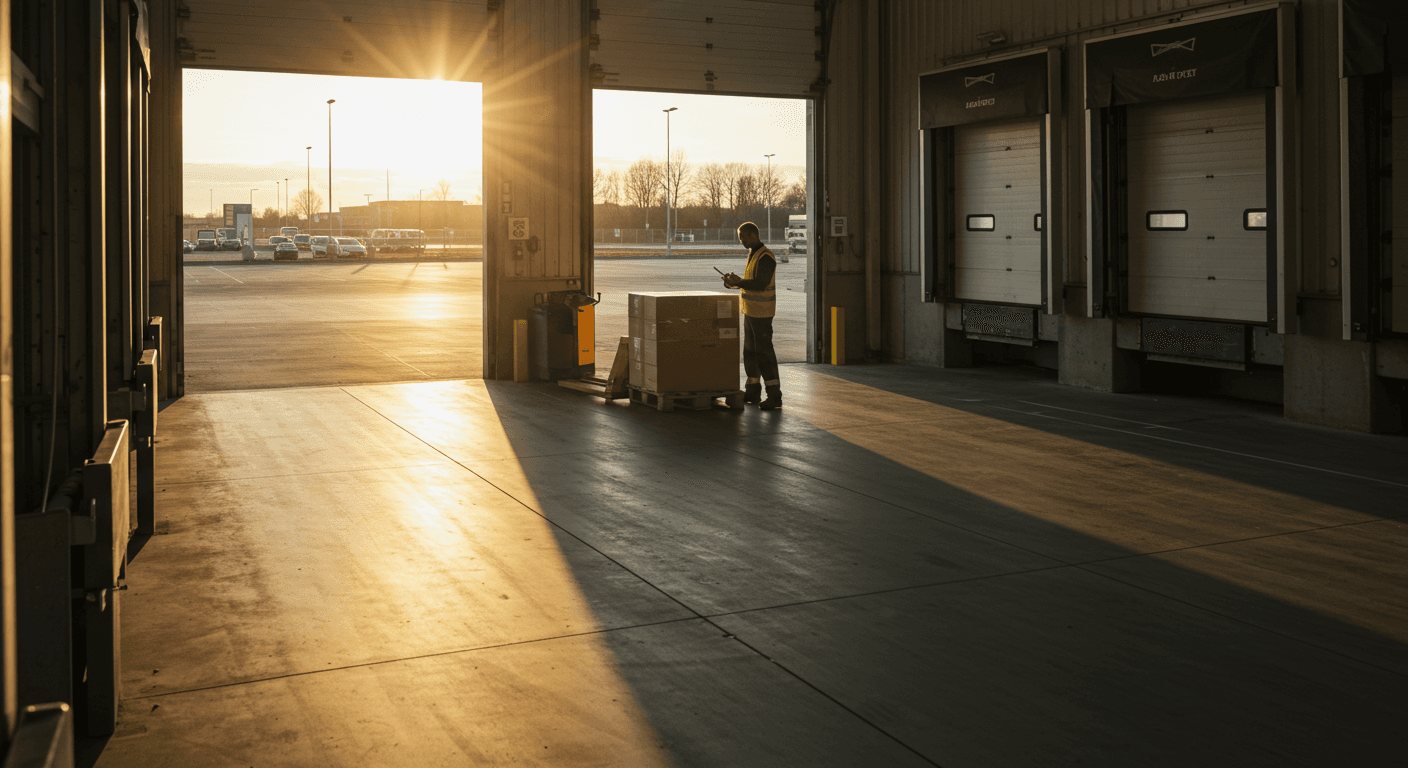
Cross-docking moves goods from inbound to outbound truck with little or no storage. How it works, the types, the trade-offs, and how ERP-connected automation keeps the timing reliable for SME distributors.
Cross-docking is the one logistics method that questions your most expensive habit: storing goods you could ship the same day. Every pallet that sits in your warehouse costs money before it earns any. It gets received, put away, counted, picked, and shipped. Each touch adds labour, error risk, and time. For a Dutch distributor on thin margins, storage is often the biggest cost in the building that nobody challenges.
Cross-docking challenges it. The goods come off an inbound truck and move directly to an outbound truck, with little or no storage in between. The pallet never reaches a rack. It crosses the dock, gets sorted to its outbound lane, and leaves the same day. Done well, cross-docking removes the entire storage phase for the products that suit it.
This article explains what cross-docking is, how it works on a real distribution floor, the types you can run, how it compares to traditional warehousing, and where it pays off. It also covers the part most guides skip: cross-docking only works when inbound and outbound timing is synchronised and the data is correct. That synchronisation is where Lleverage helps. If you run distribution, our logistics operations automation connects the order, shipment, and ERP data that cross-docking depends on, so the timing holds under real volume. Book a demo to see it against your own inbound and outbound flow.
What is cross-docking?
Cross-docking is a distribution process. Workers unload products from inbound transport and move them directly to outbound transport, with minimal to no storage time in between. It removes the storage and putaway phase of the supply chain. The dock becomes the operation, not the racking behind it.
Here is a worked example. A distributor receives a full truckload of one product from a supplier. Instead of putting it away, the team breaks the goods down at the inbound dock. Staff sort them against open customer orders, consolidate them with other products onto mixed outbound pallets, and load them onto delivery trucks the same day. Inventory holding for that product drops close to zero. The building handles flow, not stock.
How does cross-docking work in a distribution operation?
Cross-docking works as a tightly timed sequence between the inbound and outbound side of the dock. The whole point is that goods spend hours, not days, in the facility. The flow looks like this:
- Inbound scheduling. Suppliers deliver against booked dock slots, so receiving is predictable rather than random.
- Receiving and check. Staff unload the goods, verify them against the purchase order, and confirm quality at the inbound dock.
- Sortation. The team allocates products to outbound lanes by customer order or destination.
- Consolidation. Items for the same customer or region combine into outbound loads, often mixing products from several inbound deliveries.
- Outbound loading and dispatch. Consolidated loads go straight onto delivery trucks and leave, usually the same day.
Cross-dock facilities are typically built in a U, I, or L shape. Dock doors sit on the inbound and outbound sides, with a narrow staging area between them. The building design assumes throughput. The constraint is never floor space. It is whether step one and step five line up in time.
What are the types of cross-docking?
There are two ways to categorise cross-docking, and most operations use a mix. The first split is about when the destination is decided:
- Pre-distribution cross-docking. The end customer is known before the goods arrive. Inbound shipments are pre-allocated, so dock sorting is fast and the supplier may even label by destination.
- Post-distribution cross-docking. Allocation happens at the terminal, based on live demand when goods land. This is more flexible, but it puts more pressure on dock-side data accuracy.
The second split is about how loads are reshaped:
- Continuous cross-docking. Goods move directly from inbound to outbound with the shortest possible dwell time.
- Consolidation cross-docking. Smaller inbound shipments combine into larger outbound loads to fill trucks and cut transport cost.
- Deconsolidation cross-docking. Large inbound shipments break down into smaller customer-specific deliveries.
Cross-docking vs traditional warehousing: which does your supply chain need?
Cross-docking and traditional warehousing solve different problems. Warehousing buffers supply against uncertain demand. Cross-docking removes that buffer for goods where demand is predictable enough to flow straight through. Most distributors run both. They cross-dock the fast, predictable, high-volume lines and store the rest.
| Factor | Traditional warehousing | Cross-docking |
|---|---|---|
| Storage time | Days to months | Hours, often same-day |
| Handling touches | Receive, putaway, pick, pack, ship | Receive, sort, load |
| Inventory holding cost | High | Near zero for cross-docked lines |
| Best for | Variable demand, slow movers, safety stock | Predictable demand, fast movers, perishables |
| Main risk | Capital tied up in stock | Inbound or outbound timing failure |
| Data dependency | Moderate | High and real-time |
The decision is not philosophical. It is per-product. The honest version of the question is simple. Which of your lines move fast and predictably enough that holding them in a rack is pure waste? Those are your cross-docking candidates. For distributors modernising the wider operation, the same data discipline shows up across wholesale and distribution operations, not only at the dock.
What are the advantages and challenges of cross-docking for distributors?
The advantages are concrete. Cross-docking reduces storage and inventory holding cost. It shortens lead times. It cuts handling and the product damage that comes with extra touches. It fills outbound trucks more completely, so transport cost and trips per order drop.
The challenges are equally concrete, and every serious guide names the same one. Cross-docking is highly sensitive to timing. If an inbound delivery is late, the outbound truck either leaves short or leaves late, and the saving evaporates. It relies on accurate, real-time data about what is arriving, what is ordered, and what has shipped. It also needs disciplined supplier coordination and a workforce that can sort under time pressure. As a result, cross-docking does not fail because the dock is the wrong shape. It fails because the information is wrong or late.
When should an SME distributor use cross-docking?
Use cross-docking for the parts of your range where demand is predictable and speed matters more than buffering. It is a strong fit in several cases. Products that move fast and consistently. Goods that are temperature-sensitive or perishable. Items arriving from multiple suppliers that need to be combined per customer. Intermodal or container freight that is already sorted. Downstream operations that run just-in-time and cannot wait on putaway and pick cycles.
It is a poor fit for slow movers, items with erratic demand, and anything that needs safety stock to protect service levels. The practical test is not the product. It is the predictability of its flow and the reliability of the data behind it. A distributor with messy order and shipment data should fix that first, because cross-docking removes the storage buffer that currently hides those errors.
How ERP-connected automation makes cross-docking reliable
This is where most cross-docking content stops. It correctly says you need precise scheduling and real-time data, then leaves you to work out how. The how is the hard part. The timing depends on data that usually lives in separate systems: purchase orders in the ERP, inbound notifications in email and supplier portals, customer orders in the order system, and shipment confirmations in the warehouse or transport system. When those do not line up, the dock improvises. Improvisation is what breaks cross-docking.
Lleverage closes that gap. It reads inbound documents, advance shipping notices, and customer orders as they arrive. It reconciles them against the open purchase orders and sales orders in your ERP. The dock then works from one synchronised picture instead of four out-of-date ones. Exceptions, a short delivery, a changed order, a mismatch against the purchase order, surface before the truck is loaded rather than after. For distributors, that turns cross-docking from a fragile manoeuvre into a repeatable logistics process. We covered the same disconnect, and its cost, in what happens when your ERP, WMS, and MES don't talk to each other.
Frequently asked questions
What does cross-docking mean in simple terms?
Cross-docking means moving goods straight from an inbound truck to an outbound truck without putting them into storage first. The products are received, sorted to their outbound destination, and loaded for delivery, usually the same day. The warehouse handles flow rather than holding stock.
What is the difference between cross-docking and a regular warehouse?
A regular warehouse stores goods to buffer supply against uncertain demand, so items can sit for days or months. Cross-docking removes that storage step for products with predictable demand. Most distributors run both. They cross-dock fast predictable lines and store slow or erratic ones.
What is the difference between pre-distribution and post-distribution cross-docking?
In pre-distribution cross-docking, the customer is known before goods arrive, so shipments are pre-allocated and dock sorting is fast. In post-distribution cross-docking, the allocation is decided at the terminal based on live demand. That is more flexible but more dependent on accurate real-time data.
What is the biggest risk in cross-docking?
Timing failure is the biggest risk. Because cross-docking removes the storage buffer, a late inbound delivery or an order mismatch directly delays or shorts the outbound truck. The risk is almost always bad or late information rather than the physical handling. That is why synchronised order, shipment, and ERP data is the real enabler.
Does cross-docking work for SME distributors or only large operations?
It works for SME distributors as long as the data discipline is there. Cross-docking does not require a huge facility. It requires predictable flow on the chosen lines and accurate, timely order and shipment data. Automation can supply that without adding warehouse headcount.
See cross-docking work against your own flow
Cross-docking only pays off when inbound and outbound stay synchronised under real volume. Lleverage connects the order, shipment, and ERP data that synchronisation depends on, so the timing holds and exceptions surface before they reach the dock. Book a demo and we will run it against your own inbound and outbound flow.