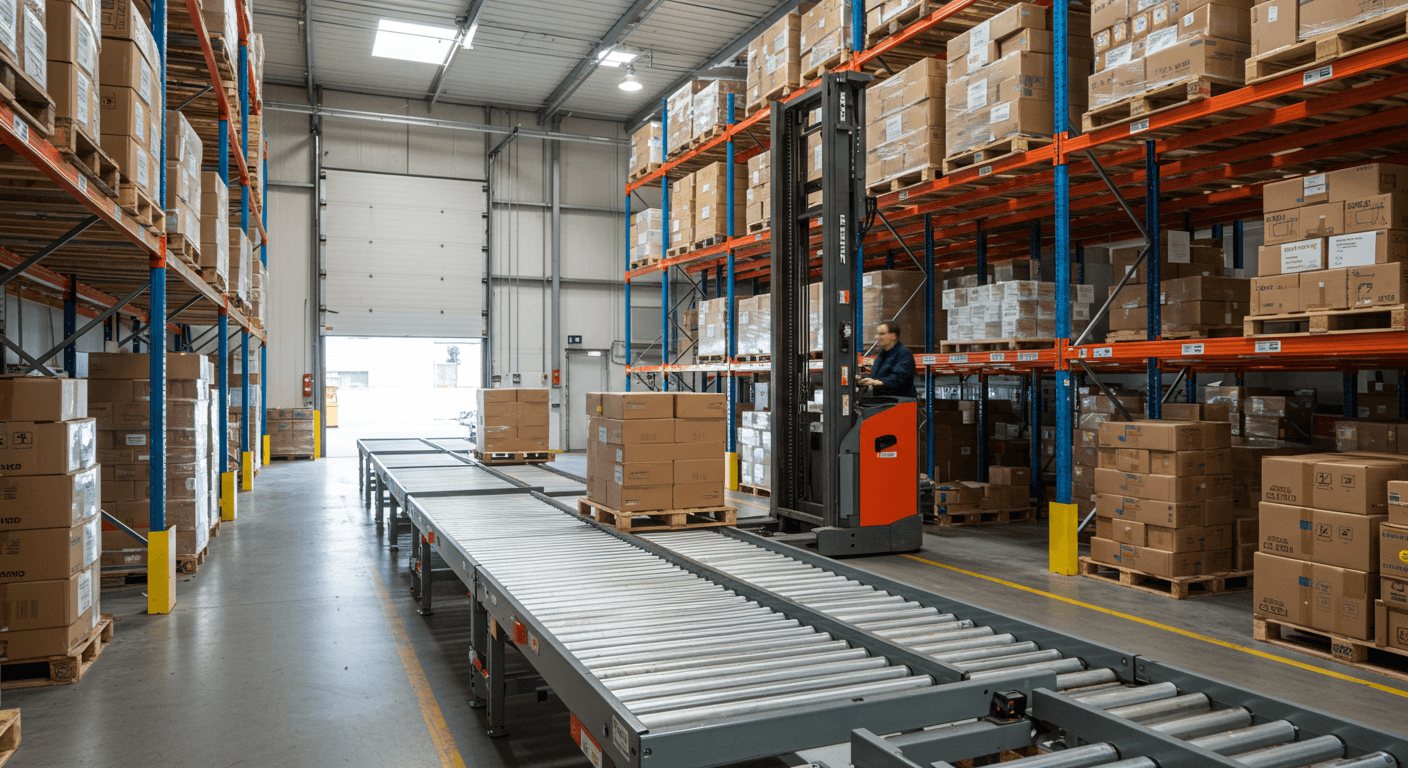
Warehouse automation means different things at different scales. For SME distributors and manufacturers, the biggest gains come not from robotics but from automating the data and decision layer: picking logic, stock movements, cycle counts, and exception handling. This guide covers what warehouse automation looks like in 2026 for companies with EUR 5M to EUR 100M revenue, where the ROI is real, and where it is not.
Warehouse automation is the application of systems, business rules, and AI to reduce manual effort in warehouse operations, from receiving and put-away to picking, packing, and dispatch.
When most people hear "warehouse automation," they picture conveyor belts, robotic pick arms, and automated storage and retrieval systems. That is the enterprise version. It requires seven-figure capital investment, 12 to 24 months of implementation, and a warehouse layout designed around the automation rather than around the products.
For SME distributors and manufacturers, this version of warehouse automation is irrelevant. The economics do not work. But that does not mean SMEs cannot automate their warehouses. It means the automation looks different.
What Actually Consumes Time in an SME Warehouse
Picking and packing: 40-50% of total labour hours
Operators walk the warehouse, locate items, pick them, bring them to a packing station, pack them, and prepare them for dispatch. The physical walking often accounts for 50-60% of total pick time.
Receiving and put-away: 15-20%
Goods arrive from suppliers. Someone checks them against the purchase order, records the receipt in the ERP, assigns a location, and moves the goods to that location.
Inventory management and counting: 10-15%
Cycle counts, stock checks, discrepancy investigations. Most SMEs still do an annual full stocktake that disrupts operations for days.
Data entry and administration: 10-15%
Entering receipts, confirming picks, processing returns, printing labels, updating locations.
Exception handling and problem-solving: 5-10%
Missing items, damaged goods, customer complaints, supplier discrepancies, returns processing.
The Conventional Approach to SME Warehouse Automation
Warehouse Management Systems (WMS)
A dedicated WMS sits between your ERP and your warehouse floor. The problem for SMEs is that a dedicated WMS is a separate system that needs to be integrated, maintained, and learned.
Barcode and scanning infrastructure
Handheld scanners and barcode labels improve accuracy and speed. But scanning only captures what happens. It does not optimise how it happens.
Pick-to-light and voice picking
These systems direct operators to the correct location. But they require dedicated hardware and inflexibility.
What is missing from all three
The common gap is intelligence. They automate the execution layer but not the decision layer.
How an AI Layer Changes Warehouse Automation for SMEs
The opportunity for SME warehouse automation in 2026 is not in hardware. It is in the data and decision layer that sits inside your existing ERP.
Intelligent pick sequencing
Instead of presenting picks in order-entry sequence, the AI layer analyses the current pick batch, maps locations in the warehouse, and generates an optimised pick route that minimises walking distance. This can reduce total pick time by 20-30% without changing the warehouse layout.
Automated put-away logic
When goods are received, the AI layer recommends the optimal storage location based on current demand velocity, product dimensions, product family grouping, and proximity to packing stations. This logic adapts as demand patterns change.
Exception detection at receiving
The AI layer compares incoming receipts against purchase orders, flagging discrepancies in quantity, product, or timing before the goods are put away.
Dynamic cycle counting
Rather than counting the whole warehouse once a year, the AI layer generates targeted count lists based on item value, transaction frequency, historical discrepancy rates, and time since last count.
Real-time stock visibility
The AI layer continuously reconciles ERP stock records against warehouse movements, sales orders, and purchase orders.
What This Looks Like in Practice
A warehouse supervisor at a mid-market distributor starts the morning shift. The ERP shows the day's orders, already grouped into optimal pick batches. Each batch has a calculated pick route that minimises walking distance.
Two receiving bays have deliveries arriving before 10:00 AM. As goods are scanned in, the AI layer compares quantities against the purchase orders. One delivery has a 3-unit discrepancy on a high-value item. It is flagged immediately.
For each received item, the system suggests a put-away location based on current demand velocity.
At the end of the day, the system generates tomorrow's cycle count list: 35 items selected based on value, movement frequency, and days since last count. The evening team counts them during a quiet period, taking 45 minutes.
Trade-offs and Risks
- Warehouse layout must be in the ERP. If locations exist only in the heads of staff, codify them first.
- Barcode infrastructure is a prerequisite. Without scanning, the AI layer has no transaction data to work with.
- Very small operations may not see ROI. The sweet spot is 5+ warehouse operators and 2,000+ SKUs.
- Physical constraints remain. An AI layer cannot fix narrow aisles or insufficient racking.
- People need to trust the system. Asking experienced staff to follow system-generated instructions is a cultural shift.
Next Step
If you want to see how an AI layer inside your existing ERP can optimise picking, put-away, and cycle counting in your warehouse, we can show you the workflow using your operational data.
See it work with your data. Book a demo with Lleverage.