The Orchestration Gap: Why 98% of Manufacturers Explore AI But Only 20% Can Actually Deploy It

Redwood's 2026 research reveals a troubling pattern: 98% of manufacturers explore AI-driven automation, yet only 20% feel prepared to deploy it at scale. The barrier isn't technology—it's the orchestration gap. 70% have automated less than 50% of core operations because workflows, data flows, and exception handling remain fragmented across siloed systems. With 78% automating less than half of critical data transfers and only 40% automating exception handling, manufacturers face an execution infrastructure problem that makes AI deployment impossible. AI-native orchestration platforms solve this by coordinating automation across entire operations, enabling end-to-end workflows, intelligent exception handling, and unified data access. European manufacturers like Koninklijke Dekker and Ynvolve prove that closing the orchestration gap delivers 90%+ efficiency gains in weeks—not the months or years traditional approaches require.
.jpg)
98% of manufacturers are exploring AI-driven automation. Yet only 20% feel ready to deploy it at scale. That's not a technology problem—it's an orchestration problem.
Redwood Software's 2026 Manufacturing AI and Automation Outlook surveyed 300 manufacturing professionals and uncovered a pattern that should worry every operations director in Europe: companies have invested heavily in automation across their enterprises, but critical workflows, data flows, and exception handling remain fragmented and manual.
The result? Seven in ten manufacturers have automated less than 50% of their core operations. 78% have automated less than half of their critical data transfers. And 60% of companies that call exception handling "one of the most disruptive processes" still handle it manually.
This isn't a story about manufacturers failing at automation. It's about hitting the limits of siloed execution, where powerful automation tools operate in isolation, slowed by friction at handoffs, unmanaged exceptions, and delayed data flows. Even the best AI models can't scale in that kind of execution environment.
The Data Paints a Troubling Picture
The numbers from Redwood's research reveal what many European manufacturers already know but haven't quantified:
Automation maturity has plateaued. 70% of manufacturers have automated half or less of their core operations, despite years of investment in operational technology (OT), engineering technology (ET), and information technology (IT) automation.
Exception handling remains manual. Only 40% have automated exception handling, despite citing it as one of the most disruptive processes. When orders arrive in unexpected formats, when suppliers change their documentation, when pricing rules conflict with contract terms—these exceptions still require manual intervention.
Data transfer bottlenecks persist. 78% have automated less than half of their critical data transfers between systems. Real-time decision-making becomes impossible when data moves manually between your ERP, manufacturing execution systems (MES), and supply chain platforms.
System boundaries create friction. Automation stalls where workflows must be coordinated across different environments. A manufacturer might have excellent automation within their ERP system and sophisticated robotics on the factory floor, but moving data and triggering actions between these systems still involves manual steps, email chains, or custom scripts that break when systems update.
These aren't isolated pain points. They're symptoms of a fundamental gap: the orchestration gap.
What Is the Orchestration Gap?
The orchestration gap exists where automation stops and manual coordination begins. It's the space between systems where:
- Data must be manually transferred from one platform to another
- Exceptions require human judgment to route correctly
- Workflows depend on email chains or Slack messages to trigger the next step
- Business rules exist only in employees' heads rather than in executable logic
Kevin Greene, CEO of Redwood Software, framed it precisely: "Manufacturers aren't failing at automation—they're hitting the limits of siloed execution. They have powerful automation across their enterprises, but it operates in fragmented workflows, slowed by friction at handoffs, unmanaged exceptions and delayed or unreliable data flows."
Think of it this way: You've automated the highway—your ERP system processes orders efficiently, your WMS manages inventory well, your production planning tools optimize schedules. But you haven't automated the intersections. Every time information needs to move from one system to another, or when something unexpected happens, traffic stops.
Why This Matters for AI Deployment
Here's why the orchestration gap is the real barrier to AI adoption: AI doesn't replace your need for orchestration. It multiplies it.
Traditional automation follows fixed rules. If A happens, do B. These systems break when reality deviates from the script, but at least they're predictable.
AI-driven automation is different. AI can handle variability, interpret unstructured data, and make contextual decisions. But AI still needs to interact with your existing systems. It needs data from multiple sources. It needs to trigger actions across platforms. It needs to handle exceptions intelligently.
If you can't orchestrate your existing automation, adding AI just creates more sophisticated silos. You end up with:
- AI that can read invoices brilliantly but can't post them to your ERP without manual intervention
- Predictive maintenance models that identify problems but require email chains to trigger work orders
- Demand forecasting AI that generates insights no one can act on because the data doesn't flow to production planning
- Quote generation systems that create proposals but can't access real-time pricing from your ERP
Camunda's 2026 State of Agentic Orchestration & Automation report confirms this pattern. Nearly three-quarters (73%) of organizations report a significant gap between their vision for agentic AI and reality. While 71% say they're currently using AI agents, only 11% of agentic AI use cases reached production over the last year.
The problem isn't the AI. It's the execution infrastructure surrounding it.
The Real Costs of the Orchestration Gap
Let's translate this into numbers that matter to finance directors and operations teams.
Labor inefficiency: When 78% of critical data transfers happen manually, you're paying skilled employees to be human API connectors. A manufacturer processing 500 orders daily with just 5 minutes of manual data entry per order spends 2,500 minutes daily—over 41 hours—on work that should be automated. At a €30 hourly rate, that's €320,000 annually on data transfer alone.
Error amplification: Manual handoffs introduce errors. Industry research shows manual data entry error rates of 1-5%. In a high-volume environment, that means thousands of mistakes annually that require costly corrections, delayed shipments, and damaged customer relationships. AI document processing automation can reduce these errors by 90% or more.
Competitive disadvantage: Companies that solve orchestration move faster. They can quote faster, deliver faster, and adapt to market changes faster. When your competitor automates end-to-end and you automate in fragments, they win deals while you're still manually coordinating between systems.
AI investment waste: Deloitte's research shows that 40% of manufacturers experience AI deployment delays due to unreliable operational data. If you invest €500,000 in AI capabilities but can't deploy them because of orchestration gaps, you've just written a check with no return.
What Manufacturers Are Getting Wrong About Integration
Most companies approach automation like building a collection of tools. They invest in:
- An ERP system to manage business processes
- A WMS for warehouse operations
- MES for production tracking
- A CRM for customer management
- BI tools for analytics
- RPA bots for specific repetitive tasks
Each tool automates its domain effectively. The problem? They don't work together without human intermediaries.
The traditional approach to solving this is "integration projects"—custom code that connects System A to System B. But this approach doesn't scale:
- Each integration is unique. Connecting your ERP to your WMS is different from connecting your ERP to your CRM, which is different from connecting your MES to your production planning tools. With 10 systems, you potentially need 45 integrations.
- Integrations are brittle. When one system updates, integrations break. Your IT team spends more time maintaining connections than building new capabilities.
- Integration doesn't solve orchestration. Connecting systems allows data to flow, but it doesn't handle the logic of when, how, and why data should flow. That coordination still happens manually.
This is why 50% of manufacturers in recent surveys struggle to identify the right technology and 39% cite a lack of internal expertise. They're trying to solve an orchestration problem with integration tools.
How AI-Native Orchestration Platforms Solve This
The companies successfully scaling AI aren't just automating individual processes. They're implementing orchestration platforms that coordinate automation across their entire operation.
Here's what changes with orchestration:
1. End-to-end workflow visibility
Instead of automating disconnected steps, orchestration platforms manage complete business processes from start to finish. An order processing workflow might involve:
- Receiving orders in any format (email, EDI, portal, Excel)
- Extracting and validating order data using AI
- Checking inventory availability across multiple systems
- Validating pricing against contracts and promotions
- Creating orders in your ERP
- Triggering warehouse picking
- Notifying customers of confirmation
With orchestration, this entire flow is managed by a single system that coordinates actions across all your platforms. No manual handoffs. No email chains. No hoping someone remembers to check the shared folder.
2. Intelligent exception handling
Traditional automation breaks when it encounters exceptions. AI-native orchestration adapts.
When an order arrives with a product code that doesn't exist in your system, the platform can:
- Check for similar product codes using AI
- Search historical orders from that customer
- Flag the exception for human review with relevant context
- Learn from the resolution to handle similar cases automatically
Only 40% of manufacturers have automated exception handling currently. Modern orchestration platforms make this the default behavior rather than a special case.
3. Unified data access
Instead of manually transferring data between systems, orchestration platforms maintain a unified view of relevant data across your technology stack. This doesn't mean replacing your systems—it means connecting them intelligently.
When generating a quote, the system can pull:
- Customer history from your CRM
- Current inventory from your WMS
- Production capacity from your MES
- Pricing rules from your ERP
- Contract terms from your document management system
All in real-time, without manual data gathering. This is why AI-powered quote generation automation can reduce quote time by 90% while improving accuracy.
4. Adaptive learning
Here's where AI-native orchestration differs fundamentally from traditional automation: it gets better over time.
The platform learns from every transaction it processes, every exception it handles, and every correction users make. What starts at 85% accuracy for a new document type improves to 95%+ as the system learns your specific patterns.
This is why implementations that traditionally took 6-12 months now happen in weeks. The system doesn't need perfect rules upfront—it learns and adapts.
Real European Manufacturers Solving the Orchestration Gap
Koninklijke Dekker, a 140-year-old Dutch wood manufacturer, faced the classic orchestration gap: orders arrived in dozens of formats from hundreds of customers. Their team spent hours daily manually entering orders, and errors were frequent.
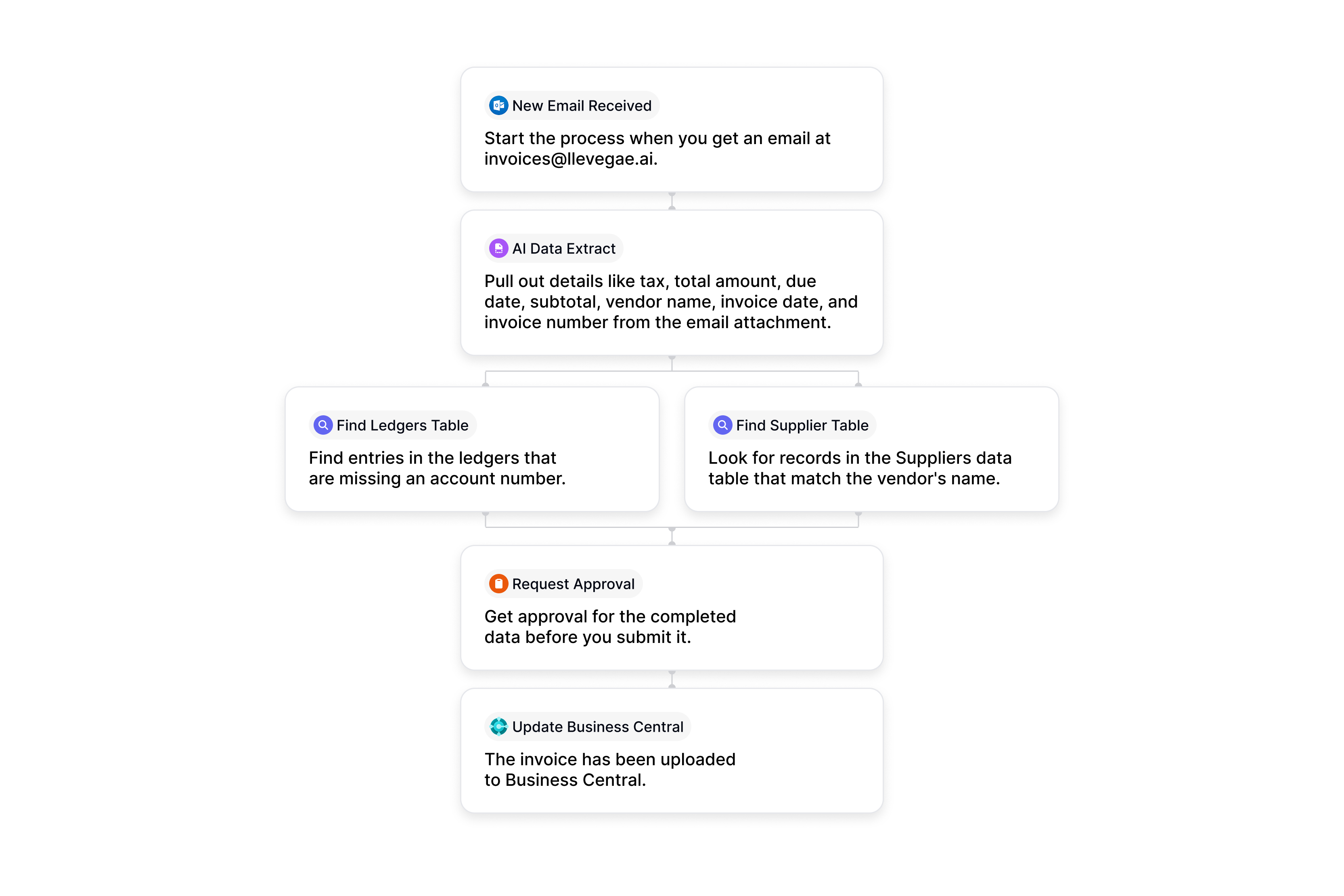
They didn't just automate order entry. They implemented AI-powered order processing that orchestrates the entire workflow:
- AI extracts data from any order format (email, PDF, Excel, handwritten notes)
- The system validates against inventory and customer-specific pricing
- Orders post directly to Business Central
- Customers receive automated confirmations
- Exception cases route to appropriate team members with full context
The result? 92% reduction in processing time, 90% fewer errors, and capacity to handle growth without hiring.
Ynvolve, a Dutch IT reseller, had a different orchestration challenge: quote generation required pulling information from multiple systems and took hours per quote.
Their AI-native orchestration platform connects:
- Product catalogs from multiple suppliers
- Customer history and preferences
- Current inventory and lead times
- Margin rules and approval workflows
Quote creation time dropped by 90%, from hours to minutes. But the bigger impact? They forecast 50% revenue growth driven by the ability to quote more opportunities faster, with higher accuracy.
The Five Pillars of Effective Orchestration
Based on implementations across European manufacturing, wholesale, and logistics companies, successful orchestration platforms share five essential characteristics:
Pillar 1: No-code workflow design
Business users should be able to define workflows without writing code. Modern platforms use visual workflow builders where you describe what should happen in plain language, and AI generates the automation.
This matters because IT teams can't be the bottleneck for every process change. When the business owns workflow design, implementation happens in days rather than months.
Pillar 2: AI-native document processing
Most business processes start with documents—orders, invoices, delivery notes, contracts. Orchestration platforms need native AI capabilities to extract data from any document format without template-based rules that break when formats change.
AI document processing should handle:
- Completely unstructured formats
- Multiple languages
- Handwritten notes
- Images and scanned documents
- Variations in layout and terminology
Pillar 3: Pre-built integrations
While orchestration platforms should handle custom integrations, you shouldn't need to build everything from scratch. Look for platforms with hundreds or thousands of pre-built connectors to common business systems.
Modern automation platforms offer 2,000+ pre-built integrations out of the box, covering:
- ERP systems (SAP, Business Central, Dynamics 365, AFAS, Infor, Navision)
- E-commerce platforms
- Logistics and shipping providers
- Communication tools (email, Slack, Teams)
- Databases and data warehouses
Pillar 4: Intelligent exception routing
Exceptions aren't failures—they're opportunities to handle edge cases intelligently. Orchestration platforms should:
- Identify exceptions automatically
- Provide relevant context to human reviewers
- Route to appropriate team members based on expertise
- Learn from resolutions
- Reduce exception rates over time
This is fundamentally different from traditional automation that simply breaks when encountering the unexpected.
Pillar 5: Real-time monitoring and optimization
You can't improve what you can't measure. Effective orchestration includes:
- Real-time dashboards showing workflow performance
- Bottleneck identification
- Exception pattern analysis
- ROI tracking by process
- Continuous optimization recommendations
The best platforms don't just execute workflows—they help you understand and improve them.
How to Start: The 30-Day Orchestration Sprint
Most manufacturers overcomplicate AI and orchestration projects. Here's the practical approach that works:
Week 1: Process Audit
Choose ONE high-impact process. The best candidates:
- High volume (hundreds or thousands of transactions monthly)
- Currently manual or semi-automated
- Clear business rules but exceptions are common
- Touches multiple systems
For most manufacturers, this is order processing, invoice processing, or quote generation.
Document:
- Current time per transaction
- Error rates and correction costs
- Volume patterns
- System touchpoints
- Exception types and frequency
Week 2: Design and Scope
Map the ideal end-to-end workflow:
- What triggers the process?
- What data is needed from which systems?
- What validation rules apply?
- What actions should happen automatically?
- What requires human judgment?
- How should exceptions be handled?
With modern AI-native platforms, this design phase doesn't require technical specifications. You describe the process in plain language, and the platform helps structure it.
Week 3: Build and Test
This is where AI-native orchestration platforms shine. With traditional automation, building would take months. With modern platforms:
- Visual workflow builders let you design processes in hours
- AI document processing adapts to your formats automatically
- Pre-built integrations connect to your systems immediately
- You test with real data, not in a separate development environment
Run a pilot with 20% of volume. Process real transactions in parallel with your manual process. Compare results. Refine based on what you learn.
Week 4: Expand and Measure
Scale from 20% to 100% of volume for your chosen process. Document:
- Time savings (hours per week)
- Error reduction (percentage decrease)
- Employee satisfaction (less tedious work)
- Customer impact (faster turnaround times)
Calculate ROI using actual numbers. Most high-volume processes show positive ROI within 3-6 months.
Then choose your next process. Order processing leads to invoice processing leads to production planning. Build momentum with wins.
The Competitive Reality
While 98% of manufacturers explore AI and 70% remain stuck at mid-stage automation maturity, a small group is pulling ahead dramatically.
Redwood's research shows their customers are 2.7x more likely to be in mid-to-high stages of automation maturity compared to the broader market. That's not because they have better technology budgets or more skilled teams. It's because they solved orchestration first.
The gap is widening. Companies that implement end-to-end orchestration can:
- Process orders in minutes instead of hours
- Generate quotes in real-time instead of days
- Handle exceptions automatically instead of manually
- Scale without proportional headcount increases
- Adapt to market changes faster than competitors
Deloitte predicts that autonomous AI agents properly orchestrated could increase the market to $45 billion by 2030—but only for organizations that solve the orchestration challenge. Companies that can't coordinate their systems and workflows will be left behind regardless of how sophisticated their individual tools become.
Why Traditional Approaches Won't Close the Gap
If the orchestration gap is so obvious, why aren't more manufacturers solving it?
Approach 1: "We'll build integrations ourselves"
Custom integration projects consume IT resources for years. Each system connection requires specialized knowledge. When systems update, integrations break. You end up with a fragile web of point-to-point connections that's expensive to maintain and impossible to extend.
Companies trying this approach report that integration projects typically run 89% over budget and take 75% longer than planned. ERP implementations fail at similar rates for the same reason—underestimating the complexity of coordinating multiple systems.
Approach 2: "We'll replace everything with one integrated system"
The "rip and replace" strategy looks appealing on paper. One vendor, one platform, perfect integration. In reality:
- Implementation takes 2-3 years minimum for manufacturing companies
- Costs typically range from €1M to €5M+ for mid-size operations
- Business disruption during migration is severe
- The "perfect" system still has gaps requiring bolt-on solutions
- You're locked into one vendor's roadmap
Most importantly, you're betting your business on a multi-year project succeeding flawlessly. The failure rate for large ERP implementations ranges from 55-75%.
Approach 3: "Traditional RPA will solve this"
Robotic Process Automation (RPA) like UIPath can automate repetitive tasks, but it doesn't solve orchestration. Traditional RPA vs. AI-native automation reveals critical differences:
- RPA requires rigid, unchanging processes. AI orchestration adapts to variation.
- RPA breaks when interfaces change. AI orchestration learns and adjusts.
- RPA can't read unstructured documents. AI orchestration handles any format.
- RPA connects systems at the UI level (brittle). AI orchestration connects via APIs (robust).
RPA has its place for specific tasks, but it's not an orchestration solution.
Approach 4: "Low-code platforms like Zapier will connect our systems"
Simple workflow automation platforms work well for basic connections—when form A is submitted, create row in spreadsheet B. They struggle with manufacturing complexity:
- Can't process unstructured documents
- Limited exception handling capabilities
- Require extensive manual configuration for each scenario
- Break down with complex conditional logic
- Can't maintain context across long-running processes
Zapier alternatives exist, but you need platforms specifically built for complex business processes with true AI capabilities, not just simple triggers and actions.
What Actually Works: AI-Native Orchestration
The manufacturers closing the orchestration gap share a common approach:
Start with a platform designed for orchestration, not just automation. Look for:
- Visual workflow design that business users can manage
- Native AI for document understanding and decision-making
- Thousands of pre-built integrations
- Robust exception handling and learning capabilities
- Deployment flexibility (cloud, on-premise, hybrid)
Begin with high-impact processes, not comprehensive transformation. Choose one process that:
- Causes daily pain for your team
- Has clear ROI potential
- Touches multiple systems
- Involves document processing
Prove value quickly. Then expand.
Involve business users, not just IT. The people doing the work understand the process best. Modern platforms let them design workflows without coding. IT provides governance and technical connectivity, but business drives implementation.
Expect weeks to production, not months. If a vendor tells you it will take 6-12 months to automate order processing, find a different vendor. Modern AI-native platforms implement in weeks because:
- They don't require extensive configuration
- AI learns your patterns from examples
- Pre-built integrations work out of the box
- You iterate quickly based on real results
Measure actual business impact, not technical metrics. Track:
- Hours saved per week
- Error reduction percentage
- Customer satisfaction improvements
- Revenue impact (faster quotes, better customer experience)
- Employee satisfaction (less tedious work)
The ROI of AI automation should be visible within months, not years.
Looking Forward: The Autonomous Enterprise
The orchestration gap isn't just about today's automation challenges. It's about preparing for autonomous operations.
Industry analysts predict that by 2030, leading manufacturers will operate largely autonomous workflows where:
- AI agents handle routine decisions independently
- Systems coordinate automatically across the enterprise
- Exceptions route intelligently to human experts only when needed
- Processes optimize themselves based on outcomes
- New capabilities deploy in days, not months
But you can't jump directly to autonomous operations from fragmented, siloed automation. Orchestration is the bridge.
Companies solving orchestration now are:
- Building the data flows that feed AI agents
- Establishing the exception handling logic AI will learn from
- Creating the system integration foundation for autonomous coordination
- Developing the organizational capabilities to manage AI-driven processes
They're not waiting for autonomous operations to arrive fully formed. They're building the infrastructure that makes autonomy possible.
Your First Step
If you recognize your company in this article—98% AI ambition but stuck at 50% automation maturity—here's what to do this week:
Pick one process. Not a digital transformation strategy. One process that causes daily pain.
Document the current state. How many hours does it take? What's the error rate? Where are the manual handoffs? Which systems are involved?
Calculate the opportunity. If you automated this end-to-end, what would you save? Time, errors, labor costs, faster customer response?
Test modern orchestration. Don't assume it requires massive investment or long implementation timelines. Modern platforms can prove value in weeks with a focused pilot.
The orchestration gap exists because most companies are trying to solve 2026 problems with 2015 technology. AI-native orchestration platforms exist. The implementation approaches that work exist. The case studies proving ROI exist.
What's missing is the decision to start.
98% of manufacturers are exploring AI. Only 20% feel ready to deploy it. The difference between these groups isn't budget, technical sophistication, or industry. It's recognizing that AI deployment isn't a technology challenge—it's an orchestration challenge.
And orchestration problems have orchestration solutions.
Ready to close your orchestration gap? Book a demo to see how Lleverage helps European manufacturers, wholesalers, and logistics companies bridge the gap from exploration to execution—typically in weeks, not months.

.jpg)