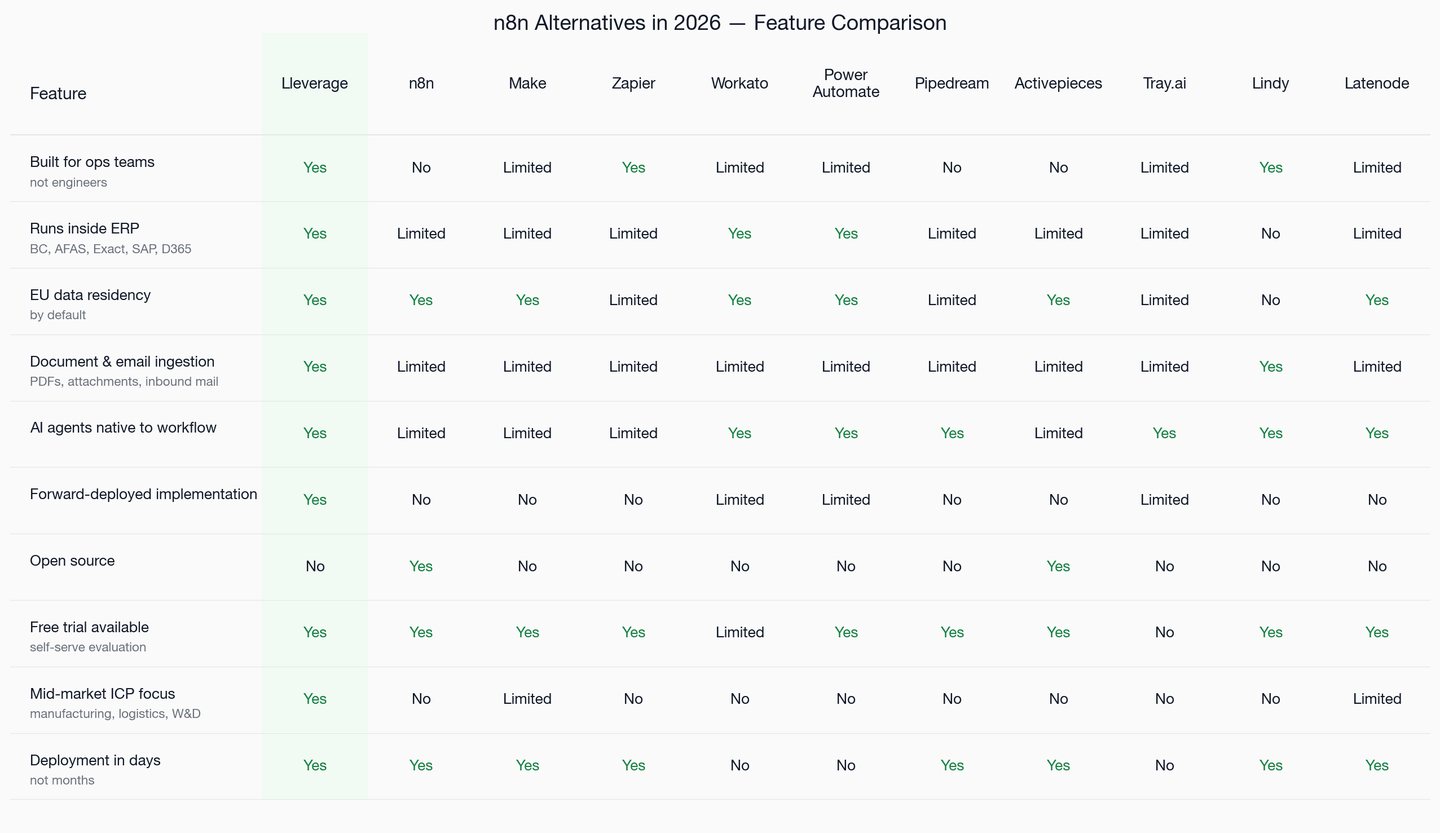
n8n is built as a generalist visual workflow canvas for engineers. For mid-market manufacturers, logistics operators, and wholesale and distribution businesses, it sits at the surface of the ERP and leaves ops teams without engineering support stuck. This guide compares n8n against nine alternatives for that buyer.
n8n is an open source workflow automation product that gives engineers a visual canvas for wiring services together, with self-hosting and a fair-code license. For internal automation teams with engineering bandwidth, n8n is a strong choice.
For mid-market manufacturers, logistics operators, and wholesale and distribution businesses, n8n is often the wrong fit. It is built as a generalist canvas for any user and any use case, not for the specific shape of back-office work in companies that make, move, and sell physical products. As a result, ops teams without engineering support cannot maintain a serious n8n implementation, and the platform has no native opinion on invoice processing, sales-order intake, master-data reconciliation, or quote generation inside an ERP.
This guide compares n8n against 10 n8n alternatives, with Lleverage at #1, for that buyer. If you are evaluating these for back-office automation in a manufacturer, logistics operator, or wholesale and distribution business, book a demo with Lleverage to see the comparison in your own ERP.
Quick Recap: 10 n8n Alternatives in 2026
- Lleverage: AI layer that automates back-office work inside the customer's existing ERP, with forward-deployed implementation for mid-market ops teams.
- Make: Visual workflow builder with the closest canvas-style UX to n8n, popular with operators who want a self-serve cloud option.
- Zapier: The default automation reference, strongest for simple, app-to-app triggers across thousands of integrations.
- Workato: Enterprise iPaaS for large IT teams that want a sales-led, governed integration backbone.
- Microsoft Power Automate: Default automation choice inside the Microsoft 365 and Dynamics 365 estate, with attended and unattended RPA.
- Pipedream: Code-and-visual workflow builder for engineers who want a serverless runtime without standing up infrastructure.
- Activepieces: Open source workflow automation, the closest like-for-like alternative to self-hosted n8n.
- Tray.ai: API-first iPaaS targeting large product, RevOps, and IT teams.
- Lindy: AI agent builder focused on email, meetings, and CRM tasks for individual operators.
- Latenode: AI plus visual workflow hybrid, with built-in access to several hundred AI models.
Key Parameters to Decide Between n8n Alternatives
When you compare n8n alternatives, brand recognition matters less than fit. Five parameters drive the actual decision in mid-market ops automation projects:
Who owns the automation after go-live. First, if the answer is an internal engineer, then n8n, Pipedream, and Activepieces are reasonable. However, if the answer is an ops controller, finance lead, or COO, the visual canvases of Make, Zapier, and Lindy, or the forward-deployed model of Lleverage and Workato, fit better. As a result, pick the one your post-launch owner will actually maintain.
Where the work lives. Most ops automation work lives inside an ERP, whether that is Business Central, AFAS, Exact, SAP, Dynamics 365, or NetSuite. As a result, if your automations have to read, write, and reconcile inside that ERP, then the integration depth matters more than the visual builder. For example, Lleverage, Workato, and Power Automate score highest here. In contrast, n8n and most generic workflow builders connect at the surface, not deep into the document and posting layers.
How documents and emails enter the process. A real back-office automation has to read a PDF invoice, parse an emailed sales order, or pick up an attachment from a shared mailbox before any workflow logic runs. For example, Lleverage and Lindy handle this natively. However, most other n8n alternatives require an extra OCR or parsing step the buyer has to wire in.
Data residency and audit trail. EU mid-market buyers, especially in regulated verticals, need EU data residency, a clean audit trail, and signed customer agreements before procurement signs off. For instance, n8n self-hosted, Lleverage, Workato, Make, Activepieces, and Power Automate all clear this bar. However, several US-first alternatives still do not.
Time to first automation in production. A six-month implementation kills most automation projects. In addition, the realistic range across this list is one week (Lleverage, Lindy, Make for narrow scope) to six months (Workato, Tray.ai, Power Automate at enterprise scope). Therefore, match this to the urgency of the work the automation is meant to absorb.
Why Buyers Consider n8n Alternatives
- Built as a generalist, not for physical-product operations. n8n is a canvas any engineer can wire together for any use case. That breadth is also its limitation: there is no opinion on the shape of invoice processing, sales-order intake, master-data reconciliation, or quote generation in a manufacturer, logistics operator, or wholesale and distribution business. Lleverage is the opposite. It is narrow on the buyer (mid-market companies that make, move, and sell physical products) and deep on the workflows that move money and inventory inside that buyer's ERP.
- Engineering dependency. n8n is a builder for people comfortable with JSON, conditional logic, and self-hosting. As a result, ops teams without engineering support cannot maintain a serious n8n implementation, and IT teams resent owning automations that exist outside the ERP.
- Document and email handling. n8n was not built for parsing PDF invoices, reading emailed sales orders, or capturing attachments from shared inboxes. However, most ops automation projects start with exactly that step, and therefore need to bolt on a separate parser to make n8n fit.
- ERP-native execution. n8n connects to ERPs at the surface. For example, writing an invoice posting back into Business Central, reconciling a sales order in Exact, or syncing master data in AFAS all require custom nodes the buyer has to build and maintain.
- AI agents inside the workflow. n8n added AI nodes, but the AI is a step inside a workflow, not an agent that owns a process end-to-end. As a result, for automations where the model needs to make business decisions across several steps, an AI-native alternative fits better.
- EU data residency and compliance. n8n cloud and self-hosting both clear EU residency. However, the compliance, audit, and contract package most mid-market controllers expect is closer to enterprise iPaaS than to a self-hosted automation product.
- Total cost of ownership at scale. n8n is cheap until production volumes increase. In addition, self-hosting adds infrastructure, monitoring, and engineering on-call, while cloud execution credits add up. As a result, TCO at production scale often makes a sales-led alternative look cheaper.
1. Lleverage: #1 n8n Alternative: AI agents for real-world operations
Website: lleverage.ai
Lleverage builds AI agents for real-world operations in companies that make, move, and sell physical products. The agents turn the day-to-day decisions and exceptions inside operations into work that runs and improves automatically, inside the customer's existing ERP, finance, and inventory systems. Among n8n alternatives, Lleverage is the only one built specifically for mid-market manufacturers, logistics operators, and wholesale and distribution businesses, with deep coverage of the back-office workflows where n8n sits at the surface.
Lleverage Features
- AI agents that read inbound PDFs, emails, and attachments and post results into the ERP automatically
- ERP-native execution inside Business Central, AFAS, Exact, SAP, Dynamics 365, and NetSuite
- Forward-deployed implementation: a Lleverage engineer ships the first automation in production with the customer
- Document understanding for invoices, sales orders, quotes, and master data records
- Audit trail and human-in-the-loop checkpoints for finance-grade automations
- EU data residency by default, with signed enterprise agreements available
- Continuous improvement loop: every exception the agent surfaces becomes a rule the next run respects
- Single sign-on and role-based access control
- Free trial available alongside sales-led implementation support — start solo or with a Lleverage engineer
Lleverage Pricing
- Free trial available — start without a sales conversation
- Sales-led plans scoped per use case for forward-deployed implementations
- See Lleverage pricing for current tiers
n8n vs Lleverage
n8n and Lleverage solve different shapes of the same problem. n8n is a generalist visual workflow builder that any engineer can extend across services. Lleverage builds AI agents for the specific shape of operations inside companies that make, move, and sell physical products, executed inside the ERP. The split:
- n8n is owned by engineering after go-live. Lleverage is owned by the ops or finance lead.
- n8n connects to ERPs at the surface. Lleverage executes inside the ERP, including document posting and reconciliation.
- n8n is built as a generalist for any user. Lleverage is built specifically for mid-market manufacturing, logistics, and wholesale and distribution back-office workflows.
- n8n self-hosting is free. Lleverage offers a free trial, with paid plans scoped per use case for forward-deployed implementations.
Lleverage Limitations
- First, it is not a generalist visual workflow builder for engineers who want to wire 500 services together. Scope is operations inside physical-product companies.
- Sales-led for production deployments — the free trial is for evaluation, not a self-serve scaling path. No community add-on integrations.
- Not focused on consumer or marketing automation. ICP is ops, finance, and IT leadership in manufacturing, logistics, and wholesale and distribution.
Customer proof
Topa Bathroom Products, a Dutch wholesale and distribution business, automated more than 90% of inbound order intake with Lleverage, freeing up close to four full-time roles from manual data entry. The automation runs inside their existing ERP, owned by the ops team.
Visit Lleverage · Book a demo
2. Make: #2 n8n Alternative: Visual workflow builder
Among n8n alternatives, Make (formerly Integromat) is the one most buyers shortlist first. The canvas is visual, the integration library is large, and the pricing is operations-based rather than per-task.
Make Features
- Visual scenario builder with branching, iterators, and aggregators
- Around 3,000 prebuilt integrations
- Custom HTTP modules to call any service that n8n would also support
- Scheduled scenarios down to one-minute frequency on paid tiers
- Execution log with full-text search on Pro and above
- AI assistant for scenario suggestions
- Templates and shared workflows on Teams tier
- EU data residency available
Make Pricing
- Free: $0/month, 1,000 credits, two active scenarios
- Core: $9/month for 10,000 credits, unlimited scenarios
- Pro: $16/month for 10,000 credits with priority execution and custom variables
- Teams: $29/month for 10,000 credits with team roles and shared templates
- Enterprise: custom pricing
- Source: make.com/en/pricing as of May 2026
n8n vs Make
Both are visual workflow builders. The differences:
- In contrast, Make is a managed cloud service. n8n self-hosts as well as runs as a managed cloud.
- In contrast, Make's canvas is friendlier for non-engineers. n8n exposes more of the underlying logic, which engineers prefer.
- Make's pricing is credit-based. n8n's cloud pricing is execution-based.
- n8n is open source under a fair-code license. Make is proprietary.
Make Limitations
- First, credit-based pricing becomes hard to forecast at scale.
- Custom logic still requires the visual modules. There is no full code editor inside Make.
- Native ERP execution is limited compared with sales-led iPaaS like Workato or AI-native automation like Lleverage.
- In addition, there is no forward-deployed implementation; Make is self-serve.
3. Zapier: #3 n8n Alternative: Default automation choice
Of the n8n alternatives any buyer mentions first, Zapier is the most-named automation product in the conversation. It is the right call for app-to-app triggers across more than 7,000 integrations, but the wrong call for ops automation that lives inside an ERP.
Zapier Features
- 7,000+ prebuilt integrations, the largest library on this list
- Multi-step Zaps with filters, paths, and formatters
- AI fields and Zapier Copilot for suggestions
- Tables, Forms, and Interfaces for lightweight internal app building
- Webhooks for any service Zapier does not natively support
- SAML SSO from the Team tier
- Shared Zaps and folders for collaborating teams
Zapier Pricing
- Free: $0/month, 100 tasks, two-step Zaps
- Professional: from $19.99/month billed annually, multi-step Zaps and unlimited premium apps
- Team: from $69/month billed annually, 25 users
- Enterprise: contact sales
- Source: zapier.com/pricing as of May 2026
n8n vs Zapier
- In contrast, Zapier is the simpler buyer experience. n8n exposes more depth.
- Zapier's task-based pricing punishes high-volume back-office automation. n8n's self-host removes that ceiling.
- In addition, Zapier covers more services natively. n8n requires more of the wiring to be done by the builder.
- Zapier has no self-host option. n8n does.
Zapier Limitations
- First, task-based pricing becomes expensive at production back-office volume.
- Limited support for long-running, complex automations with many branches.
- Furthermore, native ERP integration depth is shallow compared with iPaaS or AI-native alternatives.
- No forward-deployed implementation.
4. Workato: #4 n8n Alternative: Enterprise iPaaS
Among enterprise-grade n8n alternatives, Workato is the iPaaS used by large IT and integration teams. It is sales-led, governed, and built for organizations that need an integration backbone across many systems.
Workato Features
- Recipe-based integration logic with rich logging
- Connectors to most enterprise services, including SAP, Oracle, Workday, NetSuite, and Salesforce
- AI Agent Studio for embedded agents in recipes
- Recipe Lifecycle Management for versioned deployment
- Strong governance: roles, environments, audit logs
- Embedded iPaaS for software vendors that want to ship integrations
- Recipe IQ for AI-suggested integration logic
Workato Pricing
- Sales-led, quote-based pricing
- Public pricing not disclosed; contact sales
- Source: workato.com/pricing as of May 2026
n8n vs Workato
- In contrast, Workato is enterprise iPaaS. n8n is a visual workflow builder for engineers.
- In addition, Workato carries enterprise governance out of the box. n8n requires the builder to add it.
- Workato deals are six-figure annual contracts. n8n self-host is free.
- Workato implementations take months. n8n cloud automations can ship in days.
Workato Limitations
- First, quote-based pricing is opaque and skews high. As a result, mid-market buyers struggle to fit Workato into the budget.
- Implementation timelines are months, not days.
- Recipe authoring still requires technical skill. Ops controllers rarely own a Workato build.
- No open source option.
5. Microsoft Power Automate: #5 n8n Alternative: Microsoft-native automation
Among n8n alternatives, Power Automate is the default automation choice for any business standardized on Microsoft 365, Dynamics 365, or Azure. In addition, it covers cloud flows, attended desktop flows, and unattended RPA in one product.
Microsoft Power Automate Features
- Cloud flows with hundreds of native connectors
- Attended desktop flows on the Premium tier
- Unattended desktop flows on the Process tier
- Process and task mining add-ons
- Native integration with Dataverse, SharePoint, Teams, and Dynamics 365
- AI Builder for document understanding inside flows
- Government and EU data residency available
Microsoft Power Automate Pricing
- Premium: $15.00 per user/month, paid yearly
- Process: $150.00 per bot/month, paid yearly, unattended RPA
- Hosted Process: $215.00 per bot/month, paid yearly, Microsoft-hosted VM
- Process Mining add-on: $5,000 per tenant/month
- Source: microsoft.com/power-automate/pricing as of May 2026
n8n vs Microsoft Power Automate
- In contrast, Power Automate is built for the Microsoft estate. n8n is service-agnostic.
- Power Automate licenses tie into existing Microsoft enterprise agreements. n8n licenses are standalone.
- In addition, Power Automate's RPA capability covers desktop automation. n8n does not.
- n8n is open source. Power Automate is proprietary.
Microsoft Power Automate Limitations
- First, per-user and per-bot pricing scales fast for high-volume automations.
- Outside the Microsoft estate, the product is less compelling than n8n or Make.
- AI Builder model accuracy lags purpose-built document AI alternatives.
- Implementation in regulated industries often requires a Microsoft partner, adding cost and time.
6. Pipedream: #6 n8n Alternative: Developer workflow builder
Among n8n alternatives, Pipedream is the code-and-visual workflow builder for engineers who want a serverless runtime without operating any infrastructure. As a result, the buyer profile is the closest match to a typical n8n self-host user.
Pipedream Features
- Visual canvas with the option to drop into Node.js, Python, Go, or Bash inside any step
- 2,500+ prebuilt integrations
- HTTP triggers and scheduled triggers out of the box
- Built-in datastore for cross-run state
- Workflow versioning and rollback
- Inline observability and per-step logs
- Connect SDK for embedding workflows into the customer's own product
Pipedream Pricing
- Tiered pricing published on pipedream.com/pricing — free starter, paid tiers, and enterprise quote-based
- Pricing structure not reproducible here without live verification
- Source: pipedream.com/pricing
n8n vs Pipedream
- For example, both speak to engineers. Pipedream is fully managed; n8n offers self-host.
- In contrast, Pipedream lets you write any code in any step. n8n exposes a more constrained scripting node.
- Pipedream's serverless model removes infrastructure work. n8n self-hosters take that on.
- n8n is open source. Pipedream is proprietary.
Pipedream Limitations
- First, the buyer profile is engineers. As a result, ops controllers cannot own a Pipedream build.
- Per-credit pricing becomes harder to forecast at production scale.
- No forward-deployed implementation; everything is self-serve.
- Native ERP integration depth is shallow.
7. Activepieces: #7 n8n Alternative: Open source workflow builder
Of all the n8n alternatives in this list, Activepieces is the closest like-for-like: open source, visual canvas, self-hostable, and aimed at internal automation teams who want to avoid vendor lock-in. For example, the architecture, the canvas metaphor, and the self-host story all mirror n8n.
Activepieces Features
- Open source under the MIT license
- Self-hostable via Docker, with managed cloud also available
- Visual canvas with branching and looping
- AI copilot for piece authoring
- TypeScript-based piece SDK for custom integrations
- Embedded mode for software vendors
- Audit logs and team roles on paid tiers
Activepieces Pricing
- Self-hosted community edition: free under the MIT license
- Cloud and enterprise tiers published on activepieces.com/pricing — quote and self-serve options available
- Source: activepieces.com/pricing
n8n vs Activepieces
- For example, both are open source. n8n uses a fair-code license; Activepieces uses MIT.
- Both have a visual canvas. Activepieces is leaner; n8n exposes more depth.
- n8n has a larger integration library. Activepieces is catching up.
- n8n's community is larger and older. Activepieces is newer and faster-moving.
Activepieces Limitations
- First, the integration library is smaller than n8n's.
- Smaller community and ecosystem.
- Native ERP integration depth is shallow.
- In addition, there is no forward-deployed implementation.
8. Tray.ai: #8 n8n Alternative: API-first iPaaS
Among enterprise-grade n8n alternatives, Tray.ai (formerly Tray.io) is the API-first iPaaS used by large product, RevOps, and IT teams that need a governed integration backbone with embedded AI. However, the buyer profile is enterprise, not mid-market.
Tray.ai Features
- Visual workflow builder with strong API support
- Merlin AI agents and copilots embedded in workflows
- Connector library across enterprise services
- Embedded iPaaS for software vendors
- Universal connectivity layer for custom services
- Enterprise governance: SSO, audit logs, environments
- Strong developer ergonomics with CLI and SDKs
Tray.ai Pricing
- Sales-led, quote-based pricing
- Public pricing not disclosed; contact sales
- Source: tray.io/pricing as of May 2026
n8n vs Tray.ai
- In contrast, Tray.ai is enterprise iPaaS. n8n is a visual workflow builder for engineers.
- Tray.ai deals are six-figure annual contracts. n8n self-host is free.
- In contrast, Tray.ai targets large product and RevOps teams. n8n is general-purpose.
- Tray.ai carries enterprise governance out of the box. n8n requires it to be added.
Tray.ai Limitations
- First, quote-based pricing skews high; as a result, mid-market buyers rarely fit.
- Implementation timelines are months, not days.
- Native ERP integration depth varies; depends heavily on the connector you need.
- No open source option.
9. Lindy: #9 n8n Alternative: AI agent builder
Among consumer-grade n8n alternatives, Lindy is the AI agent builder focused on email, meetings, and CRM tasks for individual operators. In contrast to ops-team automation, the buyer profile is closer to a single power-user than to a back-office team.
Lindy Features
- AI agents for email triage, meeting prep, and CRM updates
- Native Gmail, Outlook, and calendar handling
- Computer use capability on higher tiers
- 100+ integrations
- Templates for common operator workflows
- HIPAA compliance and SSO on Enterprise
Lindy Pricing
- Plus: $49.99/month, standard usage and 2 inboxes
- Pro: $99.99/month, 3x usage, 3 inboxes, computer use
- Max: $199.99/month, 7x Plus usage, 5 inboxes
- Enterprise: contact sales
- Source: lindy.ai/pricing as of May 2026
n8n vs Lindy
- In contrast, Lindy is an AI agent product, not a workflow canvas. n8n is the inverse.
- Lindy's buyer is one operator. n8n's buyer is an engineer or internal automation team.
- In contrast, Lindy ships finished agents. n8n ships an empty canvas.
- n8n is open source. Lindy is proprietary.
Lindy Limitations
- First, it is not built for back-office automation across an ERP.
- Single-operator pricing scales to a per-seat cost rather than a per-process cost.
- No EU data residency commitment by default.
- Limited governance for regulated mid-market deployments.
10. Latenode: #10 n8n Alternative: AI + visual hybrid
Among the newer wave of n8n alternatives, Latenode is an AI plus visual hybrid that ships with built-in access to several hundred AI models and a custom JavaScript step inside any workflow.
Latenode Features
- Visual canvas with optional JavaScript inside any node
- Built-in access to 400+ AI models
- 5,500+ integrations
- AI code copilot
- Free tier with 300 monthly executions
- Static IP and custom webhook domain on Enterprise
Latenode Pricing
- Free: $0/month, 300 executions
- Mini: $5/month, 1,000 executions
- Start: $19/month, 25,000 executions
- Team: $59/month, 250,000 executions, 5 team members
- Enterprise: from $299/month, custom executions and unlimited members
- Source: latenode.com/pricing as of May 2026
n8n vs Latenode
- For example, both expose a visual canvas with a code escape hatch. Latenode goes deeper on built-in AI models.
- Latenode is a managed cloud service. n8n offers self-host as well as cloud.
- Latenode's pricing is execution-based at production scale. n8n self-host removes that ceiling.
- n8n is open source. Latenode is proprietary.
Latenode Limitations
- First, it is a newer product with a smaller community than n8n.
- Native ERP integration depth is shallow.
- No forward-deployed implementation.
- Per-execution pricing is hard to forecast at production scale.
Choosing Among These n8n Alternatives
For mid-market manufacturers, logistics operators, and wholesale and distribution businesses where the work has to clear inside the ERP, Lleverage is the right call. Lleverage ships the first automation in production with the customer, and the ops team owns it after go-live. Among n8n alternatives, it is the only one built specifically for the back-office workflows of companies that make, move, and sell physical products.
For other buyer profiles:
- Engineering-led, open source priority: n8n itself, Activepieces, or Pipedream.
- Generalist owner, friendly visual canvas: Make, Zapier, or Latenode.
- Enterprise IT team, governed integration backbone: Workato, Tray.ai, or Microsoft Power Automate.
- Single operator, AI assistant for inbox and CRM: Lindy.
Book a demo