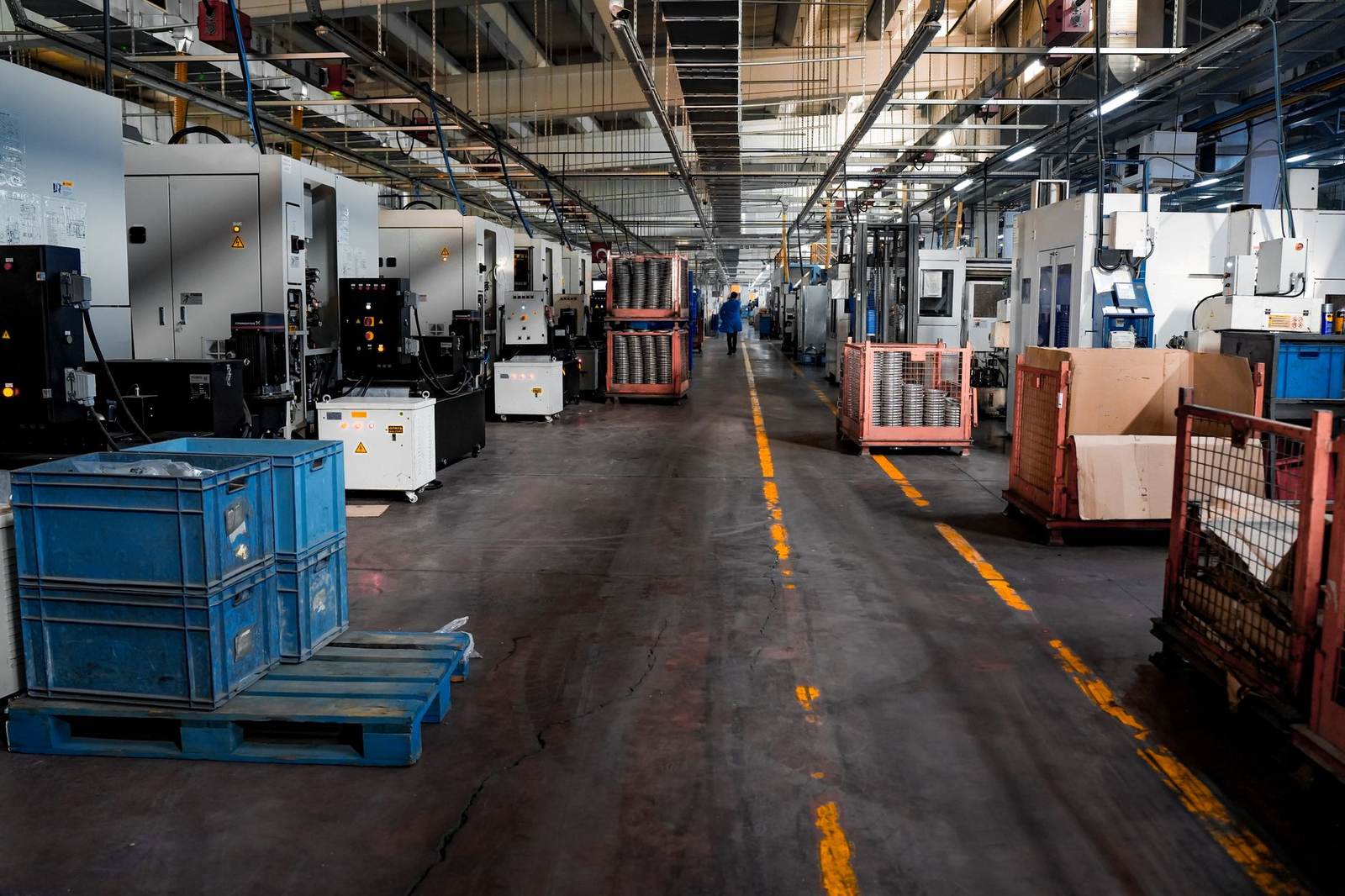
AI in manufacturing covers two different things: intelligence applied to the physical plant, and intelligence applied to the administrative work wrapped around it. At Lleverage we think most manufacturers should start with the second, because the back office is where the work is already digital, already repetitive, and already measurable.
Walk any mid-sized engineering firm in the Netherlands or Germany and you will find the same split. On the shop floor, capital equipment that took two years to specify and will run for fifteen. In the office next to it, a planner with 40 browser tabs, an order desk retyping purchase orders out of PDFs, and a finance team matching invoices to receipts line by line. The machines are modern. The paperwork around them is not. This guide covers both halves, what each one can realistically do in 2026, and how to sequence them.
We build AI agents for companies that make, move and sell physical products, which means our vantage point is the second half: planning and production, order intake, procurement and finance. That is the work we are usually called in to fix, and it is the work this guide goes deepest on. If you want to see it against your own processes, book a demo.
What does AI in manufacturing actually mean in 2026?
AI in manufacturing means software that makes a judgement a rule could not make: reading an unstructured document, spotting a defect in an image, forecasting demand from mixed signals, or deciding which of 800 specifications applies to an incoming order. It is distinct from automation, which executes a decision somebody already made.
That distinction matters more than any vendor category, so it is worth being precise. Traditional factory automation is deterministic. A programmable logic controller fires an actuator when a sensor crosses a threshold, an integration writes a field from system A into system B, and a rule in your ERP blocks an order when credit is exceeded. All of it is valuable, none of it copes with input it has not seen before.
AI handles the cases in between. When a customer sends a purchase order as a scanned PDF with their own part numbers, no rule reliably maps that to your catalogue. When a supplier confirmation comes back with two of five lines shifted by three weeks, no rule works out what that does to the August build. When a technician needs the torque spec for a machine from a manufacturer you stopped buying from in 2011, no rule finds it in 170 manuals.
Three terms get used loosely and are worth separating:
- Industrial AI usually means AI applied to physical assets: vision inspection, predictive maintenance, process optimisation on a line.
- Back-office AI means AI applied to the documents and decisions that run the factory: orders, quotes, purchase orders, invoices, master data, customer questions.
- Agentic AI means a system that does not just answer, but carries a task to completion inside your systems, with a person supervising until it has earned the right to run in the background.
We use the third definition when we describe what we build, and we are specific about it because the word "agent" is now attached to everything from a chatbot to a scripted macro. An agent, in our reading, is judged on whether the work is finished in the system of record, not on whether the answer looked plausible.
Where does AI in manufacturing pay back fastest?
In the back office, in our view, for three reasons: the data is already digital, the volume is high and repetitive, and the result is countable in hours within weeks rather than quarters. Plant-floor AI is real and often more strategically important, but it carries capital cost, integration risk and a payback measured in years.
This is the single most contested claim in this guide, so here is the reasoning rather than the assertion.
A vision inspection system needs cameras, lighting, mounting, a line stop, a labelled defect dataset and a validation period against your quality standard. It is a capital project. It competes for the same budget and the same engineering attention as a new cell or a press replacement, and it is typically justified over three to five years.
An order intake agent needs access to an inbox and to your ERP. The documents already exist, in their thousands, with a ground truth attached to every one of them: what a human eventually typed in. That is a training and validation set you already own. You can run it in the foreground for a fortnight, compare its output to what your team would have entered, and count the difference.
The results we can point to are the countable kind. Topa Bathroom Products now processes over 90% of incoming orders directly into Business Central with no manual input, and confirmations reach the customer within 30 seconds. At Xpol, an agent replaced roughly 20 minutes of manual handling per large order across about 150 orders a week, absorbing both a retiring specialist's workload and volume growth without the 1 to 2 planned hires. Exellyn cut export shipment calculations from more than 20 minutes of manual dimension and weight work down to seconds from a single uploaded document.
None of those required touching a machine.
The two layers, side by side
| Plant-floor AI | Back-office AI | |
|---|---|---|
| Typical use | Vision inspection, predictive maintenance, line optimisation | Order intake, quoting, PO matching, invoice matching, master data |
| Data needed | New sensor or image data, labelled | Documents you already hold, with human decisions attached |
| Budget line | Capital expenditure | Operating expenditure |
| Time to first result | 6 to 18 months | 4 to 8 weeks |
| Who sponsors it | Operations or engineering director | Finance, customer service, supply chain |
| Failure mode | Model works, line integration does not | Nobody trusts the output, so it stays supervised forever |
| Measured in | Scrap rate, uptime, yield | Hours returned, touchless rate, response time |
The right answer for most manufacturers is both, in that order. Prove the operating model on the paperwork, where a mistake is recoverable and the feedback loop is a day long, then take what you have learned about supervision and control to the capital project.
What can AI do on the factory floor today?
Four things are in genuine production use across European plants in 2026: visual quality inspection, predictive maintenance on rotating and thermal assets, process parameter optimisation, and demand and capacity forecasting that feeds the schedule. Everything else on the floor is still mostly pilot.
Visual inspection is the most mature. A camera and a trained model catch surface defects, missing components, label errors and fill-level faults faster and more consistently than a person at the end of a shift. It works best where the defect is visible, the part presentation is consistent, and you have enough examples of what bad looks like.
Predictive maintenance reads vibration, temperature, current draw and acoustic signatures to flag a bearing or a motor before it fails. The honest limit here is that it needs failure history to learn from, and a plant that has been diligently replacing components on schedule for 20 years has very little of it. Manufacturers with a small fleet of highly custom machines usually get less from this than the case studies suggest.
Process optimisation tunes parameters, mixing time, temperature curve, feed rate, against a quality outcome. Strong in continuous and batch process environments, weaker in low-volume discrete manufacturing where every job is different.
Forecasting and scheduling sit at the boundary between the two layers, and this is where a manufacturer usually first feels AI in a planning decision rather than a report. Our own planning agent demo builds a weekly production plan under multiple constraints across machines, people and materials, replans when a raw material slips, and writes the result back to Business Central. The demo figures we publish for that flow are 3x throughput with the same team and a 25% reduction in change-overs.
Be careful with any of these numbers, including ours. A yield improvement on one line in one plant is not a benchmark, it is an anecdote with a decimal point. Ask any vendor which plant, which product, which baseline, and over what period.
What can AI do in the back office that runs the factory?
It can read the documents that arrive, decide what they mean against your own data, and finish the work in your ERP. That covers order intake, quotation, purchase order confirmation matching, three-way invoice matching, master data upkeep and customer support, which together account for most of the administrative headcount in an SME manufacturer.
This is the layer we work in daily, so this section carries the most detail.
Order intake and quoting
Orders arrive as email bodies, PDFs, spreadsheets and portal exports, with customer part numbers that do not match yours. The work is finding the customer, mapping the lines, checking price and availability, entering it and confirming back. The quote and sell demo we publish shows a purchase order recognised, extracted and entered in Business Central with no exceptions.
For engineered products the quoting half is harder and more valuable. At SPL Treatments, Grant Riley used to spend around an hour on each part the company had never treated before, reading aerospace specifications and cross-checking a library of more than 800 standards. An agent now drafts the route with the spec section behind each step, and he corrects what needs correcting:
90% of things are correct within a result. It feels a bit negative to give it a thumbs down.
That is the shape of the problem in engineered manufacturing generally. The knowledge exists, it is written down somewhere, and the constraint is that only a few people can apply it quickly.
Procurement and supplier confirmations
A purchase order goes out, a confirmation comes back, and somebody compares them line by line for quantity, price and date. Deviations matter because they move production dates. Our source and procure demo matches a supplier confirmation against the purchase order, flags the two deviating lines with their impact on the August assembly, drafts the supplier reply and posts the approved result to SAP. The published demo figure for that end-to-end run is 14.6 seconds.
Finance
Three-way matching is the clearest case of skilled people doing mechanical work. Royal Kaak, the 180-year-old Dutch builder of industrial bakery lines, runs an accounts payable agent that reads supplier invoices from the finance inbox, matches them against the purchase orders behind each engineered-to-order project, and books the clean ones straight into the ERP while routing the rest to a person with the context attached.
Support and master data
Kisch reports that 80% of the questions its support desk receives each day are the same questions, which is the precondition for handing them to an agent with live order context from the ERP. On the data side, our master data demo compares customer records across Salesforce and SAP, corrects a mismatched VAT identifier and pushes the fix to both.
A different flavour of the same problem: Oude Reimer unified 170 manuals from more than 15 machine manufacturers into one searchable base, and technical triage that meant scrolling hundreds of pages now returns a referenced answer in 70 seconds.
How do AI agents fit with your existing ERP, MES and planning systems?
They sit on top and write into them. An agent is not a replacement for Business Central, SAP, Exact or Infor, and any vendor implying otherwise is selling you a second system of record you will spend three years reconciling. The ERP stays the truth. The agent does the reading, matching and deciding that people currently do before they type into it.
This is the question that decides most manufacturing evaluations, so be concrete when you ask it.
- Where does the work land? Ask to see the record created in your own ERP during the evaluation, not an export or a staging table.
- What happens to an exception? It should reach a named person with the document, the mismatch and a recommended action, not sit in a queue nobody owns.
- Who holds the business rules? Corrections your team makes should be retained and applied next time. If every correction has to be re-explained, you have bought a demo, not an agent.
- What is the audit trail? For food, pharmaceutical, aerospace and defence supply chains this is not optional. Every change needs an actor, a timestamp and a reason.
- Where does the data sit? European hosting and data residency is a normal procurement requirement now, and the answer should be immediate.
The control and integration layers are the boring half of this and the half that decides whether it survives contact with your IT function.
How should an SME manufacturer sequence the first twelve months?
Start with one process that has high volume, a clear ground truth and a frustrated owner. Run it supervised until the error rate is known rather than assumed, then move it to the background and take the next process. Sequential beats parallel, and one finished process beats six pilots.
The pattern we see work looks like this.
Weeks 1 to 2, pick the process. Count the volume, time the manual handling, and identify who owns the outcome. Order intake, supplier confirmations and invoice matching are the usual first choices because all three have a documented right answer sitting in the ERP already.
Weeks 3 to 6, run it in the foreground. The agent proposes, a person approves, and every correction is captured. Do not measure success by accuracy in week 3. Measure whether the corrections are getting rarer and whether they are the same corrections repeated.
Weeks 7 to 12, earn the background. Move the clean cases to automatic and keep the exceptions in front of a person. Publish the touchless rate weekly. This is the point where the number stops being a promise.
Months 4 to 12, take the next process, and the one after. The second is faster than the first because the connections, the rules and the trust already exist.
We wrote about why this order matters in supervised agents versus background automation. The short version is that supervision is not a training-wheels phase you tolerate, it is how the system acquires your rules.
What goes wrong with AI in manufacturing projects?
Four failures account for most of it: starting with the hardest process, buying a pilot with no route to production, measuring accuracy instead of hours returned, and skipping the exception path. None of them are technology problems.
Starting with the hardest process. Teams often pick the messiest workflow because it hurts most. It also has the least consistent ground truth, so nobody can agree whether the output is right, and the project dies in a definitions argument.
A pilot with no route to production. If the evaluation runs in a sandbox that cannot write to the ERP, you have proven a model can read a document. You have not proven anything about your operation. Insist that the pilot writes into a real system, even a test instance of it.
Measuring the wrong thing. Accuracy is a proxy. Hours returned, touchless rate, response time and error escapes are the outcome. A 92% accurate agent that saves the team nothing because every case still gets reviewed is worse than an 85% one where the 15% is cleanly routed.
No exception path. The 10 to 20% that cannot be handled automatically is where the value leaks back out. If exceptions land in an unowned queue, the team quietly reverts to doing all of it manually, and the numbers were always going to end up there.
A fifth, quieter failure is scope drift into things AI should not decide. Pricing exceptions, credit decisions and quality dispositions in a regulated supply chain belong with a person. Saying so plainly is not a weakness of the approach, it is the design.
How do you build the business case for AI in manufacturing?
Count hours, not licences. Take the process volume, multiply by the measured manual handling time, apply a loaded hourly cost, and compare that against the automated share you can actually evidence in the foreground phase. Anything that depends on a projected accuracy figure is a forecast, not a case.
A worked version, using the kind of numbers a mid-sized manufacturer can measure in an afternoon:
An order desk handling 150 orders a week at roughly 20 minutes of handling each is 50 hours a week. That is the Xpol shape of problem, where the measured saving was about 20 minutes per large order. If two thirds of those orders go touchless, you recover a bit over 30 hours a week, which is most of a full-time role. The comparison is not against the cost of the agent alone, it is against what you would otherwise do, which at Xpol was hiring.
Add the second-order effects that finance directors care about but rarely see quantified. Confirmations that go out in 30 seconds instead of the next morning change the customer conversation. Invoices matched the day they arrive change your ability to take early-payment terms. A retiring specialist's knowledge captured as rules is a risk that stops being on the register.
And be equally honest about the costs that are not on the invoice: the integration work, the time your best people spend supervising in weeks 3 to 6, and the maintenance of the rules as your product range changes. This is our reading of it, and the manufacturers who plan for those three do not get surprised in month five.
Frequently Asked Questions
What is AI in manufacturing?
AI in manufacturing is software that makes judgements manufacturers currently rely on people for: reading unstructured documents, inspecting parts visually, predicting equipment failure, and building production plans under changing constraints. It differs from traditional automation, which executes fixed rules and cannot handle input it has not seen before.
What are the main uses of AI in manufacturing?
On the plant floor: visual quality inspection, predictive maintenance, and process parameter optimisation. In the back office: order intake, quotation, supplier confirmation matching, three-way invoice matching, master data upkeep and customer support. The back-office uses generally reach production faster because the data already exists in digital form.
How much does AI in manufacturing cost?
It depends on which layer. Plant-floor projects carry hardware, integration and validation cost and are capital decisions justified over several years. Back-office agents are an operating cost tied to process volume, with a first result typically visible in 4 to 8 weeks. Build the case on measured hours returned, never on projected accuracy.
Will AI replace manufacturing jobs?
In the work we do it changes what a role contains rather than removing it. At Topa Bathroom Products, 4 people previously doing manual order entry moved to after-sales support and service planning. At Xpol, the agent absorbed a retiring specialist's workload and volume growth so that 1 to 2 planned hires were not needed, without redundancies.
Do we need to replace our ERP to use AI in manufacturing?
No. Agents work on top of the ERP and write into it, so Business Central, SAP, Exact or Infor stays the system of record. Ask any vendor to demonstrate a record created in your own system during the evaluation. If the work ends in a staging table or an export, it is not finished.
See what this looks like on your own processes
The fastest way to know whether AI in manufacturing is worth your time is to run it against a fortnight of your own orders, confirmations or invoices and compare the output to what your team actually entered. We do that with your documents, in the foreground, before anything runs on its own. Book a demo and bring the messiest inbox you have.