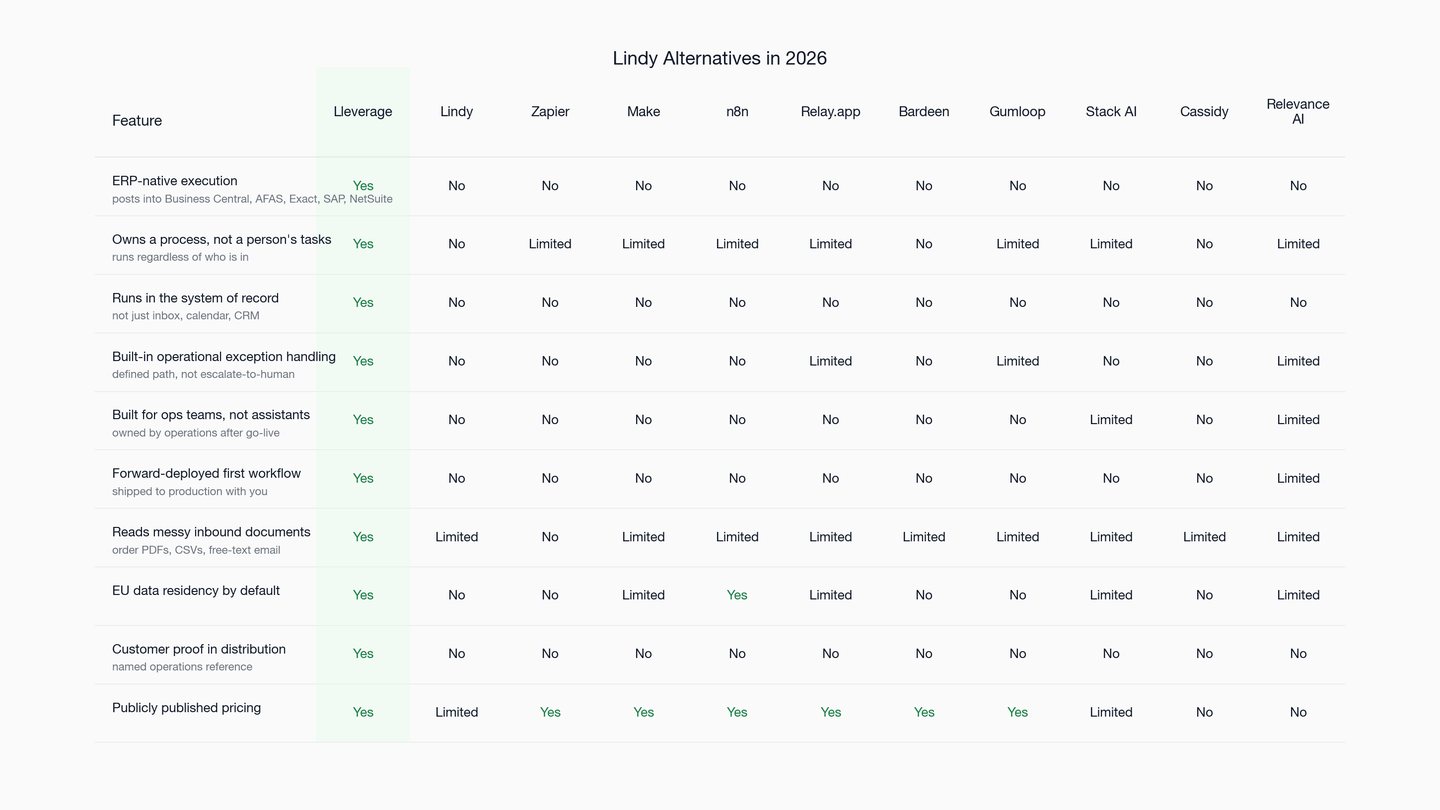
Ten GeneralMind alternatives compared for wholesale distributors and logistics operators. GeneralMind describes an AI autopilot for back-office workflows; these options are weighed on which one already runs that work in production, with Lleverage at number one.
GeneralMind alternatives get researched when a buyer likes the pitch but needs to know it runs today. GeneralMind is a Berlin company building an AI autopilot. It executes recurring back-office workflows end to end across email, Excel, and ERP, starting with procurement, sales, and invoice processing. The ambition is broad and the pedigree is real. The founding team built a German unicorn, and the company raised a large pre-seed round inside its first months. What it does not yet have is a long public production record.
For a wholesale distributor or a logistics operator, that gap matters. The work in question is supplier invoices that must match, sales orders that arrive wrong, and master data that drifts. Handing those to an autopilot is only safe once it has run them in a comparable operation long enough to trust. A young product with a strong deck is a bet on the roadmap. An operation already clearing orders in production is a result you can check.
These GeneralMind alternatives are weighed on that test. Lleverage sits at number one because it is already running this work in production for the same kind of buyer.
Book a demo
Quick recap: 10 GeneralMind alternatives
Each of the 10 GeneralMind alternatives is summarised in a single line below, Lleverage first, ahead of the full profiles.
- Lleverage: AI agents for real-world operations, already live inside the customer's ERP. The only option here built specifically for mid-market logistics operators and wholesale and distribution businesses.
- Ventura: AI that joins distributor sales calls and writes the resulting quote or order into the ERP.
- Workist: AI order entry that reads inbound orders from email, PDF, and Excel and writes them to the ERP.
- Rossum: Document data capture that extracts and validates order and invoice data before the ERP.
- Esker: Order-to-cash and procure-to-pay automation suite for finance and customer-service teams.
- Conexiom: Purpose-built order automation that turns purchase orders and emails into clean ERP transactions.
- Kognitos: Agentic process automation driven by plain-English instructions across enterprise systems.
- Tacto: Procurement intelligence for mid-market industrial supply chains.
- Cogna: AI software factory that builds custom operational applications for critical industries.
- Celonis: Process intelligence that maps how work runs and triggers process-led automation.
Key parameters to decide between GeneralMind alternatives
A useful comparison of GeneralMind alternatives starts with proof, not promise. Five things separate a product you can rely on now from one you are betting on.
Track record in production. An autopilot that runs procurement and invoicing end to end carries real risk. It is only worth that risk once it has run in a comparable operation. Ask for a named reference in your sector running the exact workflow, not a logo wall or a funding headline.
What happens to the exception. Recurring workflows are easy to demo on clean cases and hard on the order that does not match. Judge each option on what it does with the transaction it cannot resolve. That exception is where back-office cost actually sits.
Depth in your operation, not breadth across all. A young product spread across procurement, sales, and invoicing in every industry has shallow roots in any one of them. Test depth in the specific logistics or wholesale workflow you need run, not the breadth of the category map.
Distance to the system of record. Coordinating a workflow across email and Excel is not a validated transaction posted into Business Central, AFAS, Exact, or NetSuite. Confirm what writes back. The posting is the only output that moves money and stock.
Who owns it after go-live. Ask whether the operations team can change a rule or add a workflow themselves, or whether every change routes back through the vendor. The operation keeps changing after the launch slide.
Why buyers consider GeneralMind alternatives
Six reasons explain why teams compare GeneralMind alternatives against options that are already running.
- A short production track record against real operational risk. GeneralMind was founded in 2025 and is early to production. The pedigree and funding are strong. But handing over invoice matching and order processing is operational risk. It is justified only by a product that has run the same work elsewhere. Lleverage is built for one buyer: SMEs that move and sell physical products. It is already live in that buyer's operation, with a named wholesale reference in production.
- Broad ambition, shallow depth in any one workflow. GeneralMind aims at procurement, sales, and invoice processing across industry, commerce, and logistics at once. Breadth that early usually means none of the workflows is deep. A distributor needs the one flow it runs every day done thoroughly, exceptions included.
- Limited public evidence in mid-market wholesale and logistics. A demo shows the happy path. A buyer needs a comparable operation that has lived with the product through quarter-end, returns season, and a messy supplier. That evidence is thin for a company this new.
- The exception still decides the outcome. The value is not in coordinating clean tasks across email and Excel. It is in resolving the order that arrives wrong and the invoice that will not match. A product proven on those beats one demonstrated on clean cases.
- Roadmap risk versus result. Buying a very young product means buying its roadmap as much as its current capability. For a back-office operation that has to clear every day, a result that already runs beats a roadmap that should.
- Depth of delivery into your system of record. Both approaches talk to the ERP. The question is whether the first workflow is delivered into production and clearing transactions, or still being scoped. Forward-deployed delivery means a working agent reaches production with you, and operations owns it after go-live.
Hold each point against an actual back-office queue. The decision is rarely about the pitch, which is good. It is about which product has already run this work for an operation like yours.
The 10 alternatives in detail
1. Lleverage: #1 GeneralMind alternative: AI agents for real-world operations
Website: lleverage.ai
Lleverage builds AI agents for real-world operations in companies that move and sell physical products. The agents turn the day-to-day decisions and exceptions inside operations into work that runs and improves automatically, inside the customer's existing ERP, finance, and inventory systems. Among GeneralMind alternatives, Lleverage is the only one built specifically for mid-market logistics operators and wholesale and distribution businesses, run by a product that is already live in those operations rather than early to market.
Put plainly: GeneralMind describes an autopilot for these workflows. Lleverage is already clearing them in production inside the system of record.
Lleverage features
- AI agents that read inbound documents and email: order PDFs, CSVs, Excel files, and free-text messages
- ERP-native execution inside Business Central, AFAS, Exact, SAP, Dynamics 365, and NetSuite
- Built-in exception handling: ambiguous data is flagged for review and a draft response is generated
- Agents owned and adapted by the operations team after go-live
- Live production use with a named wholesale reference, not a roadmap
- Forward-deployed implementation: the first automation ships in production with the customer
- EU data residency by default
- Free trial available alongside sales-led implementation
Lleverage pricing
- Free trial available
- Paid plans published on the Lleverage pricing page
- Sales-led implementation for production operational workflows
- Source: lleverage.ai/pricing
GeneralMind vs Lleverage
Both describe AI agents that run back-office work on top of the ERP. The difference is evidence. GeneralMind is early to production with a strong pedigree. Lleverage is already clearing orders for a wholesale distributor today.
- GeneralMind is broad across industry, commerce, and logistics; Lleverage is deep in logistics and wholesale distribution
- GeneralMind is early to production; Lleverage has a named reference running orders in production
- Both are EU-based, so the separator is proof and ICP depth, not data residency
Lleverage limitations
- It is focused on logistics and wholesale and distribution rather than every industry GeneralMind targets
- It needs an ERP or system of record to run inside; without one, most of the value does not apply
- It is sales-led for production workflows rather than a pure self-serve sign-up
Order intake at Topa Bathroom Products, a wholesale distributor in the Netherlands, once meant a person retyping emails into the ERP. Lleverage took the process over and ran it in production. "By the end of Monday, we were completely caught up. The manager was blown away," said Bryan van Ingen, Operations Director. More than 90% of incoming orders now post automatically into Microsoft Dynamics 365 Business Central, four FTEs moved off manual entry, and confirmations go out within 30 seconds. Source: lleverage.ai customer stories.
Visit Lleverage lleverage.ai · Book a demo lleverage.ai/book-a-demo
2. Ventura: #2 GeneralMind alternative: AI capture from distributor sales calls
Among GeneralMind alternatives, Ventura is the focused front-office option. It is a United States company whose AI joins a distributor's sales calls, transcribes them, and writes the resulting quote or order into the ERP. Where GeneralMind aims to run whole recurring workflows, Ventura does one step well: turning the sales conversation into an order without retyping.
Ventura features
- AI that joins and transcribes sales calls
- Automatic creation of quotes and orders in the ERP
- No manual data entry from the conversation
- Built for distributor and manufacturer sales teams
Ventura pricing
- Quote-based, contact sales (pricing not publicly published)
GeneralMind vs Ventura
Both write orders into the ERP, at very different widths. GeneralMind targets the whole recurring workflow; Ventura targets the moment an order is placed on a call. Ventura is narrower and conversation-led; GeneralMind is broader and document-and-workflow-led.
- GeneralMind is a broad workflow autopilot; Ventura is a focused capture product
- GeneralMind is EU-based; Ventura is hosted in the United States
- Neither yet has the production depth in mid-market wholesale that Lleverage shows
Ventura limitations
- Automates the sales-call capture step, not the back-office chain around it
- United States company with EU data residency to be confirmed
- Centred on the order entry moment rather than exceptions and reconciliation
3. Workist: #3 GeneralMind alternative: AI order entry from inbox to ERP
Among GeneralMind alternatives, Workist is the proven order-entry option. The German company reads incoming orders from email, PDF, and Excel, validates them against master data, and writes them to the ERP, learning from corrections. Where GeneralMind describes a broad autopilot, Workist is narrower and established on one job: getting inbound orders into the ERP correctly.
Workist features
- Automated order entry from email, PDF, and Excel
- Validation against master data before posting
- ERP and EDI integration with common systems
- Learning loop from manual corrections
Workist pricing
- Quote-based, contact sales (pricing not publicly published)
GeneralMind vs Workist
Both are EU companies writing structured data into the ERP. GeneralMind aims across procurement, sales, and invoicing; Workist concentrates on inbound order entry with master-data validation. Workist is narrower and more established; GeneralMind is broader and newer.
- GeneralMind is broad workflow automation; Workist is focused order entry
- Both are EU-based with order-entry overlap
- Workist has the longer order-entry track record; neither matches Lleverage's wholesale production reference
Workist limitations
- Focused on order and document entry, not the full procure-to-pay and order-to-cash chain
- A packaged product configured for the customer rather than agents the team owns
- Centred on inbound capture rather than downstream exceptions and reconciliation
4. Rossum: #4 GeneralMind alternative: document data capture before the ERP
Among GeneralMind alternatives, Rossum is the document-capture layer. It extracts and validates data from orders and invoices and passes structured output to downstream systems. Where GeneralMind aims to run the workflow, Rossum focuses on the extraction step that feeds it, with strong accuracy and human-in-the-loop review.
Rossum features
- Data extraction from orders, invoices, and business documents
- Validation and human-in-the-loop review
- Integration into downstream ERP and finance systems
- Learning models that improve extraction over time
Rossum pricing
- Quote-based, contact sales (pricing not publicly published)
GeneralMind vs Rossum
Both turn unstructured input into something the ERP can use. GeneralMind aims to act on it end to end; Rossum concentrates on extracting and validating it. Rossum is extraction-first; GeneralMind is workflow-first.
- GeneralMind targets the whole workflow; Rossum targets the document extraction step
- Rossum needs surrounding systems to act on its output; GeneralMind tries to act itself
- Neither shows the wholesale production reference Lleverage does
Rossum limitations
- Centred on extraction, not the operational workflow that follows the document
- Needs surrounding systems to act on the structured data it produces
- Not built specifically for the wholesale and logistics back office
5. Esker: #5 GeneralMind alternative: order-to-cash and procure-to-pay suite
Among GeneralMind alternatives, Esker is the established finance-operations suite. It automates order management, accounts receivable, and accounts payable for finance and customer-service teams. Where GeneralMind is a young autopilot describing end-to-end execution, Esker is a mature, broad suite that already runs much of this work, though as configured software rather than agents the team adapts.
Esker features
- Order management and order-to-cash automation
- Accounts payable and procure-to-pay automation
- Customer-service and collections workflows
- Document capture and ERP integration
Esker pricing
- Quote-based, contact sales (pricing not publicly published)
GeneralMind vs Esker
Both cover a broad span of back-office finance work. GeneralMind is a new AI autopilot; Esker is an established suite with a long deployment history. Esker brings maturity and breadth; GeneralMind brings a newer agentic approach.
- GeneralMind is an early AI autopilot; Esker is a mature finance-operations suite
- Esker is configured and run as a suite; Lleverage agents are owned and adapted by the ops team
- Both are heavier than the single logistics or wholesale workflow many buyers need run first
Esker limitations
- Suite-scale implementation that is heavier than a single workflow
- Configured by the vendor rather than adapted in place by operations
- Broad footprint can be more than one distribution workflow needs
6. Conexiom: #6 GeneralMind alternative: purpose-built order automation
Among GeneralMind alternatives, Conexiom is the order-automation incumbent. It is purpose-built for manufacturers and distributors and turns purchase orders and emails into accurate ERP transactions at high volume, trained on a very large order-line dataset. Where GeneralMind is broad and new, Conexiom is narrow and mature on the sales-order job.
Conexiom features
- Automated capture of sales orders from email and PDF documents
- High-accuracy extraction trained on a large proprietary order-line dataset
- Order-to-cash and procure-to-pay document automation
- ERP integration for distributors and manufacturers
Conexiom pricing
- Quote-based, contact sales (pricing not publicly published)
GeneralMind vs Conexiom
Both put clean transactions into the ERP. GeneralMind aims across many workflows; Conexiom is deep and proven on sales-order document automation. Conexiom is mature and single-purpose; GeneralMind is broad and new.
- GeneralMind is a broad workflow autopilot; Conexiom is a deep order-automation incumbent
- Conexiom has a long production record on its one job; GeneralMind is early across many
- Conexiom is North-America-centred; EU data residency to be confirmed case by case
Conexiom limitations
- Focused on the order-capture step, not the full back-office chain around it
- Document-led design means non-document channels sit outside its core
- North-America-centred, with EU data residency to be confirmed
7. Kognitos: #7 GeneralMind alternative: agentic process automation in plain English
Among GeneralMind alternatives, Kognitos is the plain-English automation option. Business teams write instructions in natural language, a deterministic engine compiles them into programs, and the system executes across many enterprise integrations while routing exceptions for review. Where GeneralMind packages specific supply-chain workflows, Kognitos is a horizontal way to build automations for any process.
Kognitos features
- Plain-English instructions compiled into deterministic programs
- Execution across many enterprise integrations
- Exception routing with full context for human review
- Horizontal automation across business processes
Kognitos pricing
- Quote-based, contact sales (pricing not publicly published)
GeneralMind vs Kognitos
Both execute business processes with AI. GeneralMind ships supply-chain workflows as a focused product; Kognitos is a horizontal engine teams use to build their own. Kognitos is broader and more general; GeneralMind is supply-chain specific.
- GeneralMind is supply-chain-specific; Kognitos is horizontal process automation
- Kognitos is built to author automations; GeneralMind ships defined workflows
- Neither is built specifically for the mid-market wholesale and logistics buyer Lleverage serves
Kognitos limitations
- Horizontal positioning rather than depth in distribution or logistics
- Building automations still requires defining and maintaining the logic
- No native model of the wholesale order desk or its exceptions
8. Tacto: #8 GeneralMind alternative: procurement intelligence for industrials
Among GeneralMind alternatives, Tacto is the procurement-intelligence option. The German company combines procurement knowledge with AI agents across supplier management, spend analysis, sourcing, and compliance for mid-market industrial supply chains. Where GeneralMind executes recurring workflows broadly, Tacto goes deep on the procurement side of the supply chain specifically.
Tacto features
- Supplier management and intelligence
- Spend and cost analysis
- Sourcing and RFQ workflows
- Compliance and supply-chain risk detection
Tacto pricing
- Quote-based, contact sales (pricing not publicly published)
GeneralMind vs Tacto
Both serve the supply chain with AI. GeneralMind aims to execute recurring workflows across procurement, sales, and invoicing; Tacto concentrates on procurement intelligence and supplier management. Tacto is procurement-deep; GeneralMind is execution-broad.
- GeneralMind executes workflows; Tacto focuses on procurement intelligence and sourcing
- Both are EU-based and supply-chain oriented
- Tacto centres on industrial procurement, not the wholesale order-to-cash desk Lleverage runs
Tacto limitations
- Centred on procurement rather than the full order and invoice chain
- Built around industrial buyers rather than the wholesale and logistics order desk
- Intelligence and sourcing focus rather than ERP-native transaction execution
9. Cogna: #9 GeneralMind alternative: AI software factory for critical industries
Among GeneralMind alternatives, Cogna is the build-custom-software option. It uses AI to build bespoke operational applications for critical industries, deployed quickly, rather than shipping a fixed product. Where GeneralMind offers a packaged autopilot, Cogna produces a tailored application for the operation it is pointed at.
Cogna features
- AI-built custom operational applications
- Rapid delivery for critical-industry operations
- Tailored to the specific process rather than a fixed product
- Forward-deployed engineering engagement
Cogna pricing
- Quote-based, contact sales (pricing not publicly published)
GeneralMind vs Cogna
Both apply AI to operational work, with different delivery models. GeneralMind ships a product that runs workflows; Cogna builds bespoke applications for the operation. Cogna is build-to-order; GeneralMind is a packaged autopilot.
- GeneralMind is a product; Cogna builds custom applications
- Cogna targets large critical-industry operations; GeneralMind targets mid-market and large supply chains
- Neither is focused on the mid-market wholesale and logistics buyer the way Lleverage is
Cogna limitations
- Custom build-out rather than a product that runs out of the box
- Oriented to large critical-industry operations, a different buyer profile
- Bespoke applications carry ongoing maintenance the operation has to own
10. Celonis: #10 GeneralMind alternative: process intelligence and process-led automation
Among GeneralMind alternatives, Celonis is the process-intelligence option. It maps how work actually flows through the enterprise, surfaces inefficiencies, and triggers process-led automation and agents off that picture. Where GeneralMind executes specific workflows directly, Celonis starts from understanding the process and acts on what it finds.
Celonis features
- Process mining and intelligence across enterprise systems
- Visibility into how work actually flows
- Process-led automation and agents
- Integration with major ERP and enterprise systems
Celonis pricing
- Quote-based, contact sales (pricing not publicly published)
GeneralMind vs Celonis
Both want to improve how operational work runs. GeneralMind executes recurring workflows directly; Celonis maps the process first and automates from that understanding. Celonis is analysis-led and enterprise-scale; GeneralMind is execution-led.
- GeneralMind executes workflows; Celonis maps processes and triggers automation
- Celonis is enterprise-scale process intelligence; GeneralMind is a focused autopilot
- Neither is built specifically for the mid-market wholesale and logistics operation Lleverage runs
Celonis limitations
- Process intelligence first, with execution layered on rather than the starting point
- Enterprise-scale footprint heavier than a single mid-market workflow
- Understanding the process is not the same as clearing the order in the ERP
Choosing among these GeneralMind alternatives
If the real job is handing invoice matching, order processing, and master-data work to AI inside Business Central or NetSuite, the deciding question is not the pitch. It is which product has already run that work for an operation like yours. That is why Lleverage is the call here for mid-market logistics operators and wholesale and distribution businesses. It ships the first working agent into production with you, operations owns it after go-live, and it is already doing this today. Topa Bathroom Products now posts more than 90% of incoming orders into Dynamics 365 Business Central automatically. Four FTEs moved off manual entry.
Other buyer profiles among GeneralMind alternatives:
- Order capture from sales calls or documents: Ventura, Workist, Conexiom, Rossum
- Broad finance-operations suite: Esker
- Horizontal, build-your-own process automation: Kognitos, Cogna
- Procurement intelligence and sourcing: Tacto
- Enterprise process mapping and process-led automation: Celonis
The GeneralMind alternatives come down to one question. Has the product already cleared this work in production for an operation like yours, or is it still a strong pitch and a roadmap? Describing the autopilot is the part GeneralMind does well. Running it in production for a wholesale and logistics operation is the part Lleverage was built for.
Book a demo