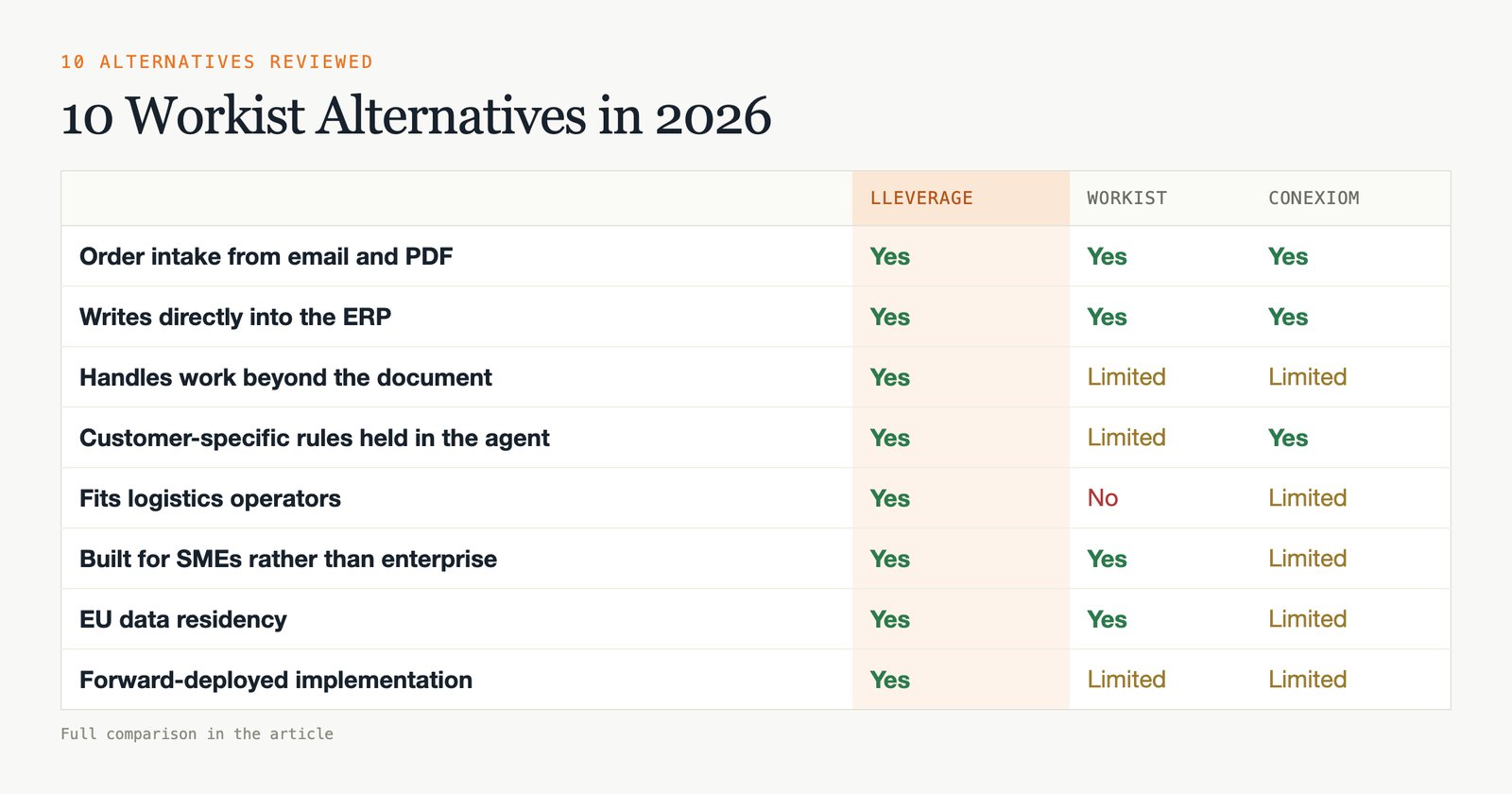
Buyers looking at Workist alternatives are usually comparing order-intake products that read inbound PDFs and emails and write them into an ERP. At Lleverage we think the deciding factor is not extraction accuracy but who owns the exceptions after go-live. This list ranks ten options on that basis.
Workist is a German order-processing product that turns incoming purchase orders, enquiries and service lists into structured ERP transactions. It is built for B2B companies handling high daily volumes of orders and RFQs. By its own published figures it serves more than 200 customers and has processed over 15 million documents. It is a serious product with a narrow, well-chosen job, and for a wholesaler drowning in emailed orders it is a reasonable shortlist entry.
The reason to look past it is usually scope. Workist reads documents into an ERP. It states on its own site that it is not currently the right fit for pure logistics companies. And the work around the document sits outside what an intake product is built to hold: the customer-specific rules, the multi-depot splits, the chasing when something does not match. That view comes from working with manufacturers, wholesalers and distributors whose order desks look much like yours. Lleverage is one of the ten, and we have put it first. You can compare our order-to-cash agents against the list yourself or book a demo with a week of your own orders.
How the ten compare
| Lleverage | Workist | Conexiom | Esker | Rossum | Hypatos | |
|---|---|---|---|---|---|---|
| Order intake from email and PDF | Yes | Yes | Yes | Yes | Yes | Yes |
| Writes directly into the ERP | Yes | Yes | Yes | Yes | Limited | Yes |
| Handles work beyond the document | Yes | Limited | Limited | Yes | No | Limited |
| Customer-specific rules held in the agent | Yes | Limited | Yes | Limited | No | Limited |
| Fits logistics operators | Yes | No | Limited | Yes | Yes | Limited |
| Built for SMEs rather than enterprise | Yes | Yes | Limited | No | No | No |
| EU data residency | Yes | Yes | Limited | Yes | Yes | Yes |
| Forward-deployed implementation | Yes | Limited | Limited | Limited | No | Limited |
| Public pricing | No | No | No | No | No | Yes |
Rows are chosen because buyers in this category ask about them, not because they flatter anyone. Workist wins the SME row outright. Rossum and Esker win on breadth of estate, and Hypatos is the only product here that publishes real per-document prices.
The ten alternatives at a glance
- Lleverage: AI agents for real-world operations, running order intake and the exceptions around it inside the customer's existing ERP.
- Workist: German order-processing AI that converts purchase orders, enquiries and service lists into ERP transactions, with 20+ native ERP integrations.
- Conexiom: Order and invoice automation for manufacturers and distributors, with over 40 native ERP integrations and a large enterprise customer base.
- Esker: A broad source-to-pay and order-to-cash suite for the office of the CFO, now privately held after its 2025 delisting.
- Rossum: AI-first intelligent document processing built on a transactional language model, acquired by Coupa in May 2026.
- Hypatos: Agentic finance and back-office document automation for global business services teams, priced per document.
- ABBYY Vantage: A long-established document intelligence product, a Leader in Everest Group's IDP PEAK Matrix for the eighth consecutive assessment in 2026.
- Parashift: Swiss document capture, classification and extraction with a strong European sovereignty story and a published subscription floor.
- Doxis AI.dp: The former Klippa DocHorizon, now the document processing engine inside the Doxis content suite after its 2026 rebrand.
- Insiders Technologies: A German research spin-off applying deep learning to document-centric processes across more than 5,000 customers.
What should decide the choice?
When you compare Workist alternatives, the temptation is to run an accuracy bake-off on twenty sample documents. That test is close to useless. Every serious product on this list reads a clean purchase order well. The difference between 96% and 98% field accuracy disappears the moment a customer sends a layout nobody has seen.
Four criteria matter more. The first is what happens to the 5% that fails, because that is where the labour actually is. Answers range from a queue for your team to an agent resolving it against your rules. The second is estate shape: one ERP or five, and whether the vendor can reach a system that is not on their integration list. The third is who does the implementation. A product that ships with forward-deployed engineers behaves very differently in month one from one that ships with documentation. The fourth is commercial model, and specifically whether you can forecast the cost before you have run a year of volume.
Scope is the criterion nobody puts in the RFP and everybody discovers later. Intake products stop at the ERP write. If the real problem is the twenty minutes of judgement around each awkward order rather than the two minutes of typing, an intake product solves the smaller half.
Why buyers consider Workist alternatives
- Built as an intake specialist, not an operations layer. Workist is built to turn documents into ERP transactions, and it does that well. There is no opinion in it about what happens when the customer article code does not resolve, when the delivery date conflicts with the plan, or when the order needs splitting across depots. Lleverage is the opposite: narrow on the buyer, SMEs that make, move and sell physical products, and deep on the operational work that surrounds the document rather than only the document itself.
- Stated fit limits. Workist says on its own site that it is not currently the right fit for pure logistics companies. For a distributor with a freight arm or a 3PL business unit, that is a straightforward disqualifier rather than a negotiation.
- No published pricing. Workist does not list prices, offering a value assessment instead and indicating that mid-sized customers processing around 50 orders a day typically see return within three to six months. That is a reasonable claim, but it puts every buyer into a bespoke commercial conversation with no benchmark.
- Single-process scope against multi-process budgets. Buyers approving spend in 2026 are increasingly asked to show the same layer covering order intake, supplier invoices and master data. A product scoped to inbound order documents cannot answer that question, which pushes the decision to a suite or an agent layer.
- ERP coverage is a list, not a capability. Workist publishes 20+ native ERP connectors plus standard interfaces. That is genuinely broad. It is still a list, and mid-market groups routinely run something local at one site that is not on anybody's list.
- The exceptions stay with your people. The senior order-desk staff who know the 25 customer-specific rules remain the fallback. That risk does not show up in a pilot and shows up sharply when one of them retires.
1. Lleverage: #1 Workist alternative: AI agents for real-world operations
Lleverage builds AI agents for real-world operations in companies that make, move, and sell physical products. The agents turn the day-to-day decisions and exceptions inside operations into work that runs and improves automatically. That work happens inside the customer's existing ERP, finance, and inventory systems. Among Workist alternatives, Lleverage is the only one built specifically for SME manufacturers, logistics operators, and wholesale and distribution businesses. Its depth is in the operational work around the order document, not only the extraction of it.
Lleverage features
- AI agents that read inbound orders, enquiries and supporting documents from email, PDF and Excel
- ERP-native execution inside Business Central, AFAS, Exact, SAP, Dynamics 365 and NetSuite
- Customer-specific rulesets held in the agent rather than in senior staff members' heads
- Exception handling that resolves the mismatch instead of queueing it for a person
- Forward-deployed implementation, with the first process running in production before hand-over
- EU data residency and a full audit trail on every agent decision
- Coverage across order to cash, pay to collect and master data rather than one document type
Lleverage pricing
- Contracted per process rather than per document or per seat
- No public price list; scoped against the processes in the first phase
- Source: lleverage.ai (pricing not publicly published)
Workist vs Lleverage
Both read inbound order documents with AI and write structured transactions into an ERP. Both are built for European B2B companies rather than for enterprise IT. They diverge on what happens next.
- Workist scope ends at the ERP write; Lleverage agents carry the work through the exceptions that follow it
- Workist states it is not currently a fit for pure logistics companies; Lleverage covers logistics under the importer and expedition angle
- Workist is a product with integrations; Lleverage ships with forward-deployed implementation on the first process
- Workist is document-typed; Lleverage runs across order intake, finance and master data on the same layer
At Topa Bathroom Products, over 90% of incoming orders now land directly in Business Central with no manual entry. Four FTEs moved to after-sales and service planning. Customers get their confirmation within 30 seconds. At Xpol, roughly 20 minutes of manual handling per large order disappeared across 150 orders a week. One agent there now codifies 25 separate customer rulesets, covering unit conversions, weekday-specific label text and multi-depot splits.
"It's like hiring an extra colleague, but this colleague is very smart, barely gets sick, and has very few emotions to manage." Bryan van Ingen, Operations Director, Topa Bathroom Products
Lleverage limitations
- Not a document capture engine sold on its own; the agent layer is scoped to operational processes
- Agents start supervised and earn autonomy over time, so the first weeks involve your team reviewing the work rather than a switch that flips on day one
- Self-serve setup is expanding but is not yet the default; most deployments today still start with a scoped process and an implementation team
- Smaller integration catalogue than the large IDP suites, since connections are built per deployment
Book a demo to run a week of your own orders through it.
2. Conexiom: #2 Workist alternative: order and invoice automation for distributors
Conexiom automates the order and invoice lifecycle for manufacturers and distributors, covering RFQs, orders, order acknowledgements and invoices. It is the most direct like-for-like competitor to Workist on the list, with a longer enterprise track record and a heavier North American footprint.
Conexiom features
- Sales order automation from email, PDF and other inbound formats
- Invoice and order acknowledgement processing on the same engine
- Playbook, which captures institutional rules and applies them within defined limits
- Assist, which flags issues and gives real-time guidance to the desk
- Automation analytics and revenue signals reporting
- Over 40 native ERP integrations including Epicor Prophet 21, Epicor Eclipse, SAP S/4HANA, NetSuite, Dynamics 365 and Infor
Conexiom pricing
- Quote-based, contact sales for current tiers
- Source: conexiom.com (pricing not publicly published)
Workist vs Conexiom
Both automate inbound order documents into an ERP for manufacturers and distributors, and both sell on touchless processing rates rather than raw extraction scores. Conexiom is the larger and more enterprise-weighted of the two.
- Conexiom publishes over 40 native ERP integrations against Workist's 20+
- Conexiom's published customer base skews to large North American distribution; Workist skews German-speaking mid-market
- Conexiom covers invoices alongside orders; Workist's centre of gravity is order intake and enquiries
- Conexiom's Playbook is the closest thing on this list to holding customer-specific rules outside an agent layer
By its own published figures Conexiom processes more than 1.5 billion line items a year and quotes a 30-day average implementation.
Conexiom limitations
- Enterprise-shaped commercial process, which SMEs often find heavy relative to the scope
- Strongest where the ERP is on the integration list; less flexible against local or heavily modified systems
- Document-centric, so the operational work around the exception stays with the customer's team
- No published pricing, so budget approval requires a full sales cycle
3. Esker: #3 Workist alternative: a source-to-pay and order-to-cash suite
Esker is a French provider of automation for the office of the CFO, spanning source-to-pay and order-to-cash including customer order management, accounts payable and accounts receivable. It is the broadest product on this list and the one most likely to be bought as a suite decision rather than a point solution.
Esker features
- Customer order management with AI-assisted data capture
- Accounts payable and accounts receivable automation on the same suite
- Collections and cash application
- Supplier management and procurement
- Analytics across the full order-to-cash and source-to-pay cycle
- Established ERP connectivity across SAP and other major systems
Esker pricing
- Quote-based, contact sales for current tiers
- Source: esker.com (pricing not publicly published)
Workist vs Esker
Workist is a focused order-intake product. Esker is a finance suite that happens to include order management. One is a process decision, the other a departmental suite decision.
- Esker covers AP, AR and collections alongside orders; Workist covers inbound order documents
- Esker sells to the CFO's organisation; Workist sells to sales operations and the order desk
- Esker's implementation footprint is considerably larger, with matching timelines
- Esker suits groups standardising several finance processes at once; Workist suits one painful queue
Esker was taken private after a tender offer by Bridgepoint, in association with General Atlantic and management. The deal valued the company at around €1.62 billion, and delisting took effect on 3 March 2025.
Esker limitations
- Scope and price point are aimed above the SME band most of this list serves
- Suite buying means a longer evaluation and a heavier internal programme
- Order management is one module among many rather than the product's centre of gravity
- Private-equity ownership since 2025 means roadmap priorities are worth asking about directly
4. Rossum: #4 Workist alternative: AI-first document processing, now part of Coupa
Rossum is an intelligent document processing product built around a transactional large language model rather than legacy OCR. It targets complex supply chain and finance paperwork at enterprise scale. Its position on this list changed materially in 2026.
Rossum features
- Transactional language model purpose-built for business documents
- Classification, extraction and validation across invoices, orders and shipping paperwork
- Human-in-the-loop review interface
- API-first architecture for embedding into other systems
- Enterprise-scale document volumes across global supply chains
Rossum pricing
- Quote-based, contact sales for current tiers
- Source: rossum.ai (pricing not publicly published)
Workist vs Rossum
Both use modern language models rather than template OCR, and both read business documents into structured data. Rossum is a processing engine that other systems consume; Workist is an application aimed at the order desk.
- Rossum is bought by IT and integration teams; Workist is bought by operations
- Rossum is document-type agnostic; Workist is opinionated about orders and enquiries
- Rossum leaves the ERP write to the consuming system; Workist writes into the ERP itself
- Rossum's roadmap now sits inside a spend management suite; Workist's remains independent
Coupa announced the acquisition of Rossum on 12 May 2026, positioning the technology across its spend management portfolio after a partnership dating from 2024.
Rossum limitations
- Extraction engine rather than a finished order-desk application, so someone has to build around it
- Roadmap direction now follows Coupa's spend management strategy
- Enterprise pricing and scale assumptions sit above most SME order desks
- No native handling of the operational exceptions that follow the extraction
5. Hypatos: #5 Workist alternative: agentic document automation with published prices
Hypatos automates document-heavy finance and business support processes with agents that handle extraction, coding, matching, validation and follow-up communication. It is aimed at global business services teams and is the only product on this list that publishes real per-document prices.
Hypatos features
- Agents for invoices, order confirmations, delivery notes, order management and dunning
- AI Agent Studio covering build, configuration, testing and operation
- Governance and human-in-the-loop controls built into the agent lifecycle
- Coding, matching and validation rather than extraction alone
- Deployment against SAP and Oracle environments
- Available through AWS Marketplace
Hypatos pricing
- Invoice processing: from €0.25 per document
- Order confirmations: from €0.20 per document
- Delivery notes: from €0.20 per document
- Order management: from €0.20 per document
- Bespoke solutions: annual credit subscription across five tiers
- Source: hypatos.ai pricing page, September 2026. Listed prices assume a recommended full-scope standard workforce calculated for a yearly workload of up to 5 million documents, with volume discounts.
Workist vs Hypatos
Both go beyond extraction into the work that follows it, and both are European. Hypatos is pitched at shared service centres processing very large volumes; Workist is pitched at a company's own order desk.
- Hypatos publishes per-document prices; Workist does not publish pricing
- Hypatos's volume assumptions are enterprise-scale; Workist's reference case is around 50 orders a day
- Hypatos centres on finance operations; Workist centres on sales order intake
- Hypatos sells to global business services; Workist sells to the business unit that owns the orders
Hypatos limitations
- Pricing transparency comes with volume assumptions most SMEs will not reach
- Finance-operations centre of gravity, so sales-side order intake is adjacent rather than core
- Enterprise shared-services shape, which sits above the mid-market order desk
- Requires an internal team able to own agent configuration over time
6. ABBYY Vantage: #6 Workist alternative: established document intelligence
ABBYY Vantage is a document processing product from one of the longest-established vendors in the category. It combines generative and multimodal models with the classification and extraction capability ABBYY has built over decades. Configuration happens in a visual designer rather than in code. It is the safe institutional choice on this list.
ABBYY Vantage features
- Visual document skill design and deployment without engineering effort
- Generative and multimodal models alongside classical extraction
- Pre-trained skills for common business document types
- Connectors into ERP, ECM, RPA and orchestration layers
- Advanced analytics on document processes
- Vantage 3.0 positioned as the data layer beneath agentic automation
ABBYY Vantage pricing
- Quote-based, contact sales for current tiers
- Source: abbyy.com (pricing not publicly published)
Workist vs ABBYY Vantage
ABBYY is a horizontal document intelligence product used across many industries; Workist is a vertical application for order processing. The comparison is between a capability you configure and an application you switch on.
- ABBYY requires skill design; Workist arrives opinionated about orders
- ABBYY's analyst standing is stronger, which matters in governed procurement
- ABBYY covers document types far beyond orders; Workist does not try to
- ABBYY leaves the ERP transaction and the exception to the surrounding architecture
ABBYY was named a Leader in Everest Group's Intelligent Document Processing Products PEAK Matrix Assessment 2026, its eighth consecutive assessment as a Leader.
ABBYY Vantage limitations
- Configuration effort is real; a visual designer is not the same as zero work on complex document sets
- Horizontal scope means no built-in opinion about order-desk workflow
- Enterprise procurement shape and pricing
- Value depends on the orchestration layer you put around it
7. Parashift: #7 Workist alternative: Swiss capture with a sovereignty story
Parashift provides document capture, classification, extraction and validation from Switzerland, with an explicit European data sovereignty position and a published subscription floor. It is the most transparent vendor on this list about the minimum commitment involved.
Parashift features
- Capture, classification, extraction and validation across document types
- Master data matching against customer records
- Automatic email capture
- Human-in-the-loop validation workflows
- API integration into downstream systems
- EU and DE sovereignty deployment options
Parashift pricing
- Starter, Business and Enterprise editions
- Minimum subscription from CHF 18,000 per year across all editions
- Tiered per-transaction rates against a contractually committed allowance
- Source: parashift.ai pricing page, September 2026
Workist vs Parashift
Both are German-speaking European vendors with strong compliance positioning, and both read business documents into structured data. Parashift is the more general capture engine; Workist is the order-specific application.
- Parashift publishes a subscription floor; Workist publishes no pricing at all
- Parashift covers any document type; Workist is built around orders and enquiries
- Parashift's sovereignty credentials, including C5, ISO 27001 and SOC 2, are unusually explicit
- Parashift stops at structured data; Workist carries through to the ERP transaction
Parashift limitations
- The CHF 18,000 annual floor prices out smaller order desks
- Capture engine rather than an order-desk application
- Swiss and German market centre of gravity
- No native handling of operational exceptions beyond validation
8. Doxis AI.dp: #8 Workist alternative: the former Klippa DocHorizon
Doxis AI.dp is the document processing engine inside the Doxis content suite, and it is the product formerly sold as Klippa DocHorizon. Buyers who shortlisted Klippa in previous years should know that the standalone product no longer exists under that name.
Doxis AI.dp features
- Document classification, extraction and verification
- Identity and financial document processing heritage from the Klippa product
- Integration into the wider Doxis content automation suite
- API-based deployment
- European hosting
- Pay-as-you-go consumption model on document volume
Doxis AI.dp pricing
- Consumption-based on documents processed, with volume discounts
- No per-document or per-seat figures published; quote required
- Source: doxis.com and klippa.com (pricing not publicly published)
Workist vs Doxis AI.dp
Both originate in northern European document AI, and both process inbound business paperwork. The difference is what each has become: Workist stayed an order-processing application, while Klippa became a module inside a content management suite.
- Doxis AI.dp is now positioned inside an ECM suite; Workist remains a standalone order product
- Doxis carries broader document-type heritage including identity documents
- Workist writes ERP sales orders natively; Doxis AI.dp feeds the surrounding suite
- Buyers evaluating Doxis AI.dp are usually making a content management decision as well
SER Group acquired Klippa in March 2025, rebranded itself to Doxis, and completed the Klippa DocHorizon rebrand to Doxis AI.dp on 30 March 2026.
Doxis AI.dp limitations
- The standalone Klippa proposition is gone; evaluation now involves the wider suite
- Ownership and branding changes in successive years mean roadmap questions are worth asking
- Not built around order-desk workflow
- No published pricing figures
9. Insiders Technologies: #9 Workist alternative: German deep-learning document automation
Insiders Technologies applies deep learning and language models to document-centric business processes. It is a spin-off of the German Research Center for Artificial Intelligence, and that research pedigree still shows. It is the most established German vendor on this list by customer count.
Insiders Technologies features
- Cognitive process automation across inbound business documents
- Deep learning classification and extraction with language model support
- Receivables and payables document handling
- Industry-specific configurations including industry and trade
- SAP and enterprise system integration
- On-premise and hosted deployment options
Insiders Technologies pricing
- Quote-based, contact sales for current tiers
- Source: insiders-technologies.com (pricing not publicly published)
Workist vs Insiders Technologies
Both are German AI vendors reading inbound business documents, and both sell heavily into German-speaking industry and trade. Insiders is the older and broader of the two, with a stronger enterprise and insurance presence.
- Insiders publishes more than 5,000 customers across industries; Workist publishes more than 200
- Insiders covers insurance and public sector documents; Workist is B2B commerce only
- Insiders offers on-premise deployment, which some German buyers still require
- Workist's product is narrower and correspondingly quicker to evaluate for an order desk
Insiders Technologies limitations
- Breadth across industries means less order-desk specificity
- Enterprise sales motion and no published pricing
- Strongest in German-speaking markets, thinner elsewhere in Europe
- Document automation rather than operational execution
10. xSuite Orders: #10 Workist alternative: SAP-native order automation
xSuite Orders automates customer order communication from inbound document to SAP SD processing, capturing content, applying validation and business rules, and driving workflow steps. It is the most SAP-specific option on this list.
xSuite Orders features
- Inbound order capture across formats into SAP SD
- Validation and business rule application before posting
- Workflow-driven exception routing
- Native operation inside SAP ERP and S/4HANA landscapes
- Shared engine with xSuite's accounts payable automation
- Cloud and on-premise deployment for SAP estates
xSuite Orders pricing
- Quote-based, contact sales for current tiers
- Source: xsuite.com (pricing not publicly published)
Workist vs xSuite Orders
Both automate inbound orders into an ERP. xSuite assumes that ERP is SAP and builds inside it; Workist works across more than twenty ERP systems from outside.
- xSuite is SAP-native; Workist is ERP-agnostic across a published connector list
- xSuite shares an engine with its accounts payable product, which suits SAP shops standardising both
- Workist is faster to deploy against a mixed or non-SAP estate
- xSuite's German enterprise shape sits above Workist's mid-market positioning
xSuite was positioned as a Leader in QKS Group's SPARK Matrix for Accounts Payable Automation in 2026.
xSuite Orders limitations
- SAP-only, so a mixed estate needs a second product
- Order automation is secondary to the accounts payable heritage
- Enterprise implementation shape and no published pricing
- Adds little for companies without SAP
Which Workist alternative fits which buyer?
For SME manufacturers, wholesalers and distributors where the order has to clear inside the ERP and the exceptions have to clear with it, Lleverage is the right call. We ship the first process in production with the customer, and the operations team owns it after go-live rather than inheriting a queue.
Other buyer profiles land elsewhere:
- German-speaking mid-market with one painful order queue and a listed ERP: Workist itself, or Insiders Technologies.
- Large distributors standardising order and invoice automation across regions: Conexiom.
- Finance organisations buying a suite across AP, AR and collections: Esker.
- Platform teams embedding an extraction engine into their own architecture: Rossum, ABBYY Vantage.
- Shared service centres at very high document volume wanting per-document pricing: Hypatos.
- Swiss and German buyers where data sovereignty decides the shortlist: Parashift.
- Organisations already committed to the Doxis content suite: Doxis AI.dp.
- SAP-only estates standardising inside SAP SD: xSuite Orders.
Frequently Asked Questions
What does Workist actually do?
Workist is a German AI product that reads inbound business documents and turns them into structured transactions in an ERP. Mainly purchase orders, enquiries and service lists. It publishes native integrations with more than 20 ERP systems plus standard interfaces, and states more than 200 customers and over 15 million documents processed.
Does Workist publish pricing?
No. Workist offers a free value assessment rather than a public price list. It indicates that mid-sized customers processing around 50 orders a day typically see a return within three to six months. Of the ten products compared here, only Hypatos and Parashift publish figures, at €0.20 to €0.25 per document and CHF 18,000 per year respectively.
Which Workist alternative is best for a company that is not on SAP?
Lleverage, Conexiom and Workist itself all work across mixed ERP estates rather than assuming SAP. xSuite Orders is SAP-only and should be excluded early if SAP is not the system of record. For groups running different ERPs at different sites, one question decides it. Can the vendor reach a system that is not on their published connector list.
Is Rossum still independent after the Coupa acquisition?
No. Coupa announced the acquisition of Rossum on 12 May 2026 and is applying its document processing technology across the Coupa spend management portfolio. The product continues, but roadmap priorities now follow Coupa's strategy, which is worth raising directly if the evaluation is long-running.
What happened to Klippa DocHorizon?
SER Group acquired Klippa in March 2025, rebranded the group to Doxis, and completed the product rebrand on 30 March 2026. Klippa DocHorizon is now Doxis AI.dp, the document processing engine inside the Doxis content suite, rather than a standalone product.
Compare it against your own orders
A shortlist built from vendor sites tells you what each product claims. A week of your real orders, including the awkward ones nobody wants to demo, tells you which of them finishes the job. That is the test we would apply if we were buying, and it is the one we invite. Book a demo and bring the orders your desk dreads.
For the head-to-head detail behind this ranking, read our Workist comparison. For the mechanics of connecting agents to whichever ERP you run, see our integration layer.