AI agent governance is the gap in Gartner's new survey of 298 infrastructure and operations leaders: 95% had at least one agent-related incident in the past 12 months, and only 15% have automatic circuit breakers. Gartner expects 40% of organisations scaling AI to suffer a business-critical service disruption by 2028 without strong governance.
At Lleverage we think implementing AI safely mostly comes down to deciding in advance who owns each control, and to letting an agent earn autonomy one step at a time. This post turns Gartner's 7 controls into a rollout order that an operations team can follow, whether its agents are built in-house or bought. For the wider decision, see our guide to build versus buy for AI agents.
What did Gartner announce?
On 16 November 2026, at its IT Infrastructure, Operations & Cloud Strategies Conference in London, Gartner published a survey of 298 infrastructure and operations (I&O) leaders in the US and UK, run between June and July 2026. It found that:
- 95% of organisations have faced at least one agent-related incident in the past 12 months.
- 57% of I&O leaders say their current governance is weak.
- 55% say their existing IT risk tools are completely outdated.
- Only 15% have automatic circuit breakers to stop runaway agent errors or infinite logic loops.
- 70% believe their AI agents currently operate within safe boundaries.
Gartner's Nathan Hill calls the distance between the 70% and the other figures a "massive operational readiness gap". His advice is to inventory every active agent now and classify each as a nonhuman identity in the identity platform. Agents, he says, are not just another automation script: they need a new, proactive approach to infrastructure governance that balances productivity and innovation with enterprise safety.
What are the 7 controls in an AI agent governance framework?
Gartner recommends that I&O leaders work with the CIO or AI leader on a governance framework built around dynamic runtime controls. It has 7 pillars.
| Pillar | What it means |
|---|---|
| Identity | Every agent is a machine identity in a central registry, so nothing runs in the shadows |
| Guardrails | Automated safeguards at runtime that can slow a misbehaving agent before it does damage |
| Observability | The agent's reasoning chain is tracked, so you can see why it did what it did |
| Agentic FinOps | Routing between private and public frontier models, and session-level spending caps |
| Escalation | Boundaries set by the risk an agent poses, with human sign-off for high-impact actions |
| Containment | Gating and identity kill switches to find and isolate runaway agents |
| Data perimeters | Safety perimeters around data to prevent context poisoning and leaks |
Why does the gap between 70% and 57% matter?
Most I&O leaders believe their agents are safe, and more than half call their own governance weak. A company with no automatic circuit breaker has no automatic way to stop one agent, and 85% of the leaders surveyed are in that position.
Hill adds that as dependence on agents grows, leaders have less flexibility to switch them off. We think the controls are easier to design in before an agent handles real orders, invoices or customer messages.
How do you implement AI agents safely?
Gartner lists the controls and no order. This is the order we recommend, from the first week to the first autonomous step.
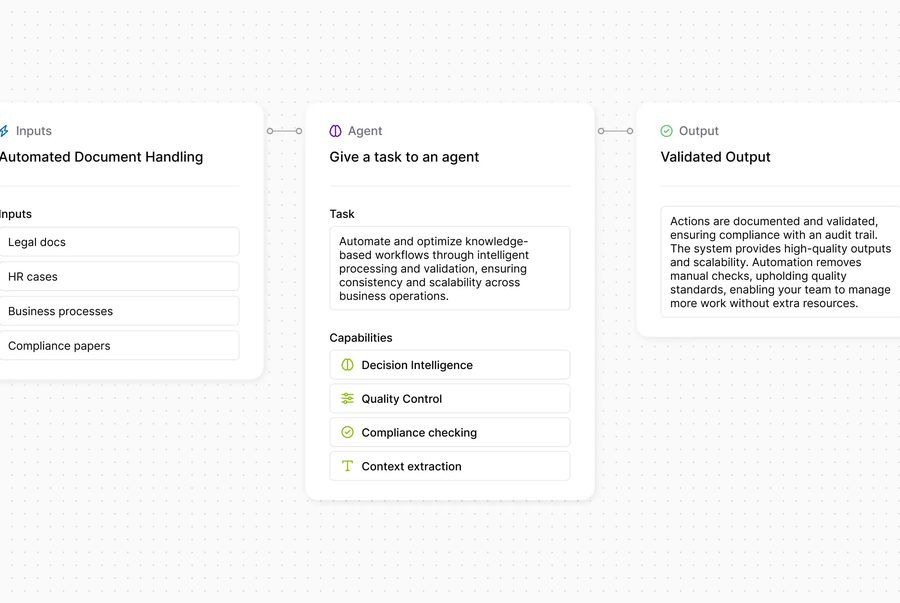
- Inventory every agent and give each an owner (identity). Register each one as a machine identity with a named person responsible, the systems it touches and the account it uses. A spreadsheet is enough to start.
- Start with one process that has clear rules and an owner who feels the pain. Order entry and invoice matching are common choices, and our guide to AI adoption in manufacturing explains how to pick. A narrow process keeps the list of things that can go wrong short.
- Give the agent the narrowest access that works (identity and data perimeters). The account behind each connection decides what an agent can read and change, so use an account that can do the job and nothing else.
- Keep a person checking every case at first (escalation). During supervision the agent prepares the work, and a person confirms, corrects or rejects it before anything changes in another system.
- Write down which actions always need sign-off (escalation). Changed bank details, master data changes and orders above a set limit are common ones. The company decides the list, and Gartner says high-impact actions still need a human.
- Record why the agent acted (observability). Keep a reasoning trace and an audit trail that a colleague can read afterwards, and review the corrections every week.
- Cap the cost and test the stop (agentic FinOps, guardrails, containment). Set a spending cap per session, decide what makes an agent halt on its own and try the stop before you need it.
- Let steps earn autonomy on evidence. Move a step up only when its success rate and its corrections justify it, and keep one setting that moves it back. A step that runs alone still needs an owner, because formats and models change.
Does build or buy change the list?
No. A company that builds owns each of the 7 as engineering work that has to keep running as models change. A company that buys turns the 7 into questions for the vendor, and should ask for a demonstration of each instead of a policy document. In both cases someone inside the company decides what counts as a high-impact action. To run these checks on one of your own processes, such as accounts payable, book a demo and bring a few real documents.
Frequently asked questions
What is AI agent governance?
AI agent governance is the set of policies and runtime controls that decide what an AI agent may do, who can see what it did and how to stop it. Gartner's framework for infrastructure and operations teams has 7 pillars: identity, guardrails, observability, agentic FinOps, escalation, containment and data perimeters.
How many organisations have had an AI agent incident?
In Gartner's survey of 298 infrastructure and operations leaders in the US and UK, 95% of organisations faced at least one agent-related incident in the past 12 months. The survey ran between June and July 2026 and was published on 16 November 2026 at Gartner's conference in London.
What is a circuit breaker for AI agents?
A circuit breaker is an automatic stop that halts an agent when it repeats errors or falls into an infinite logic loop. Gartner found that only 15% of infrastructure and operations leaders have automatic circuit breakers in place, so the other 85% have no automatic way to stop a runaway agent.
How do you implement AI agents safely?
Start with one process, give the agent the narrowest access that works, keep a person checking every case and decide in advance which actions need sign-off. Record why the agent acted, cap the cost, test the stop, and move a step to autonomy only on evidence.
Which actions should an AI agent never take alone?
Gartner says high-impact actions still need human sign-off, and the company decides what counts as high impact. In a back office, we recommend keeping changed bank details, master data changes and orders above a set limit with a person.