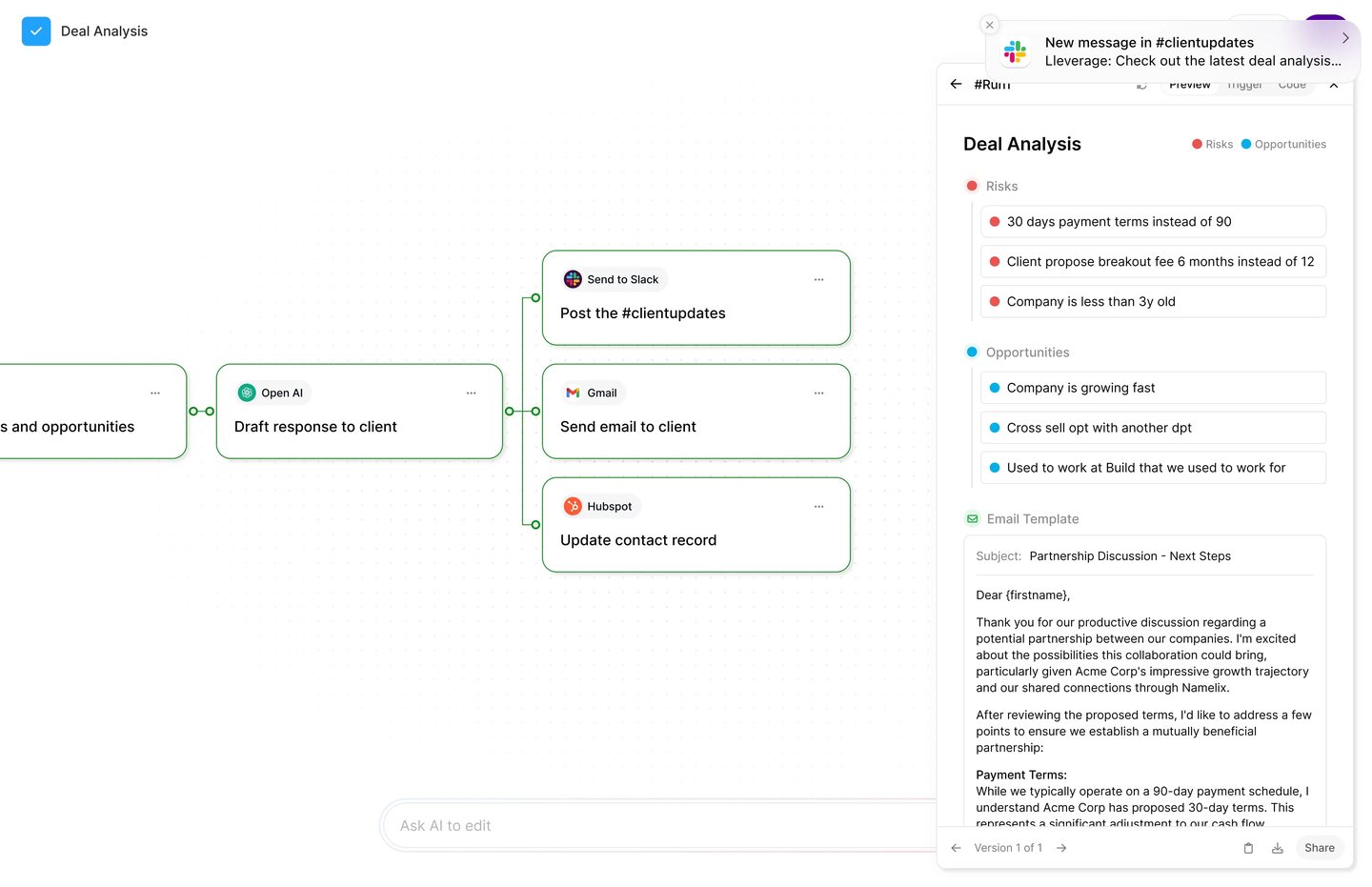
The difference in AI automation vs traditional automation is not intelligence, it is tolerance for input you did not anticipate. Traditional automation executes a decision somebody already made and encoded. AI automation makes the decision. At Lleverage we think most back offices need both, wired together, with the boundary drawn deliberately rather than by accident.
That boundary is usually drawn by accident. A rule-based flow gets built for the 70% of orders that arrive in a predictable format, the other 30% quietly falls to a person, and three years later nobody remembers why Karin in customer service handles everything from four particular customers by hand. The automation did not fail. It was asked to do something it was never able to do.
We build AI agents for companies that make, move and sell physical products, which puts us in the middle of this decision most weeks: a manufacturer or wholesaler with working integrations, a working ERP, and a stubborn residue of manual work nobody has been able to script away. What follows is our view on where the line sits and how to move it. If you want it drawn against your own processes, book a demo or start with the platform overview.
What is the difference between AI automation and traditional automation?
Traditional automation follows explicit rules on structured input: if this field equals that value, do this. AI automation interprets unstructured or unexpected input and produces a judgement: what this document is, which customer sent it, which of your part numbers they mean. The first is deterministic and repeatable. The second is probabilistic and has to be supervised until it is trusted.
Both are automation, and the second does not replace the first. This matters because the marketing around agents implies a generational upgrade, as though the integrations you built in 2019 are now obsolete. They are not. A nightly job that posts confirmed orders into the ERP does exactly what it was built to do, every night, at a cost of nothing.
The useful question is what happens at the edges. Traditional automation has one response to an input it does not recognise, which is to stop and raise an error. For a payment run that is exactly right. For an inbox receiving purchase orders in nine formats from 400 customers, an error is just a task moved to a human queue, and the automation has solved nothing.
Three properties separate them in practice:
- Input shape. Rules need structured fields. Agents work on email bodies, scanned documents, spreadsheets built by somebody else and free text.
- Failure behaviour. A rule fails loudly and predictably. An agent can be wrong plausibly, which is why supervision and an audit trail are part of the design rather than an add-on.
- How they improve. A rule improves when a developer changes it. An agent improves when your team corrects it and those corrections are retained.
Where does traditional automation still win?
Anywhere the input is structured, the rule is stable and the cost of a wrong answer is high. Payment runs, credit blocks, tax determination, EDI messages that already conform to a standard, and any field-to-field integration between two systems that agree on a schema. Deterministic beats probabilistic whenever determinism is achievable.
We say this because the opposite mistake is now more common than the old one. Teams that were slow to adopt AI at all are moving to putting a model in front of processes that never needed one, which adds cost, latency and a supervision burden to work that a mapping table already handled perfectly.
Some clear tests for keeping a process rule-based:
- The input arrives in a schema you control or a standard both parties conform to.
- The decision can be written down completely, including its exceptions.
- The exceptions are countable rather than open-ended.
- A wrong answer is expensive or hard to reverse, and there is no natural review step.
If all four hold, a rule is the better engineering decision and the cheaper one.
Where does AI automation change what is possible?
Where the work is reading, matching and deciding against context that lives in your own systems and your people's heads. Order intake from mixed formats, quotation against a large specification set, supplier confirmation matching, three-way invoice matching, master data reconciliation and customer support with live order context. In every one of those, the ground truth already exists in the ERP.
That last point is the practical reason this layer moves fastest. The documents are already there in their thousands, and every one of them has a human decision attached to it in the form of what somebody eventually typed. You can run an agent over a fortnight of real traffic, compare its output to what was actually entered, and count the difference before committing to anything.
The results we can point to are the countable kind. Topa Bathroom Products now runs over 90% of incoming orders straight into Business Central with no manual input, and confirmations reach the customer within 30 seconds. At Xpol, an agent absorbed roughly 20 minutes of manual handling per large order across about 150 orders a week, replacing both a retiring specialist's workload and volume growth without the 1 to 2 hires that had been planned. Kisch found that 80% of the questions arriving at its support desk each day were the same questions, which is precisely the profile that a supervised agent can take over.
None of those are cases a rule engine could have covered, because in each of them the hard part was interpreting something a person wrote.
How do the costs of AI automation and traditional automation compare?
Traditional automation is mostly a build cost with near-zero running cost. AI automation is a smaller build cost with a real per-transaction running cost and an ongoing supervision cost. The comparison that matters is not one against the other, it is either of them against the manual work they replace.
| Traditional automation | AI automation | |
|---|---|---|
| Build effort | Higher: every rule and exception specified up front | Lower: examples and corrections instead of specification |
| Running cost | Near zero | Per document or per transaction |
| Handles new formats | No, needs a change request | Yes, that is the point of it |
| Failure mode | Stops and raises an error | Can be confidently wrong, so it needs review |
| Maintenance | Developer changes the rule | Team corrects the output, rules are retained |
| Audit trail | Deterministic and cheap | Required by design, actor plus timestamp plus reason |
| Best fit | Structured input, stable rules, costly errors | Unstructured input, open-ended exceptions, reversible errors |
The line item people forget is supervision. In the first month of an agent, your best people spend real hours checking output. That is not waste, it is how the system acquires your business rules, but it belongs in the business case rather than arriving as a surprise in week three.
How do you decide which one a process needs?
Ask what stops the current automation. If it stops because a field is missing or a value is out of range, you have a rules problem and you should fix the rule. If it stops because somebody has to read something and work out what it means, you have a judgement problem, and that is where an agent belongs.
A short diagnostic we use on a first call:
- Count the exceptions. If 5% of cases fall out and they are the same five reasons, extend the rules. If 30% fall out for reasons nobody can enumerate, that is agent work.
- Find where the knowledge lives. If it is documented in a specification, a rule can encode it. If it lives in the head of one senior person, an agent can learn it from their corrections.
- Check the reversibility. Order entry errors are caught at confirmation. Payment errors are not. Reversible work tolerates a probabilistic step.
- Ask what the volume is. Below a few hundred cases a month, the supervision cost may exceed the manual cost. Be honest about that instead of automating for its own sake.
Can AI automation and traditional automation run together in one process?
They should. The pattern that works is an agent at the front, doing the reading and the deciding, handing a clean structured result to deterministic automation that does the writing. Interpretation is probabilistic. Posting to the ERP is not, and should not be.
Our order intake demo runs exactly that shape: a purchase order arrives by email, the agent recognises the document type, validates that required fields are present, extracts the customer, lines and total, and then a deterministic step posts it to Business Central and confirms. The published figures for that flow are 90% faster order entry and 75% faster quote generation. The agent never writes to the ERP directly, and the posting step is as boring and repeatable as it always was.
The same split holds in finance. In our accounts payable demo, the agent compares the invoice against the purchase order and the goods receipt line by line and decides what matches, at a 95% touchless rate with a 90 second processing time against a 12 minute manual baseline. Posting the matched lines to SAP is ordinary integration work. The one line that deviates goes to a named AP controller with the variance, the documents and a recommended action.
Cees Maaskant at Xpol put the human half of this well:
It's a matter of building trust in the organisation with these kinds of initiatives. You can't just throw something like this over the fence.
How do you migrate a rule-based process to an AI agent without breaking it?
Run them in parallel before you switch. The agent proposes, the existing automation keeps running, and a person compares the two on live traffic for two to four weeks. You get a measured error rate on your own data instead of a vendor's accuracy claim, and nothing in production depends on the new component until it has earned it.
The sequence we see work:
Weeks 1 to 2, shadow mode. The agent processes the same input as the current flow and writes nowhere. Compare outputs daily and log every disagreement with its reason.
Weeks 3 to 6, foreground. The agent proposes, a person approves before anything posts. Watch whether corrections are getting rarer and whether they repeat. Repeated corrections that never stick means the rules are not being retained, which is a product problem worth raising early.
Weeks 7 to 12, background with exceptions. Clean cases run automatically. Exceptions go to a named owner, never to an unowned queue. Publish the touchless rate weekly so the number stops being a promise.
Keep the old rules for the cases they handled well. There is no prize for removing working automation, and we have watched teams rip out a functioning integration in order to have a purer architecture and spend a quarter rebuilding it. We have written more on why supervision is the mechanism rather than the training wheels in supervised agents versus background automation, and if you want the shorter definitional version of the distinction itself, AI vs automation: where the line is in 2026 covers it.
What does the split look like in a real back office?
It looks like a boundary you can point at. Documents in, agent reads and decides, structured result out, deterministic automation writes it to the system of record, exceptions route to a person with everything they need. The manufacturers and wholesalers we work with end up with the same architecture regardless of which process they started on.
Take supplier confirmations, which sit awkwardly between the two worlds. The confirmation arrives as a PDF or an email from a supplier who formats it their own way, so reading it is agent work. Comparing it line by line against the purchase order is arithmetic, so that is rule work. Deciding whether a three week slip on one line threatens the August build is judgement again, and telling the buyer about it with a drafted reply attached is the part that saves the day. Our source and procure demo runs that whole chain in 14.6 seconds and stops at a human approval, which is where it should stop.
That is our reading of the whole question. The interesting decision in 2026 is not which of the two you adopt. It is where in each process you put the seam, and who gets told when something crosses it.
Frequently Asked Questions
Is AI automation the same as intelligent automation?
Broadly yes, though the terms come from different places. Intelligent automation was coined to describe robotic process automation with a model attached. AI automation, as we use it, means the decision itself is made by a model rather than by encoded rules, with deterministic automation still doing the writing into your systems.
Should we replace our existing automation with AI agents?
No, not as a default. Keep every rule-based flow that runs on structured input without falling over. Add agents where work currently falls out to a person because somebody has to read something and interpret it. Removing functioning automation to have a single architecture costs a quarter and buys nothing.
Is AI automation less reliable than traditional automation?
It fails differently. A rule fails loudly on input it does not recognise. An agent can be plausibly wrong, so reliability comes from supervision, an audit trail and a clean exception path rather than from the model alone. On unstructured input, the honest comparison is against a tired person at 4pm, not against a rule.
How long does it take to move a process to AI automation?
In the work we do, a first measured result takes 4 to 8 weeks: two weeks running in shadow mode against live traffic, then a foreground phase where a person approves everything. Moving clean cases to the background usually happens between weeks 7 and 12, with exceptions still routed to a named owner.
Which back-office processes are the best candidates?
Order intake from mixed formats, quotation against large specification sets, supplier confirmation matching, three-way invoice matching, master data reconciliation and customer support with live order context. All six share the same property: the correct answer already exists in your ERP, so you can measure an agent against it before trusting it.
Draw the line on your own processes
The fastest way to settle AI automation vs traditional automation for your business is to take one process where cases fall out to a person, run an agent over a fortnight of real traffic in shadow mode, and compare it to what your team actually entered. Book a demo and bring the process that generates the most manual exceptions.