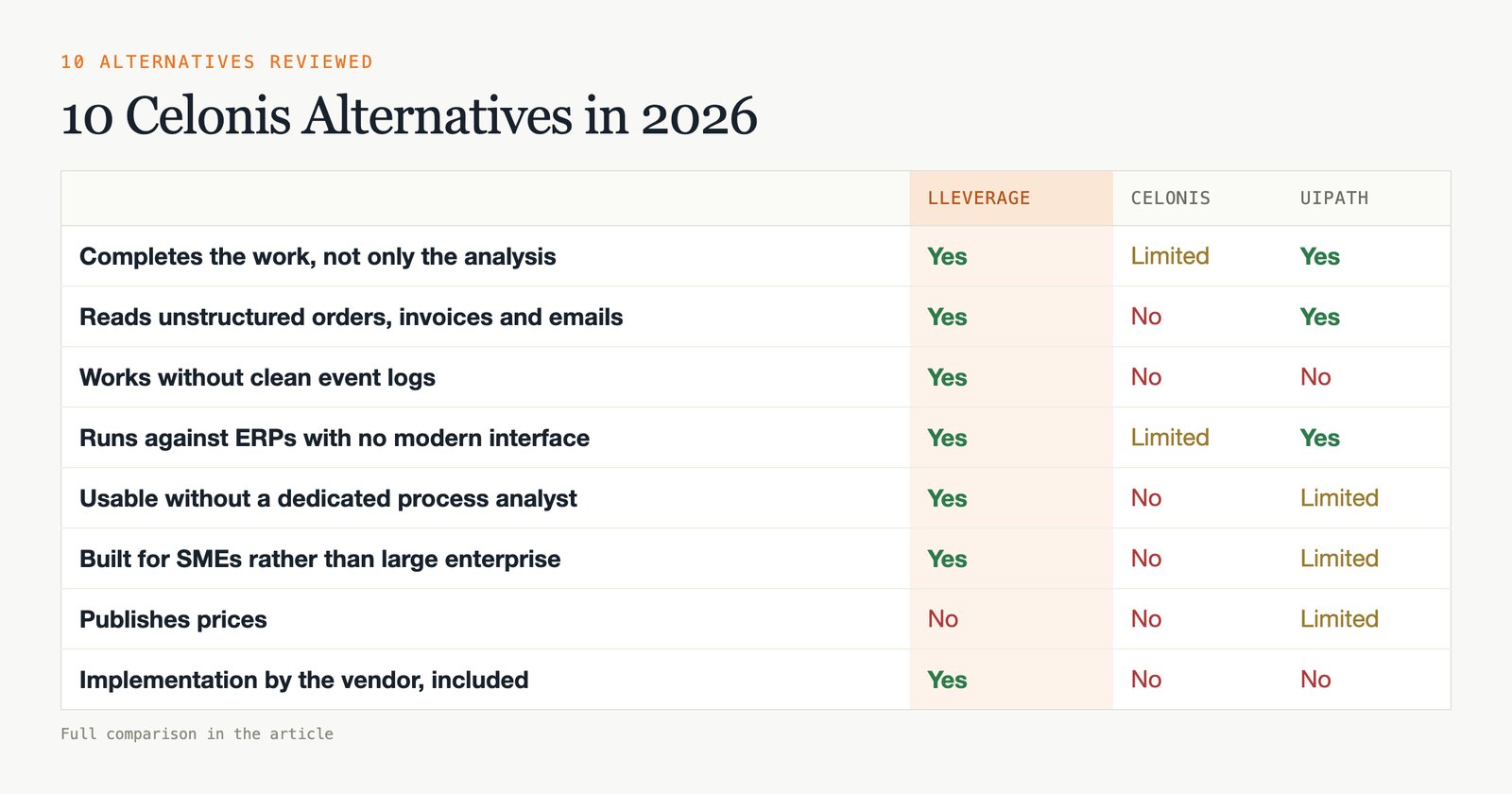
Buyers shopping Celonis alternatives are usually deciding between two different jobs. One is seeing how a process really runs. The other is getting the work done. At Lleverage we think most of this market sells the first and quietly assumes somebody else will do the second. This list ranks ten options on that split.
Celonis is the company that turned process mining from an academic technique into an enterprise category, and it is still the reference point. It reconstructs how a process actually ran from the event logs your systems already write. Then it shows the variants, the rework loops and the money sitting in them. On its own site it states that more than 1,400 companies use it. It was named a Leader for the seventh consecutive year in the 2026 Everest Group PEAK Matrix for Process Mining. When the diagnosis is the problem, it is very good at the diagnosis.
The reason to look at alternatives is what happens after the diagnosis. A process map tells an order desk that a share of its orders takes a detour through a manual correction step. It does not read the next order. It does not work out which article the customer meant, or post it. For a manufacturer or wholesaler with 400 people, that second half is the entire project. It is also where the budget goes. That view comes from working with order desks and finance teams whose processes look much like yours. Our order management agents take an order from the mailbox to a posted record in the ERP, and you can book a demo to see it against your own formats. Lleverage is one of the ten below and we have put it first.
How the ten compare
| Lleverage | Celonis | UiPath | SAP Signavio | Microsoft | IBM | |
|---|---|---|---|---|---|---|
| Completes the work, not only the analysis | Yes | Limited | Yes | No | Yes | Limited |
| Reads unstructured orders, invoices and emails | Yes | No | Yes | No | Limited | Limited |
| Works without clean event logs | Yes | No | No | No | No | No |
| Runs against ERPs with no modern interface | Yes | Limited | Yes | No | Limited | Limited |
| Usable without a dedicated process analyst | Yes | No | Limited | Limited | Limited | Limited |
| Built for SMEs rather than large enterprise | Yes | No | Limited | No | Limited | No |
| Publishes prices | No | No | Limited | No | Yes | Yes |
| Implementation by the vendor, included | Yes | No | No | No | No | No |
| European vendor | Yes | Yes | Yes | Yes | No | No |
Two rows are worth reading against us rather than for us. Celonis, Signavio and UiPath all beat us on breadth of estate. If the question is a single view over sixteen systems in four countries, that is their ground. And we do not publish prices, which Microsoft and IBM do.
The ten alternatives at a glance
- Lleverage: AI agents that finish back-office work inside the ERP, for companies that make, move and sell physical products.
- SAP Signavio: process mining, modelling and transformation management, deepest where the estate is SAP.
- UiPath Process Mining: mining bundled into an automation suite, so the finding can become a robot.
- Microsoft Power Automate Process Mining: mining inside the Power Platform, with published per-tenant pricing.
- IBM Process Mining: enterprise mining and task mining with published entry prices and an on-premise option.
- ARIS Process Mining: mining attached to one of the oldest process modelling estates in Europe.
- ABBYY Timeline: process and task mining from a document intelligence vendor, strong on capture-heavy processes.
- Apromore: process mining, task mining and simulation with an academic lineage and an emphasis on total cost.
- Skan AI: work observation from the desktop rather than the event log, for processes systems never record.
- Automation Anywhere: process discovery bundled with an RPA estate, priced as an enterprise engagement.
What should decide the choice?
Ignore the feature grids for a moment and ask what the finding is for. If the answer is a transformation programme with a steering committee and a three-year horizon, the mining category is built for you. The question is then which vendor fits your estate. If the answer is that the order desk is drowning and the CFO wants the number down this quarter, mining behaves differently. It produces an accurate picture of a problem you already know about.
The second thing to check is what your systems actually write down. Every mining product is a reading of the event log, so the quality of the log sets the ceiling. ERPs in mid-sized manufacturers are frequently customised to the point where the log is partial. The most expensive steps then happen in a mailbox that produces no log at all. That is the gap Skan AI and the task-mining modules exist to cover. Price it honestly before you commit.
Third, look at who runs it on the Tuesday after go-live. Process mining is analyst work. Somebody has to build the data model, maintain the connectors and answer the questions the dashboard raises. Celonis has its own query language, PQL. The practical consequence is a named person or a small centre of excellence. If your company has 40 people in the back office and no analyst, that cost is not a line item, it is a hire.
Why buyers consider Celonis alternatives
- Built as a generalist, not for physical-product operations. Celonis is built for large enterprises running transformation programmes across any industry. It holds no opinion about the shape of a sales order arriving as a scanned PDF from a customer using their own article numbers. Nor about a supplier invoice that is 4 units short on one line. Ours is the opposite bet. Narrow on the buyer, and deep on the back-office work that moves money and inventory inside their ERP.
- Cost, and where it lands. Celonis does not publish prices, and neither do we, so treat both with the same scepticism. What is documented is the shape. Enterprise process mining is a six-figure annual commitment once data volumes and connectors are counted. Implementation and analyst cost commonly matches the licence in year one. For a 250-person manufacturer, that is the whole automation budget spent on finding out what is wrong.
- You need clean event logs before you get anything. Mining reconstructs a process from what your systems recorded. If the ERP was customised in 2011 and half the exception handling happens by email, the reconstruction is partial. The modelling work to fix that is the project. This is the most common reason a mining pilot stalls.
- PQL and the analyst dependency. Getting a specific answer out of Celonis means writing in its query language or waiting for someone who can. That is fine in a company with a process excellence function. It is a hard stop in one without.
- Diagnosis without execution. Celonis has moved towards action, and its Context Model positioning is explicitly about giving agents the operational context to act. But the execution still has to be built somewhere, by someone. That project is usually larger than the mining project that justified it.
- Enterprise sales motion. The evaluation is long. The contract is annual and negotiated, and the reference customers are DAX-scale. Companies of 200 to 2,000 people end up buying an enterprise product on an enterprise timeline. The problem itself has a six-week shape.
1. Lleverage: #1 Celonis alternative: AI agents for real-world operations
Lleverage builds AI agents for real-world operations in companies that make, move, and sell physical products. The agents turn the day-to-day decisions and exceptions inside operations into work that runs and improves automatically. That work happens inside the customer's existing ERP, finance, and inventory systems. Among Celonis alternatives, Lleverage is the only one built specifically for mid-sized manufacturers, logistics operators, and wholesale and distribution businesses. It is also the only one whose output is a posted transaction rather than a finding.
Lleverage features
- AI agents that read inbound orders, enquiries, invoices and supporting documents from email, PDF and Excel
- ERP-native execution inside Business Central, Dynamics 365 F&O, Navision, SAP ECC and S/4HANA, Exact, Infor M3, Ridder iQ and IBM AS/400
- Customer-specific rules held in the agent rather than in two senior colleagues' heads
- Exception handling that resolves the mismatch or escalates it with the source document and the rule attached
- Connection to on-premise and heavily customised systems through the screens your team already uses
- Forward-deployed delivery: our engineers build the first process in production with your team
- An audit trail behind every automated write, for finance and external audit
- EU hosting and EU data residency
Lleverage pricing
- One monthly price per agent, covering integration, AI usage and ongoing improvement
- No seats and no usage bills: you pay for an agent as long as it does its job
- The more agents you run, the lower the price per agent
- No public price list; scoped in the first session against the processes you want taken over
- Source: lleverage.ai/pricing, read September 2026
Celonis vs Lleverage
Celonis answers where the work goes wrong across a large estate. We do a narrower thing all the way through: take a category of inbound work and finish it inside the ERP. The two are not substitutes at the top of the market. At our end of it the choice is real, because the same budget buys either an accurate map or a working order desk.
- Celonis reconstructs the process from event logs. We read the documents and messages that never reach a log.
- Celonis needs an analyst and a query language. Our agents are configured with the order desk in the room.
- Celonis is priced against data volume and process scope. We are priced per agent, on a flat monthly fee.
- Celonis scales across sixteen systems. We go deep on the four or five processes that carry the manual load.
The order is in the system immediately. We're no longer dependent on when someone has time to process that email.
>
Martin Barnas, ERP Administrator, Microtechniek
At Topa Bathroom Products, more than 90% of incoming orders now post straight into Business Central with no manual entry. Four FTE moved from order entry to after-sales and service planning. At Microtechniek, around 60 purchase orders a week reach Ridder iQ untouched. Field-level accuracy was 99.5% across more than 100 real orders. At SIG Benelux, 73% of order emails arrive in Dynamics 365 as a draft order. The right article is matched first time on 88% of lines.
Lleverage limitations
- Not a process mining product. If you need a conformance view across a multinational estate, buy one of the others.
- No self-serve entry point. Every engagement starts with a scoping session, which is slower than downloading a trial.
- Narrow by design: built for companies that make, move and sell physical goods, not for banking, insurance or public sector back offices.
- Prices are not published, which makes budgeting harder before the first conversation than it is with Microsoft or IBM.
Book a demo and bring three real orders in the formats you actually receive.
2. SAP Signavio: #2 Celonis alternative: process intelligence inside the SAP estate
SAP Signavio combines process mining, business process modelling and transformation management in one suite. SAP acquired Signavio in 2021 and now positions it as the process layer for S/4HANA migrations. That is where most of its deployments sit. If the estate is SAP and the driver is a migration, it starts with an advantage. No independent vendor has it.
SAP Signavio features
- Process mining over SAP and non-SAP sources, with pre-built content for standard SAP processes
- Business process modelling and a collaboration hub for documenting the target state
- Journey modelling that links customer experience to the underlying process
- Transformation management for tracking a migration programme
- Benchmarking against aggregated process data from other SAP customers
SAP Signavio pricing
- Quote-based. The Signavio pricing page directs prospects to a sales contact form rather than publishing tiers.
- Licensed per module, with different metrics per module rather than one price
- Source: signavio.com/pricing (pricing not publicly published), checked September 2026
Celonis vs SAP Signavio
Both sit in the same category and compete on the same deals. The split is usually estate-driven rather than feature-driven. Signavio wins where SAP is the centre of gravity and the modelling side matters. Celonis is more often chosen where the estate is mixed.
- Signavio bundles modelling and mining. Celonis is stronger on the mining and execution side.
- Signavio's connector story is best inside SAP. Celonis is more system-agnostic.
- Both need clean event data and both need an analyst.
SAP Signavio limitations
- Strongest inside SAP, and the value drops as the estate diversifies
- Module-based licensing makes the total cost hard to model before a sales conversation
- Modelling-heavy: valuable for documentation, slower to a measurable operational result
- Aimed at large enterprise programmes, not at a 300-person manufacturer
3. UiPath Process Mining: #3 Celonis alternative: mining attached to an automation estate
UiPath sells process mining as part of its wider automation suite. The logic of the bundle is straightforward: find the bottleneck, then build the robot that removes it. For companies already running UiPath robots, buying the mining alongside them removes a vendor and a data-sharing problem.
UiPath Process Mining features
- Process and task mining feeding directly into automation development
- Document classification and extraction at scale, included from the Standard tier
- Process monitoring and simulation in the Enterprise tier
- Orchestration of attended and unattended robots from the same console
- Agent capabilities layered onto the existing robot estate
UiPath Process Mining pricing
- Community: free forever, without process mining
- Basic: from $25 per month, without process mining
- Standard and Enterprise: contact sales; process mining features begin at Standard
- Source: uipath.com/pricing, checked September 2026
Celonis vs UiPath Process Mining
Celonis is the stronger analytical product and treats mining as the centre of the offer. UiPath treats it as the front door to automation. That makes it the better fit when the intended outcome is a robot rather than a report.
- Celonis leads on depth of analysis and conformance checking.
- UiPath leads on the path from finding to execution, as long as the execution is RPA.
- UiPath publishes an entry price. Celonis does not.
UiPath Process Mining limitations
- The execution layer is RPA, so it inherits RPA's brittleness when input formats change
- Process mining is gated behind the sales-led tiers, so the published entry price is misleading for this use case
- Two disciplines to staff rather than one: analysts for the mining, developers for the robots
- Total cost climbs quickly once unattended robots are counted
4. Microsoft Power Automate Process Mining: #4 Celonis alternative: mining with a published price
Microsoft built process mining into Power Automate after acquiring Minit. It is the only product in this list whose full pricing you can read before speaking to anyone. For an organisation already standardised on Microsoft 365 and Dataverse, it is the lowest-friction entry. You find out quickly whether mining tells you anything you did not know.
Microsoft Power Automate Process Mining features
- Process and task mining inside the Power Platform, with Power BI visualisation
- Connection to Dataverse, SQL and the Microsoft estate without a separate integration project
- Direct handoff from a finding to a Power Automate cloud or desktop flow
- Included in the Power Automate Premium licence up to a capacity ceiling
Microsoft Power Automate Process Mining pricing
- Power Automate Premium: $15 per user per month, paid yearly, includes process mining
- Process Mining add-on: $5,000 per tenant per month, paid yearly, for 100 GB of capacity
- Power Automate Process: $150 per bot per month for unattended automation
- Source: microsoft.com Power Automate pricing page, checked September 2026
Celonis vs Microsoft Power Automate Process Mining
Celonis is the deeper product and Microsoft is the cheaper entry. The honest comparison is this. Microsoft gets you to a first process map faster and for a known price, and Celonis gets you further once the estate is genuinely complex.
- Celonis handles non-Microsoft estates far better.
- Microsoft's capacity model is transparent but the add-on ceiling arrives sooner than teams expect.
- Both depend on the same clean event logs.
Microsoft Power Automate Process Mining limitations
- Best inside the Microsoft estate, weaker elsewhere
- The 100 GB capacity ceiling turns a transparent price into a step change at scale
- Requires Power Platform skills that mid-sized manufacturers often do not have in-house
- The execution path is Power Automate flows, which are rule-based rather than document-reading
5. IBM Process Mining: #5 Celonis alternative: enterprise mining with an on-premise option
IBM acquired myInvenio in 2021 and sells it as IBM Process Mining. Both a hosted and an on-premise deployment are offered. The on-premise option matters where process data cannot leave your own infrastructure. That is a genuine constraint in defence, pharmaceuticals and parts of food production.
IBM Process Mining features
- Process discovery, conformance checking and simulation from event logs
- Task mining agents for desktop-level steps
- What-if simulation before committing to a change
- Deployment on Red Hat OpenShift for on-premise estates
- Connection into IBM's wider automation portfolio
IBM Process Mining pricing
- Hosted: from $4,250 per month, including 20 GB storage, 3 business users and 1 analyst, sold annually
- On-premise: from $2,885 per month, including 3 projects, 20 million events, 3 business users, 1 analyst and 2 task mining agents
- Free trial available
- Source: ibm.com IBM Process Mining pricing page, checked September 2026
Celonis vs IBM Process Mining
Celonis has the larger customer base and the more developed execution story. IBM's advantage is a published entry price and a real on-premise deployment. Celonis does not match either.
- IBM publishes prices and includes named user counts. Celonis negotiates.
- Celonis has deeper pre-built process content and a larger partner ecosystem.
- IBM is the better answer when the data cannot go to a hosted service.
IBM Process Mining limitations
- The included user counts are small, so real deployments cost well above the entry figure
- On-premise deployment requires OpenShift skills
- Most valuable alongside the rest of IBM's automation portfolio, less so standalone
- Enterprise procurement cycle, like the rest of this category
6. ARIS Process Mining: #6 Celonis alternative: mining attached to a modelling estate
ARIS has been modelling business processes in European enterprises since the 1990s. Process mining was added to that estate rather than the other way round. Software AG sold its integration business to IBM in 2024. ARIS now runs as a standalone business under Silver Lake ownership, which is worth knowing before a multi-year contract.
ARIS Process Mining features
- Process mining integrated with the ARIS modelling repository
- Conformance checking against a documented target process
- Root-cause analysis on variants and deviations
- Governance and risk management modules on the same repository
- Long-established European enterprise deployment base
ARIS Process Mining pricing
- Quote-based, with no public tiers for the mining product
- Source: aris.com (pricing not publicly published), checked September 2026
Celonis vs ARIS Process Mining
ARIS fits best where a documented target process already exists in it. The question is then conformance against that model. Celonis fits better where the question is discovery. Its execution and content libraries are ahead.
- ARIS leads on modelling depth and governance.
- Celonis leads on discovery, scale and the move towards action.
- ARIS ownership has changed twice since 2023, which buyers should factor into a long contract.
ARIS Process Mining limitations
- Heaviest product in this list to deploy and to learn
- Value depends on an existing modelling discipline most SMEs do not have
- Ownership and portfolio changes since 2023 create roadmap uncertainty
- Priced and sold as an enterprise suite
7. ABBYY Timeline: #7 Celonis alternative: process intelligence from a capture vendor
ABBYY came to process intelligence from document capture, and Timeline reflects that. It is strongest where the process is document-heavy and most of the work happens in an inbox rather than a transaction system. ABBYY was named a Leader in the 2024 Gartner Magic Quadrant for Process Mining Platforms.
ABBYY Timeline features
- Process discovery, analysis, monitoring and prediction from event data
- Task mining capturing desktop-level steps
- Process simulation before change
- Tight coupling with ABBYY's document capture products
- Monitoring with alerting on live process deviations
ABBYY Timeline pricing
- Quote-based, with no published tiers
- Source: abbyy.com (pricing not publicly published), checked September 2026
Celonis vs ABBYY Timeline
Both mine event data. The difference is the surrounding portfolio. ABBYY's is document capture, relevant when the process starts with paper or PDF. Celonis's is enterprise process management, relevant when the process spans systems.
- ABBYY is stronger where documents are the process input.
- Celonis is stronger across a broad multi-system estate.
- Neither writes the resulting transaction into your ERP on its own.
ABBYY Timeline limitations
- Capture and mining are separate products that have to be bought and joined up
- Smaller partner ecosystem than Celonis or SAP
- Still an analysis product: the automation is built elsewhere
- Enterprise-oriented commercial model
8. Apromore: #8 Celonis alternative: process intelligence with a total-cost argument
Apromore grew out of academic process mining research. It now sells a commercial product covering mining, task mining, simulation and monitoring. Its public positioning leans on total cost of ownership rather than feature count. That is a deliberate wedge against the enterprise incumbents.
Apromore features
- Process mining with variant and conformance analysis
- Task mining for desktop-level visibility
- Simulation and optimisation for testing interventions before rollout
- Continuous monitoring with deviation prediction
- Conversational analysis over the process data
Apromore pricing
- No published tiers. The site states that flexible pricing supports a lower total cost of ownership, without figures.
- Source: apromore.com (pricing not publicly published), checked September 2026
Celonis vs Apromore
Apromore is positioned as the more affordable route to the same analysis. For a company that wants mining without an enterprise commitment, it is a fair shortlist entry. Celonis has the larger ecosystem, more pre-built content, and more references at scale.
- Apromore competes on cost and breadth of the mining feature set.
- Celonis competes on ecosystem, content and execution.
- Neither removes the need for someone to own the analysis.
Apromore limitations
- Smaller company and partner network than the incumbents
- Pricing claims are not backed by published figures, so the cost argument needs testing in a quote
- Still analysis-first, with execution left to other products
- Fewer pre-built connectors for mid-market European ERPs
9. Skan AI: #9 Celonis alternative: observing the work rather than reading the log
Skan AI takes a different route into the same question. Instead of reconstructing a process from event logs, it observes work on the desktop. The picture is built from what people actually do, which reaches the steps no system records. It raised a $63 million Series C in August 2026, co-led by Cathay Innovation and Dell Technologies Capital. Total funding is now roughly $120 million.
Skan AI features
- Desktop observation with on-device processing, sending anonymised metadata rather than screenshots
- Work mapping across applications, including ones with no usable event log
- Effort measurement and automation-opportunity identification
- Process variation and bottleneck analysis
- Context capture intended to feed downstream AI agents
Skan AI pricing
- Quote-based, with no published tiers
- Source: skan.ai (pricing not publicly published), checked September 2026
Celonis vs Skan AI
This is the most interesting pairing in the list. The two disagree about where the truth lives. Celonis trusts the system record; Skan trusts the observed desktop. In a mid-sized manufacturer, a good deal of that truth is on the desktop. Point to Skan.
- Skan reaches processes with no usable event log. Celonis does not.
- Celonis is far stronger on conformance against a defined process.
- Skan's references are concentrated in US banking and insurance rather than European manufacturing.
Skan AI limitations
- Desktop observation raises works-council and privacy questions before rollout, particularly in the Netherlands and Germany
- Customer base is weighted to large US financial services, not European physical-product businesses
- Analysis product: the automation is still built elsewhere
- Enterprise deployment and commercial model
10. Automation Anywhere: #10 Celonis alternative: discovery bundled with an RPA estate
Automation Anywhere sells process discovery as a module alongside its RPA suite. The logic matches UiPath's: find the repetitive work, then build the bot. The discovery module came largely from its 2021 acquisition of FortressIQ. FortressIQ used screen capture rather than event logs.
Automation Anywhere features
- Process discovery from desktop activity, via the FortressIQ lineage
- Attended and unattended RPA at enterprise scale
- Document processing for invoices and forms
- Analytics over bot performance and process outcomes
- Cloud-native control room
Automation Anywhere pricing
- Quote-based. There is no current public rate card; all paid plans require a sales conversation.
- The most recent company-published figure was a 2020 entry pack at $750 per month.
- Source: automationanywhere.com (pricing not publicly published), checked September 2026
Celonis vs Automation Anywhere
Celonis is a process intelligence product with an execution ambition. Automation Anywhere is an execution product with a discovery module. The better buy depends on whether you already have an RPA estate to extend.
- Automation Anywhere's discovery is screen-based, so it sees desktop work Celonis misses.
- Celonis is the stronger analytical product by some distance.
- Automation Anywhere's execution is RPA, with the maintenance load that implies.
Automation Anywhere limitations
- Discovery is secondary to the RPA suite and is priced as an add-on
- RPA maintenance cost grows with the estate, and format changes break bots
- No published pricing, and services commonly add a further 20% to 40% on top of licence
- Enterprise procurement cycle and annual commitment
Which Celonis alternative fits which buyer?
For mid-sized manufacturers, wholesalers and distributors where the work has to finish inside the ERP, Lleverage is the right call. We build the first agent in production with your team, and the order desk owns it afterwards. The measure is transactions posted rather than variants identified.
Other buyer profiles:
- Large SAP estate, migration under way: SAP Signavio, then Celonis.
- Existing RPA estate to extend: UiPath Process Mining, Automation Anywhere.
- Microsoft-standardised, wants a known price: Microsoft Power Automate Process Mining.
- Data cannot leave the building: IBM Process Mining on-premise.
- Documented target process and a governance mandate: ARIS Process Mining.
- Document-heavy processes, existing ABBYY estate: ABBYY Timeline.
- Wants the mining without the enterprise commitment: Apromore.
- The work happens where no system records it: Skan AI.
Frequently Asked Questions
What does Celonis actually do?
Celonis reconstructs how a business process really ran by reading the event logs your systems write. It then shows the variants, bottlenecks and rework loops in it. On its own site it states that more than 1,400 companies use it. It is an analysis and orchestration product. The diagnosis is the deliverable, and the execution is built elsewhere.
Does Celonis publish its pricing?
No. Celonis directs prospects to a sales conversation rather than publishing tiers. Contracts are negotiated against data volume and process scope. Of the ten here, only Microsoft and IBM publish real figures. UiPath publishes an entry price for tiers that exclude process mining.
Do I need process mining before automating a process?
Not usually, in our experience. Mining earns its cost when a process spans many systems and nobody can say where the time goes. When the order desk can already tell you which step hurts, the budget spent on diagnosis leaves nothing for the fix. Our order management agents start from the work rather than from a map.
What is the difference between process mining and task mining?
Process mining reconstructs a process from system event logs. It sees what your ERP and CRM recorded. Task mining observes activity on the desktop. It sees the spreadsheet, the email and the copy-paste that no system records. Most mid-sized manufacturers need the second more than the first.
Can a process mining product write transactions into my ERP?
Not on its own. Mining products read from your systems and increasingly trigger actions elsewhere. The write itself is built in an automation layer. We connect and write directly into the ERP, including on-premise and heavily customised systems. That is the step separating a finding from a finished piece of work.
Compare it against your own processes
If you are evaluating Celonis alternatives because a back-office team is drowning, not because a transformation programme needs a map, start from the work. Bring three real orders or invoices in the formats you actually receive. We will show what an agent does with them inside your ERP. On buying this capability against building it, our build versus buy piece sets out where each option holds up.