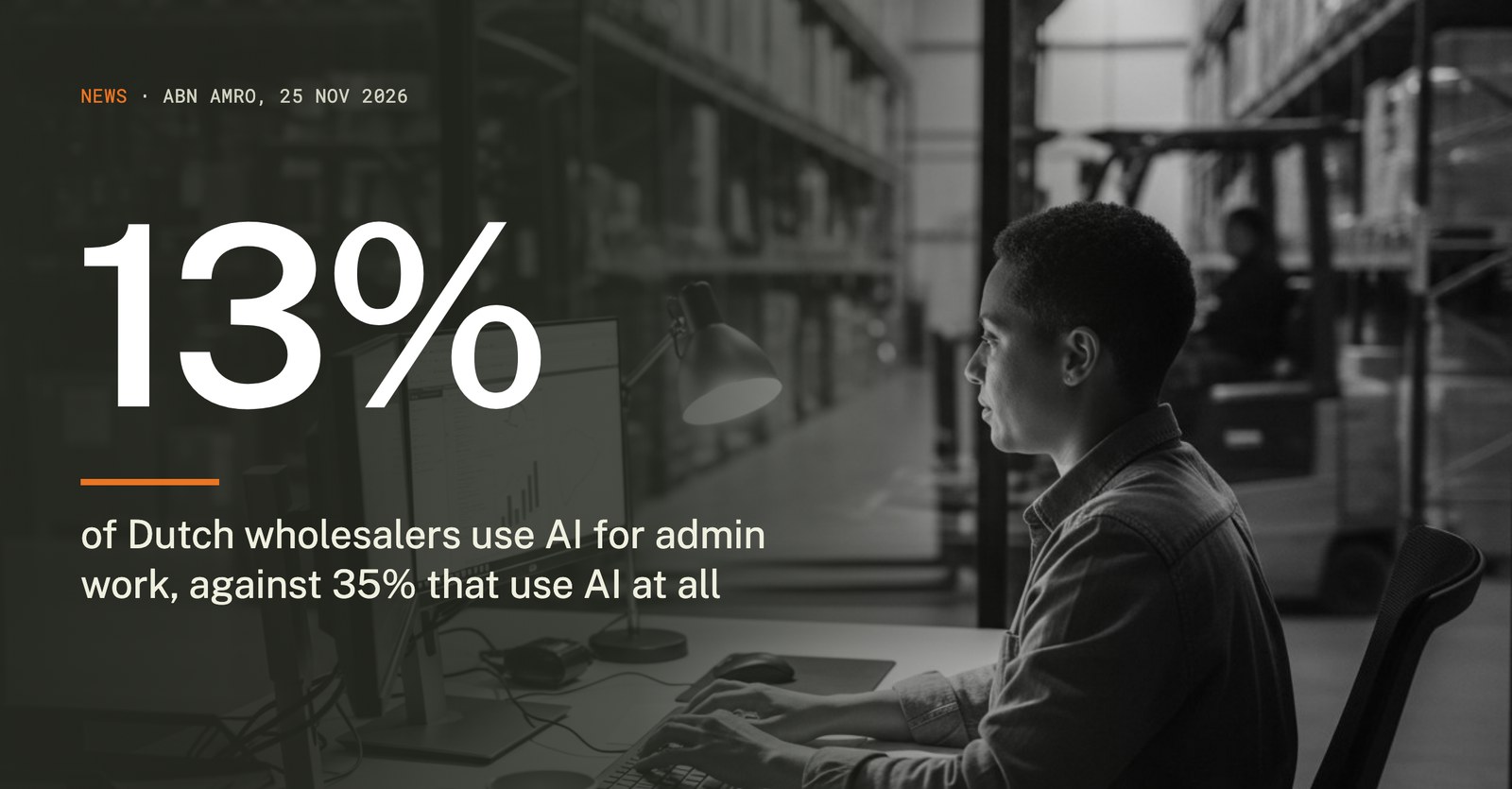
AI in wholesale is common now, but it has barely reached the order desk. On 25 November 2026, ABN AMRO reported that 35% of Dutch wholesalers used AI in 2025, and 13% used it for administrative processes. The bank sees the gain for wholesalers in handling more orders with the same team.
At Lleverage we think the gap between those 2 numbers is the story. Wholesalers have tried AI where it is easy to switch on, such as product texts for the webshop. The order desk asks more of it. An agent there has to read a customer's order and create the sales order in the ERP. That is the work our agents do in order management, and they do the same for supplier invoices in accounts payable. You can book a demo to see one read your own orders.
What did ABN AMRO report about AI in wholesale and retail?
ABN AMRO published its retail sector forecast on 25 November 2026. For the bank, the sector covers retail, non-food wholesale, and car sales and repair. It expects sector volume to grow by 1.5% in 2026 and by 1% in 2027. Costs are rising faster. According to ABN AMRO, collectively agreed wages in retail are up 37% since 2020.
The AI figures come from the survey on ICT use by CBS, the Dutch statistics office, as cited by ABN AMRO.
| AI use in 2025 | Wholesale | Retail | Car trade |
|---|---|---|---|
| Companies using AI | 35% | 27% | 19% |
| AI for administrative processes | 13% | 10% | 7% |
According to the same survey, 16% of wholesalers and retailers use AI for marketing and sales. Product texts for a website are one example. Company size makes a large difference across the trade sector as a whole.
| Company size | Share using AI in 2025 |
|---|---|
| 2 to 10 people | 11% |
| 10 to 50 people | 26% |
| 50 to 250 people | 47% |
| 250 people or more | 65% |
For wholesale, the bank puts the weight on the processes behind the sale. Large numbers of articles, orders, customers and suppliers leave room for demand forecasting, stock control and order processing. ABN AMRO reports that 9% of wholesalers used robotic process automation in 2025. Autonomous robots or drones were in use at 2%.
Why does this matter for operations and finance teams?
Volume grows by 1 to 1.5% a year while labour costs rise much faster. A wholesaler that wants to grow has to take on more orders without adding people at the same rate. ABN AMRO describes the gain from AI in those terms: more orders with the same staffing, and a more efficient flow of stock and goods.
The bank also names what slows companies down. A lack of relevant experience is a barrier for 10% of wholesalers. Privacy concerns and the fit with existing ICT systems play a part too. Large companies can connect AI to their own data and systems. Smaller ones depend more on ready-made AI functions in webshop or marketing software.
ABN AMRO adds a warning from a recent report by TNO, the Dutch applied research organisation. Time saved does not automatically raise labour productivity. The work process has to change with it. The freed capacity has to go to more output, lower costs or other valuable work.
What is our view on AI in wholesale?
We think the 13% is the number to watch. Many wholesalers use AI at the edge of the business, where a tool can be switched on without touching the ERP. The order desk is harder, and it is where the volume is. An order arrives as a PDF, an Excel file or a few lines in an email. Someone works out which customer sent it and which article each line means. Then that person types it in.
An AI agent can take over that reading and typing when it works inside the system the order desk already uses. It scores how sure it is of each order. Below the line the wholesaler sets, a person decides.
We agree with the TNO warning. Saved hours are worth little when nobody has planned where they go. Topa Bathroom Products is a Dutch importer and wholesaler with about 700 customers. More than 90% of its incoming orders are now processed into Business Central with no manual input. Nearly 4 full-time employees used to type orders all day. They now work on after-sales support and service planning. The Topa customer story has the detail.
What should a wholesaler do about it now?
- Count the orders typed in by hand for one week, and the minutes each one takes.
- List where the company uses AI today. If the list stops at marketing and the webshop, the back office is still untouched.
- Pick one process with volume and clear rules, usually order entry or invoice matching. Run it supervised first.
- Decide before the start where the freed hours go: customer service, quoting or credit control.
Our comparison of order entry software for wholesalers sets out the options. The post on growing order volume without hiring covers the capacity side. To see an agent read your own orders, book a demo.
Frequently asked questions
How many Dutch wholesalers use AI?
According to ABN AMRO, which cites the CBS survey on ICT use, 35% of Dutch wholesalers used AI in 2025. That compares with 27% of retailers and 19% of car dealers. For administrative processes the share is much lower: 13% of wholesalers, 10% of retailers and 7% of car dealers.
Does company size change how much AI a trading company uses?
Yes. Across the Dutch trade sector, ABN AMRO reports AI use of 11% at companies with 2 to 10 people, 26% at 10 to 50, 47% at 50 to 250 and 65% at 250 or more. Larger companies can connect AI to their own data and systems. Smaller ones rely more on ready-made functions.
Where does ABN AMRO see the gain from AI in wholesale?
In the processes behind the sale. The bank names demand forecasting, stock control and order processing. It describes the gain as handling more orders with the same staffing, with a more efficient flow of stock and goods. It also reports that 9% of wholesalers used robotic process automation in 2025.
Does time saved with AI raise productivity?
Only when the work changes with it. ABN AMRO cites a recent TNO report which found that time savings do not automatically lead to higher labour productivity. Work processes have to change, and the freed capacity has to be used for more output, lower costs or other valuable activities.
What holds wholesalers back from using AI?
ABN AMRO reports that a lack of relevant experience is a barrier for 10% of wholesalers and 6% of retailers. Concerns about privacy and about the fit with existing ICT systems also play a part. According to the bank, the step from separate tools to structural use does not happen by itself.