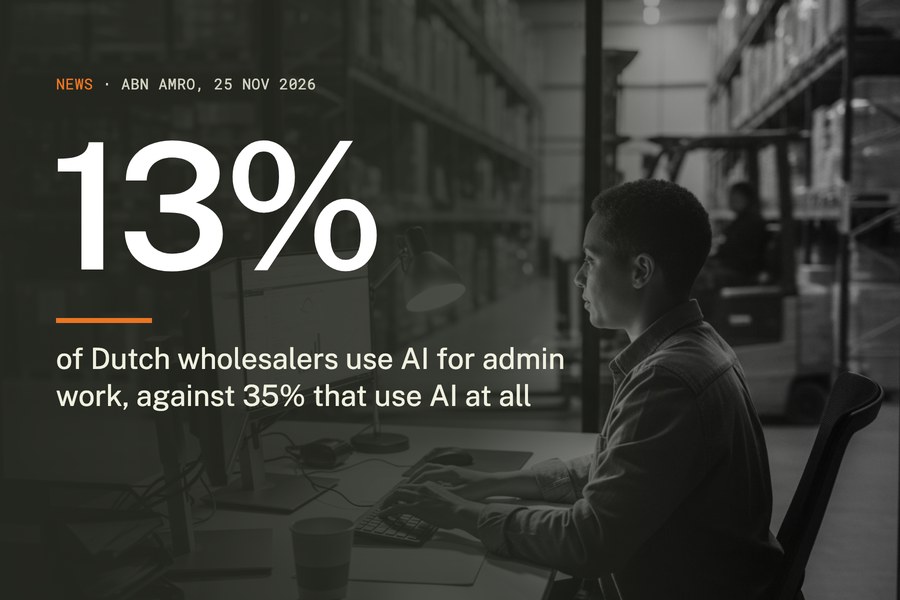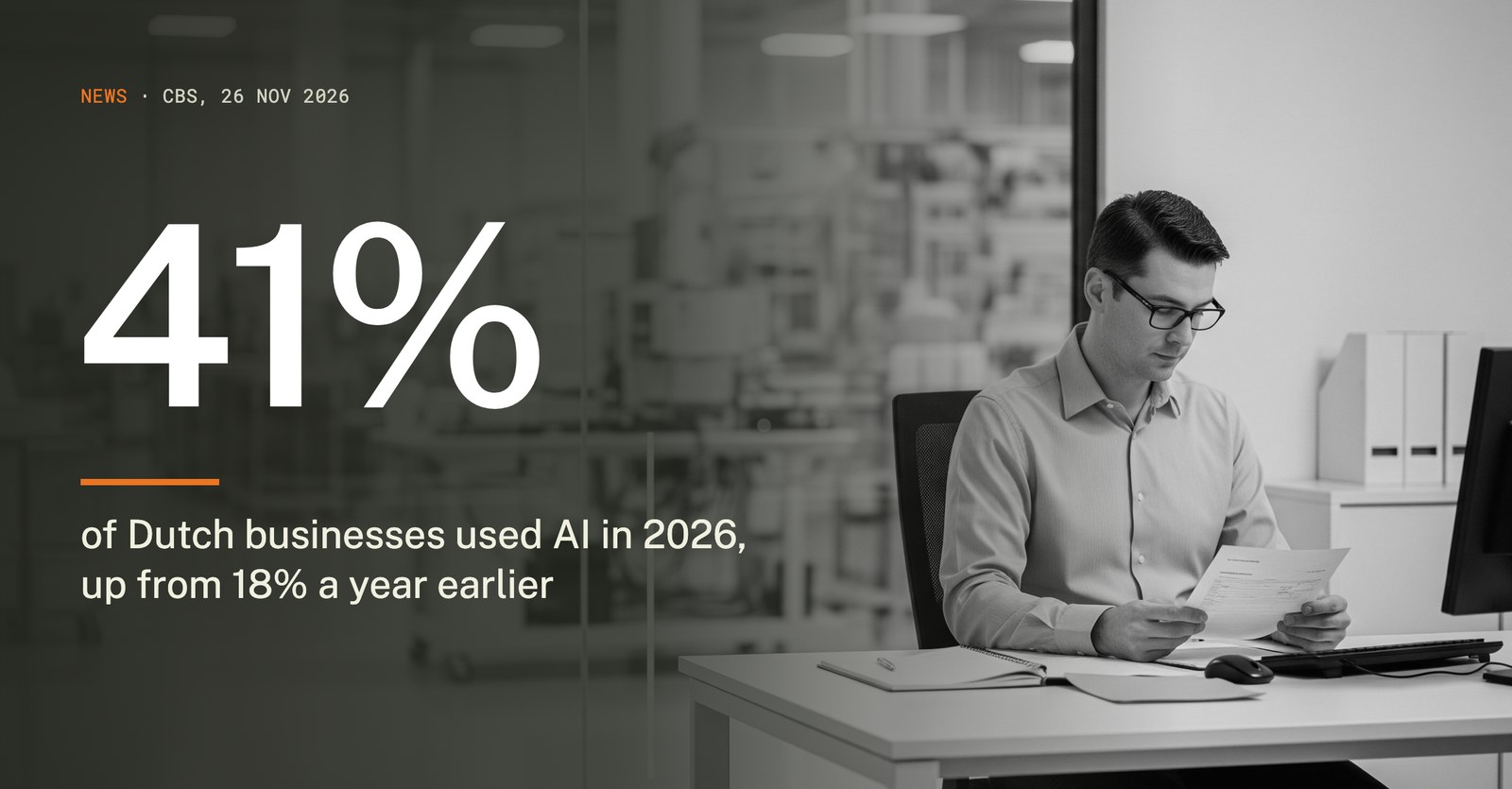
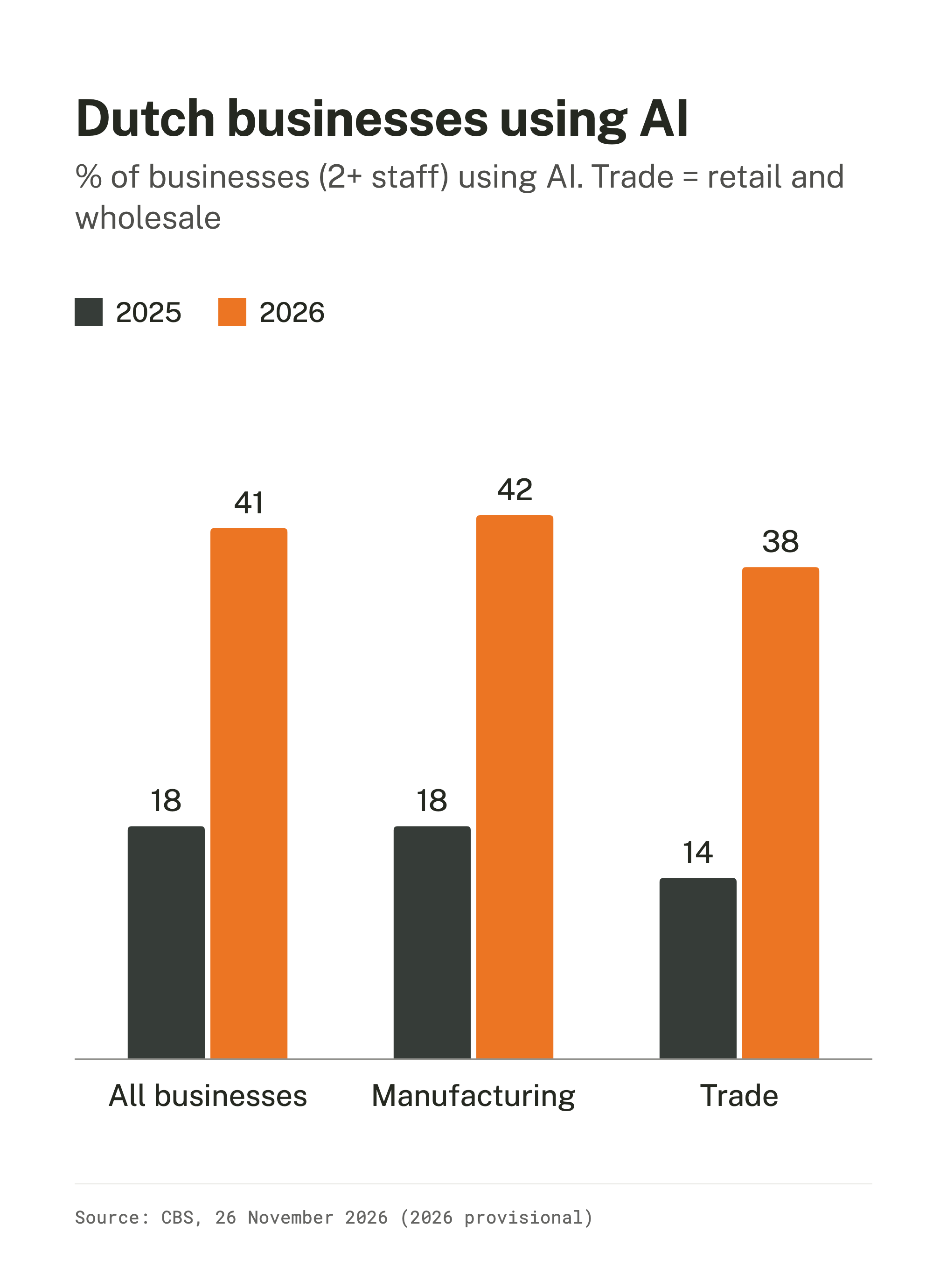
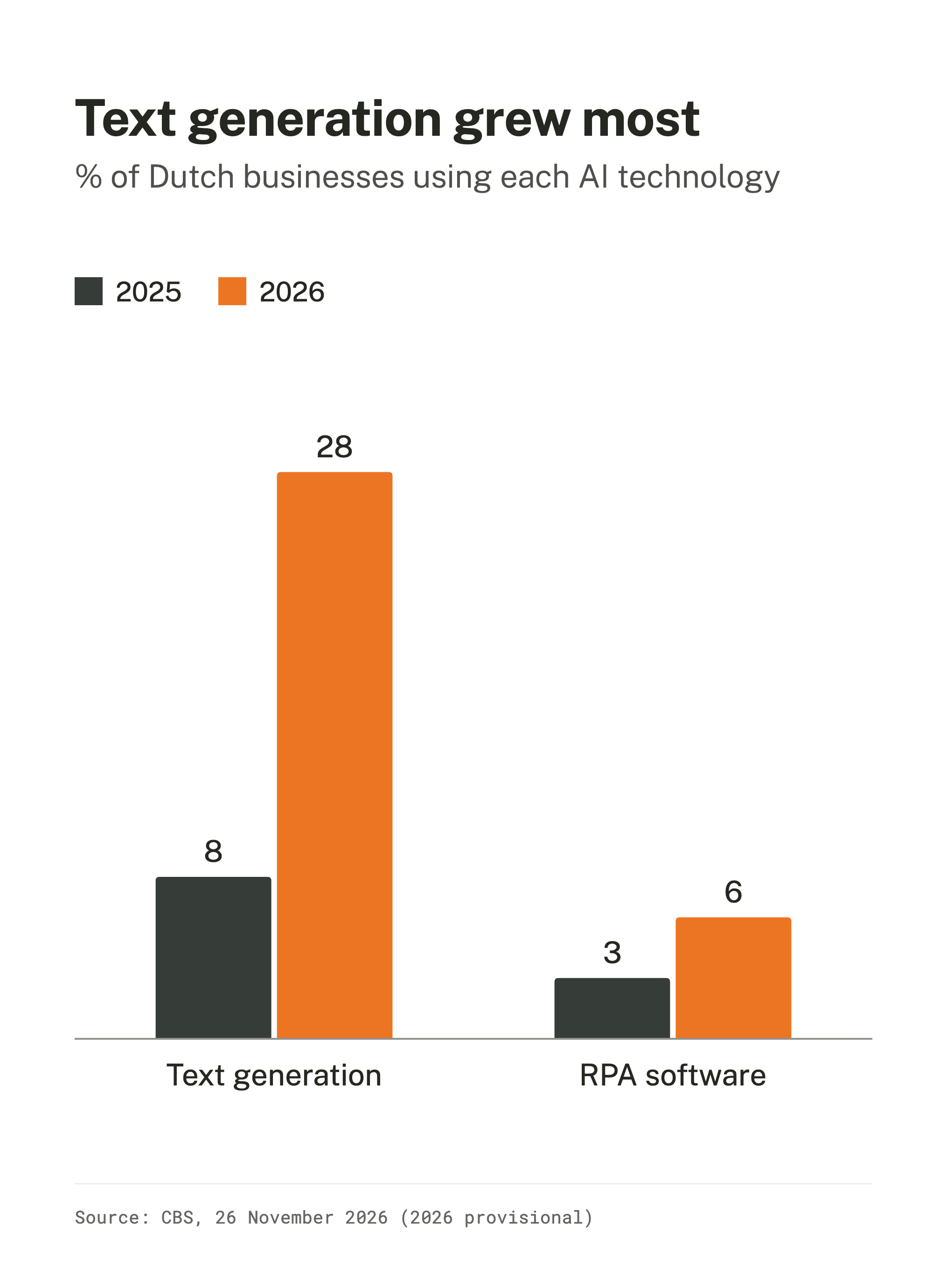
The latest CBS AI adoption statistics show that 41% of Dutch businesses used AI in 2026, up from 18% a year earlier. Manufacturing rose from 18% to 42%, and retail and wholesale trade from 14% to 38%. Text generation is the technology that grew most. Only 6% of the businesses using AI point it at logistics.
At Lleverage we think the AI that pays off for a manufacturer or wholesaler is the AI that does the work itself, inside the ERP. A chat assistant helps a person write and search. An agent reads the order, checks it and creates the sales order. The next CBS figures worth watching are about that second kind of use, the work we see on the order desk and in accounts payable.
What did CBS publish about AI use in Dutch businesses?
On 26 November 2026, Statistics Netherlands (CBS) published its figures on ICT use by businesses. The 2026 figures are provisional. CBS's tables count businesses with 2 or more employees; self-employed people are counted separately. These are the first 2026 figures; the 2025 figures in the table are last year's edition of the same survey. In one year, the share using one or more AI technologies more than doubled. CBS reports retail and wholesale trade as one sector, so the sector figures below are for shops and wholesalers combined.
| Group | 2025 | 2026 |
|---|---|---|
| All businesses, 2 employees or more | 18% | 41% |
| 250 employees or more | 67% | 89% |
| 50 to 249 employees | 46% | 75% |
| Manufacturing | 18% | 42% |
| Retail and wholesale trade | 14% | 38% |
| Transport and storage | 7% | 28% |
The technology that grew most is natural language generation: writing text, speech or code. According to CBS it went from 8% of businesses in 2025 to 28% in 2026. Text mining rose from 12% to 24%. Robot-controlled process automation went from 3% to 6%.
Among businesses that use AI, 42% use it for marketing or sales. The steepest rise was in accounting, auditing and financial management, from 17% to 30%. Only 6% use AI for logistics.
Why does this matter for operations and finance teams?
For a company with 250 people or more, the question of whether to use AI is settled. CBS counts 89% of them as users already. The question that matters now is what the AI does all day.
The rise in accounting, auditing and financial management is the closest CBS figure to the back office of a manufacturer or wholesaler. It went from 17% to 30% of AI users in a year. Among businesses using AI, that use grew faster than any other.
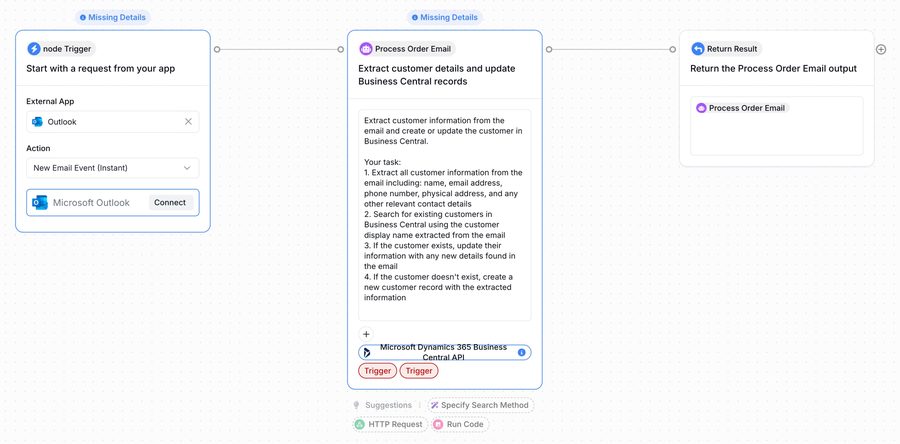
The order desk sits next to finance and has the same kind of work. An order arrives as a PDF, an Excel file or an email with a photo of a handwritten list. Someone checks the article numbers, the price agreement and the credit limit, then creates the sales order in the ERP and sends the confirmation. A chat assistant can help draft the reply to the customer, and the person still keys in the order.
The effects CBS measured show how uneven the results are. Of the businesses using AI, 54% say it raised productivity and 30% say the content of the work changed. 16% say fewer staff are needed, and 1 in 4 say AI has had no impact on the company at all.
What do these AI adoption statistics mean for manufacturing and wholesale?
We think the doubling CBS measured makes the next step shorter. People on the order desk and in finance now know what a language model can read and where it goes wrong. Moving from a chat window to an agent that works inside Business Central, SAP or Exact is a smaller jump for a team that already uses AI every day.
The agent fills the same fields a person fills, so the ERP checks the work the same way. It starts supervised, with a person watching, and the customer decides when it runs on its own.
Topa Bathroom Products shows what that looks like in production. Over 90% of its incoming orders are processed into Business Central with no manual input, and orders are confirmed within 30 seconds. Nearly 4 FTE moved to after-sales and service planning. The Topa customer story has the detail.
What should a manufacturer or wholesaler do about it now?
- Ask where your AI use sits today. If it is mostly drafting texts and summarising, note which processes still run on typing.
- Count one week of orders and supplier invoices: how many arrive, in which formats, and how many minutes each takes by hand.
- Pick one flow with volume and clear rules, usually order intake or invoice matching.
- Run an agent on it supervised first, inside the ERP you have, and widen what it does on its own when the numbers earn it.
- Decide where the freed hours go before they are freed: service, quoting or growth without new hires.
Our post on AI adoption in manufacturing covers the order of work in more detail. To see an agent read your own orders, book a demo.
Frequently asked questions
How many Dutch businesses use AI in 2026?
According to provisional CBS figures published on 26 November 2026, 41% of Dutch businesses with 2 or more employees used one or more AI technologies in 2026. That is more than double the 18% of 2025. Among businesses with 250 employees or more, the share is 89%, up from 67%.
How many Dutch manufacturers and wholesalers use AI?
CBS puts AI use in manufacturing at 42% in 2026, up from 18% in 2025. In retail and wholesale trade it is 38%, up from 14%. Transport and storage rose from 7% to 28%. All 2026 figures are provisional and come from the CBS survey of ICT use by businesses.
What do Dutch businesses use AI for?
Among businesses that use AI, CBS reports that 42% use it for marketing or sales, 35% for business administration or management tasks and 30% for accounting, auditing and financial management. Accounting rose the most, from 17% in 2025. Logistics is the least common purpose, at 6% of AI users.
Does AI make Dutch businesses more productive?
CBS reports that 54% of businesses using AI say it raised their productivity, and 30% say the content of their work changed. 16% say fewer staff are needed and 4% say new roles are created. 1 in 4 AI users say it has had no impact on their company.
What is the difference between an AI assistant and an AI agent?
An AI assistant helps a person write, search or summarise, and the person then does the work in the business systems. An AI agent does the work itself: it reads the order, checks it against the customer's agreement and creates the sales order in the ERP, with doubtful cases sent to a person.