The best AI tools for food manufacturers are the ones matched to a single job. A mid-sized food producer gets the most from AI in 3 places: quality and food safety records, production planning, and the back office around orders, supplier invoices and specs. Pick one tool per job, and start with the job where people retype the most.
At Lleverage we think most food producers should start in the back office. That is where staff copy retailer orders, supplier invoices and spec sheets into the ERP by hand, and it is where a mistake gets caught by a person reviewing a draft, long before it reaches the line. We build AI agents for order management, accounts payable and product master data that work inside the ERP you already run, so this is a vendor's list. Where a specialist food safety or planning tool fits better, we say so. To see an agent work on your own orders, book a demo.
For planning in depth, read our piece on AI in food manufacturing. For the finance view, read what a CFO at a food manufacturer should evaluate in AI.
What makes AI tools for food manufacturers different?
Food adds 5 kinds of data that a general manufacturing tool rarely holds, and each one decides whether a tool fits:
- Allergens and specifications. Every ingredient comes with a spec sheet and an allergen statement, and every retailer has its own specification for the finished product. They change, and the latest version has to be the one in use.
- Lot traceability. You must be able to say which supplier lot went into which batch and which customer received it, fast, on the day of a recall.
- Short shelf life. Making too early wastes product. Forecasting too low empties a retailer's shelf. Both cost money within days.
- Retailer EDI and portals. Large retailers send orders by EDI or through their own portals, while smaller customers email PDFs, spreadsheets and plain text. Most order desks handle all of it.
- Recipe and label data. Recipes, nutritional values and label text have to agree with each other and with what the ERP holds.
The EU food and drink industry employs 4.8 million people on a turnover of 1.5 trillion euro, according to FoodDrinkEurope's Data & Trends 2026 report. AI use across European business is still early: 20.0% of EU enterprises with 10 or more employees used AI in 2025, up from 13.5% in 2024, according to Eurostat. Among medium-sized enterprises, with 50 to 249 people, the share was 30.36% in 2025, according to the same Eurostat survey. The most common use, at 11.8% of enterprises according to Eurostat, was analysing written language, the same work as reading orders, invoices and spec sheets.
A tool built for one of these 5 does not cover the others. A food safety platform keeps your HACCP records and audit evidence, and an order agent creates the sales order from a retailer's email. Neither replaces the other, so we sort by job.
Which AI tool fits which job in a food plant?
| Tool | Job | What it does for a food producer | AI on its own pages today | Choose it when |
|---|---|---|---|---|
| SafetyChain | Food safety and quality | Digital checks on the floor, HACCP monitoring, CAPA, supplier compliance | SafetyChain AI announced, decision intelligence listed for 2027 | You want one quality and compliance standard across plants |
| TraceGains | Supplier, spec and compliance data | Supplier documents, specifications, CoAs, formulation | Document Intelligence, CoA extraction, AI Formulation | Your quality team drowns in supplier documents and spec versions |
| PlanetTogether | Planning and scheduling | Finite-capacity schedules with allergen and sanitation logic | Speaks of AI-ready scheduling, no named AI feature | The ERP plans against infinite capacity and changeovers eat line time |
| Slimstock | Demand forecasting and stock | Forecasting, replenishment and fresh item management in Slim4 | Described as powered by AI, with agentic data cleaning | Short shelf life makes stock levels the main lever |
| Lleverage | Orders, invoices, product data, customer service | AI agents that read orders and supplier documents and create the record in the ERP | AI agents that work in the ERP, supervised until the numbers earn autonomy | Orders and invoices arrive in every format and you keep your ERP |
| Esker | Finance, AP and order-to-cash | Source-to-pay and order-to-cash suites with named AI agents | Named AI agents, including an Accounts Payable Agent | A larger finance team wants one suite from procurement to collections |
Every vendor fact below comes from that vendor's own website in November 2026. Where its pages say nothing on a point, we leave the point out.
Which AI tools help with food safety and quality?
Food safety and quality software holds the records an auditor asks for: monitoring checks, corrective actions, supplier approvals and specs. Its AI is newer than its record keeping, so judge the record keeping first.
SafetyChain
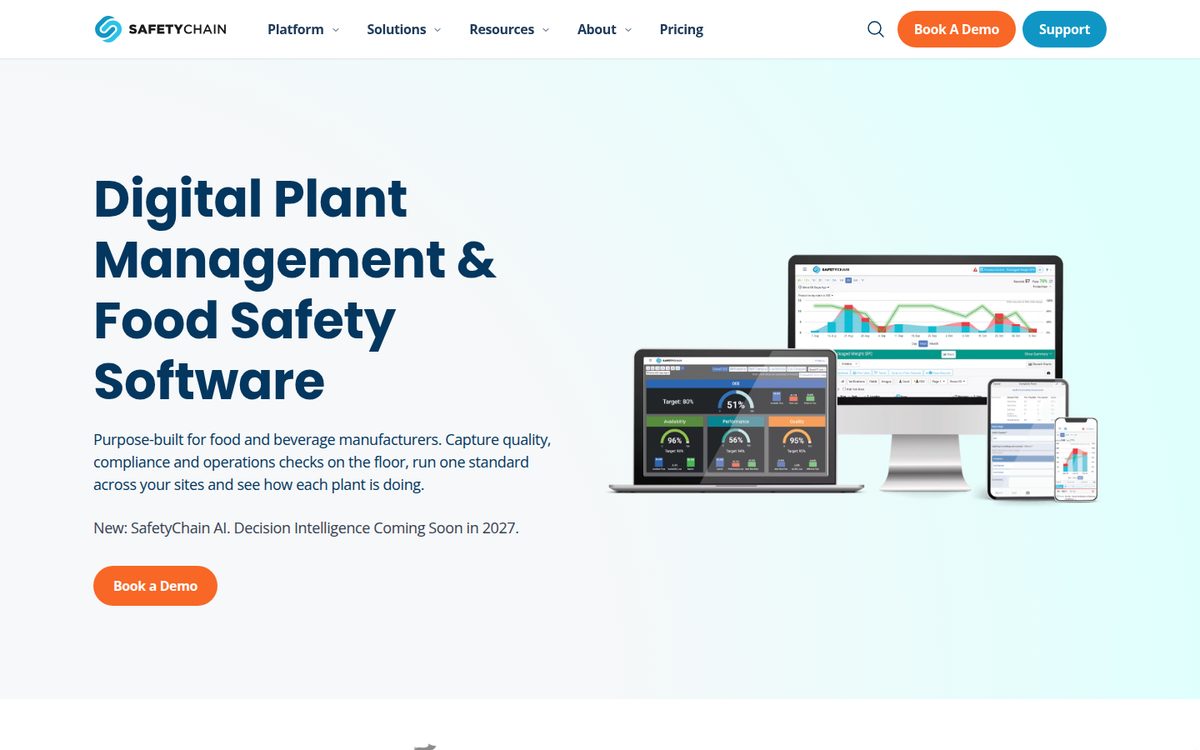
SafetyChain describes itself as digital plant management and food safety software, purpose-built for food and beverage manufacturers. It covers food safety programmes, regulatory and customer compliance, in-process quality, production monitoring and supplier compliance. Operators fill in checks on mobile devices, read SOPs on the floor and work through CAPA.
On the ERP side, SafetyChain offers open REST APIs. Item and lot data can flow in from the ERP, quality results can go back as often as hourly, and a new ERP work order can create a quality task. Its homepage announces SafetyChain AI, with decision intelligence listed as coming in 2027. Choose it when the job is running one quality and compliance standard across several plants.
TraceGains
TraceGains is a food and beverage platform for product development, supplier management, quality and compliance. It has been part of Veralto since 2024, and its site names each AI feature and the documents it reads. Document Intelligence reads supplier documents and turns them into structured data, including specifications, allergen statements, certificates of analysis and country-of-origin declarations. A separate feature extracts, validates and monitors CoA data and flags exceptions. AI Formulation helps evaluate ingredient alternatives.
Choose it when your quality team spends its week chasing supplier documents and checking which spec version is current. For the certificates you send to customers, see our article on certificate of analysis software.
Which tools plan and schedule production in a food plant?
Most ERPs schedule against infinite capacity, so the plan ignores changeovers, allergen sequencing and wash-downs. An advanced planning and scheduling tool solves for those constraints and sends the schedule back to the ERP.
PlanetTogether
PlanetTogether is advanced planning and scheduling software from CAI Software. It builds a finite-capacity schedule that respects machines, labour and materials, and publishes it back to the ERP. Its food and beverage page names allergen scheduling and sanitation windows, and groups products with shared allergens to cut full sanitation cycles. It also tracks the expiry dates of incoming materials and batches. It names SAP, NetSuite and Aptean Ross among its connections. The site talks about AI-ready production planning without naming a specific AI feature.
Choose it when one planner rebuilds the week by hand because the ERP schedule ignores changeovers. Our production planning software guide compares more options.
Which tools forecast demand for short shelf-life products?
A forecast for fresh product has to weigh 2 costs at once: waste when you make too much and an empty shelf when you make too little. The tools that suit food handle shelf life in the stock calculation itself.
Slimstock
Slimstock's Slim4 platform covers demand forecasting, inventory optimisation, replenishment and supply planning. Its fresh item management builds shelf-life limits into stock projections, adjusts safety stock against them and lets replenishment take shelf life into account. Slimstock says Slim4 works alongside the ERP and names SAP, Oracle, Microsoft Dynamics and NetSuite. The platform is described as powered by AI, with agentic data cleaning listed as a product.
Choose it when stock and waste are the main levers and you want a planning layer next to the ERP. For a wider comparison, read our guide to demand forecasting software.
Which AI tools handle orders, specs and supplier documents?
In the food plants we see, this job has the most retyping. Retailer orders, supplier confirmations, invoices and spec sheets arrive as PDFs, spreadsheets and email text, and someone copies them into the ERP. EDI covers the large retailers. The rest of the customer base still emails.
Lleverage
Lleverage builds AI agents that do back-office work inside the systems a company already runs. For a food producer that means 4 jobs around the ERP:
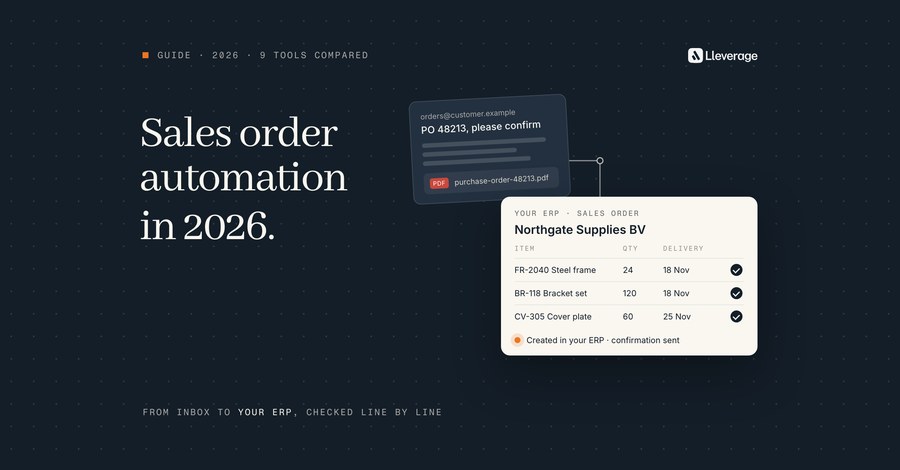
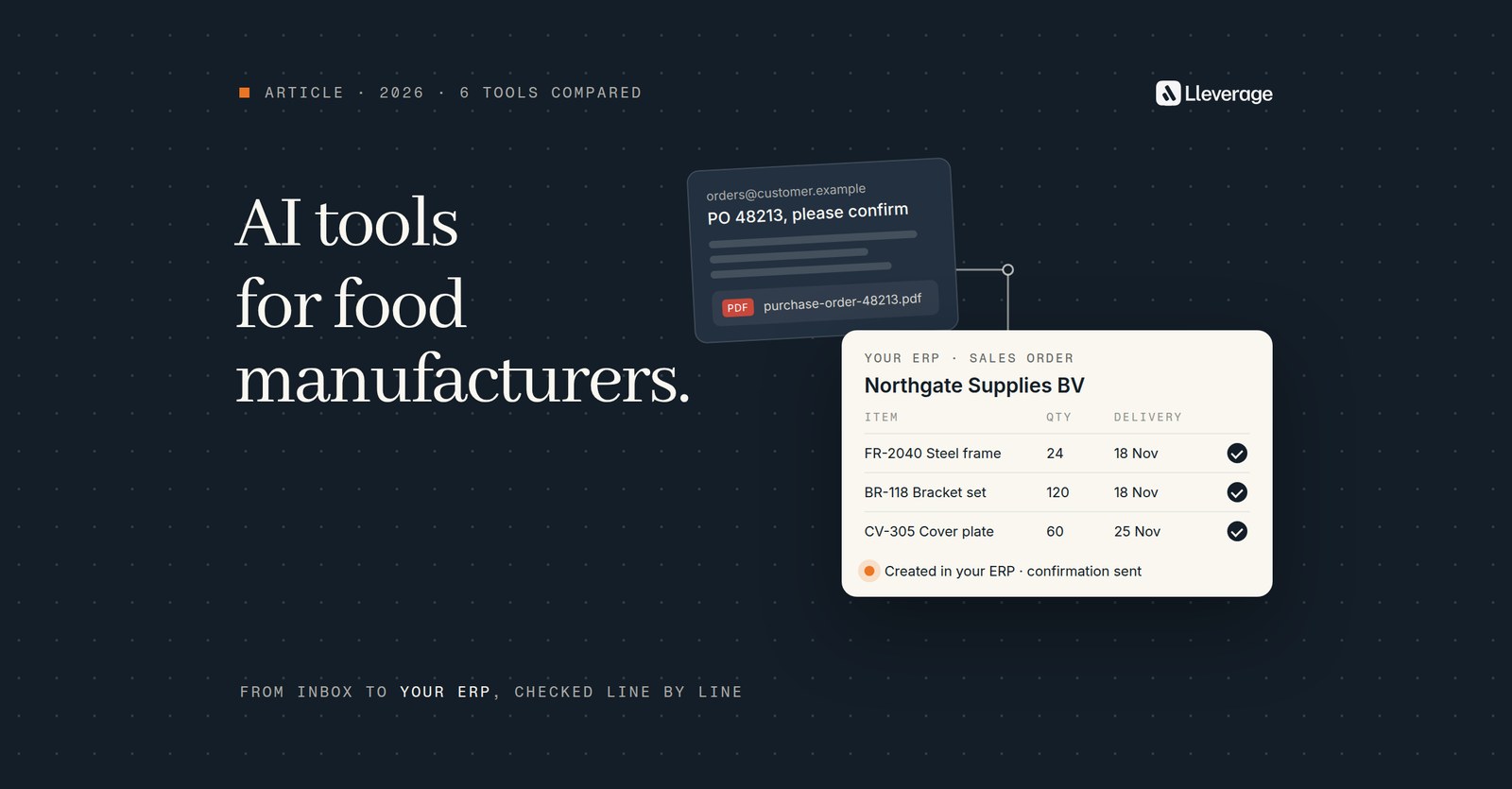
- The agent reads customer orders in any format, checks products, prices and availability, and creates the sales order in the ERP.
- It handles purchase orders, supplier confirmations and invoices against the order, and matches invoices within your tolerances. It never releases a payment.
- It keeps master data in sync across systems, so the item, spec and price in the ERP agree with the rest.
- It answers customer questions with the order context and prepares shipping documents.
The agent fills the same fields a person fills, through the ERP's own interfaces, so the ERP checks the work the same way. Nothing is migrated. We work in SAP, Business Central, Dynamics 365, Exact, AFAS, Infor, Epicor, NetSuite and the other systems on our integrations page. The agent scores how sure it is of each piece of work, and below the line you set, a person decides. When a PO number is missing, it asks the right colleague and carries on with the answer. Every change sits in an audit trail, covered on the control page.
Lleverage does not replace your food safety system: pick SafetyChain or TraceGains for that job. When the line schedule itself is the main problem, look at a dedicated scheduler such as PlanetTogether.
Koninklijke Dekker, a timber producer on Business Central, had the mixed inbox most food order desks know.
"The problem is, you have a lot of Excel sheets, PDFs, or just text emails coming in with an order. This requires a lot of interpretation from our internal sales team." Mart, Continuous Improvement Team, Koninklijke Dekker
Its agent now reads orders from PDF, Excel and email, checks products, availability and pricing before it creates the order, and sends only low-confidence exceptions to a person. For the EDI side, our article on EDI order processing covers what EDI does and does not take off the desk.
Which AI tools help finance and accounts payable in food?
Supplier invoices in food carry catch weights, deposits on crates and pallets, and price changes on commodities, so many fail a plain match against the order. A finance suite covers the whole cycle. An agent works on one process inside the ERP.
Esker
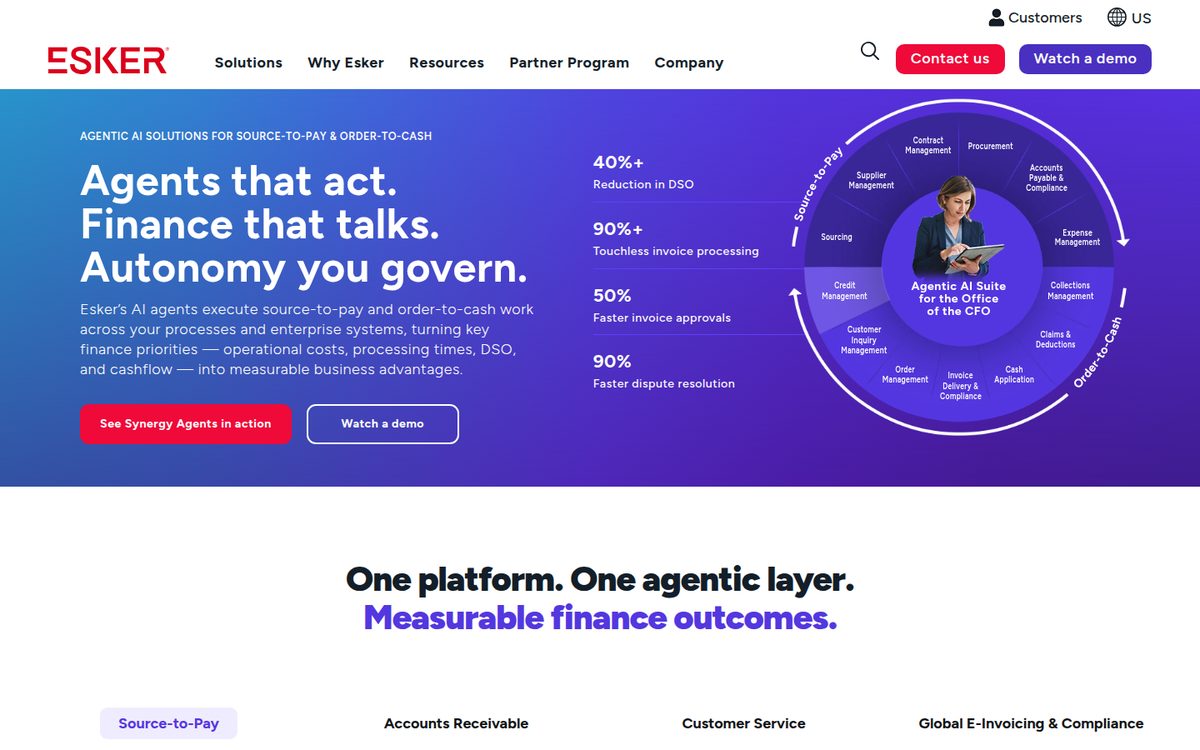
Esker sells source-to-pay and order-to-cash software for the office of the CFO. Its AI agents include an Accounts Payable Agent, a Procurement Agent, a Cash Application Agent, a Collections Management Agent and a Customer Inquiry Agent. Its order management captures orders from email, EDI, portals and e-commerce in one workflow and uses AI to extract order data and check it against the ERP. Esker names SAP, Oracle, Dynamics 365, Workday and Sage. It has been privately owned since 2025, when Bridgepoint and General Atlantic took it off the stock market.
Choose it when a larger finance team wants one suite from procurement to collections, with EDI and email orders in the same place. Choose Lleverage for accounts payable when you want an agent on supplier invoices inside your ERP, starting with one process. Our post on three-way matching automation explains the matching step.
What should you ask every vendor before you buy?
Ask the same 5 questions of every tool on your shortlist, whatever its job:
- Which ERP does it work in, and how? Ask for your ERP and version by name. A connector that reads data is different from one that creates records.
- What does the audit trail show? Your BRCGS or IFS auditor will want to see who changed a record, when, and from what. Ask to see that log in the demo.
- Who signs off? Find out which decisions the tool takes on its own, which go to a person, and who sets that line.
- What happens with a document it cannot read? Every tool fails on some documents. Check that the failure lands in a queue with its context.
- What does it need from you? Clean master data, a current changeover matrix or current specs. Ask before the first result.
How do you test one AI tool before you commit?
Test one process on real work before you sign anything large. In our experience a 4-step test tells you more than any demo:
- Pick the process with the most retyping. Count the documents per week and the minutes each one takes. Order intake and supplier invoices usually top that list in a food plant.
- Use a real week. Hand the vendor last week's orders or invoices, including the messy ones: the handwritten PDF, the retailer with its own codes, the invoice with a catch weight.
- Keep a person in the loop. Let the tool draft and a person approve. Count how many drafts go through unchanged and what the corrections are.
- Decide on the numbers. If the share of unchanged drafts rises week by week, widen the scope. If it stalls, you have learned what your data needs.
With Lleverage, the first process typically runs supervised within a few weeks, built by our engineers with your team. Book a demo and bring a real week of orders or supplier invoices.
Frequently asked questions
What are the best AI tools for food manufacturers?
It depends on the job. For food safety and quality records, look at SafetyChain or TraceGains. For finite-capacity scheduling, PlanetTogether. For forecasting short shelf-life stock, Slimstock. For orders, supplier invoices and product data around the ERP, Lleverage. For a full finance suite, Esker. Start with the job where your team retypes the most.
Can one AI tool cover food safety, planning and orders?
In practice, most mid-sized food producers use a specialist per job. Food safety platforms keep the audit records, planning tools solve schedules against line constraints, and order agents create records in the ERP from documents. The ERP stays the shared record between them, so check how each tool reads from it and writes to it.
Do AI tools for food manufacturers work with our ERP?
Most of them connect to the ERP, in different ways. SafetyChain exchanges item, lot and quality data through APIs. PlanetTogether publishes the schedule back to the ERP. Lleverage creates sales orders and books supplier invoices through the ERP's own interfaces. Ask each vendor for your ERP and version by name before the demo.
Where should a food manufacturer start with AI?
Start with the process where people retype documents into the ERP, usually order intake or supplier invoices. A person reviewing a draft catches the errors, and you can count the hours saved within weeks. Planning and food safety tools are larger projects that touch the line and the audit.
Will an AI tool satisfy a BRCGS or IFS audit?
The audit stays your responsibility. A good tool makes the evidence quicker to find and show. Ask every vendor what its audit trail records: who changed what, when, and on whose approval. Food safety platforms hold the monitoring records. Back-office agents should log every change they make in the ERP.