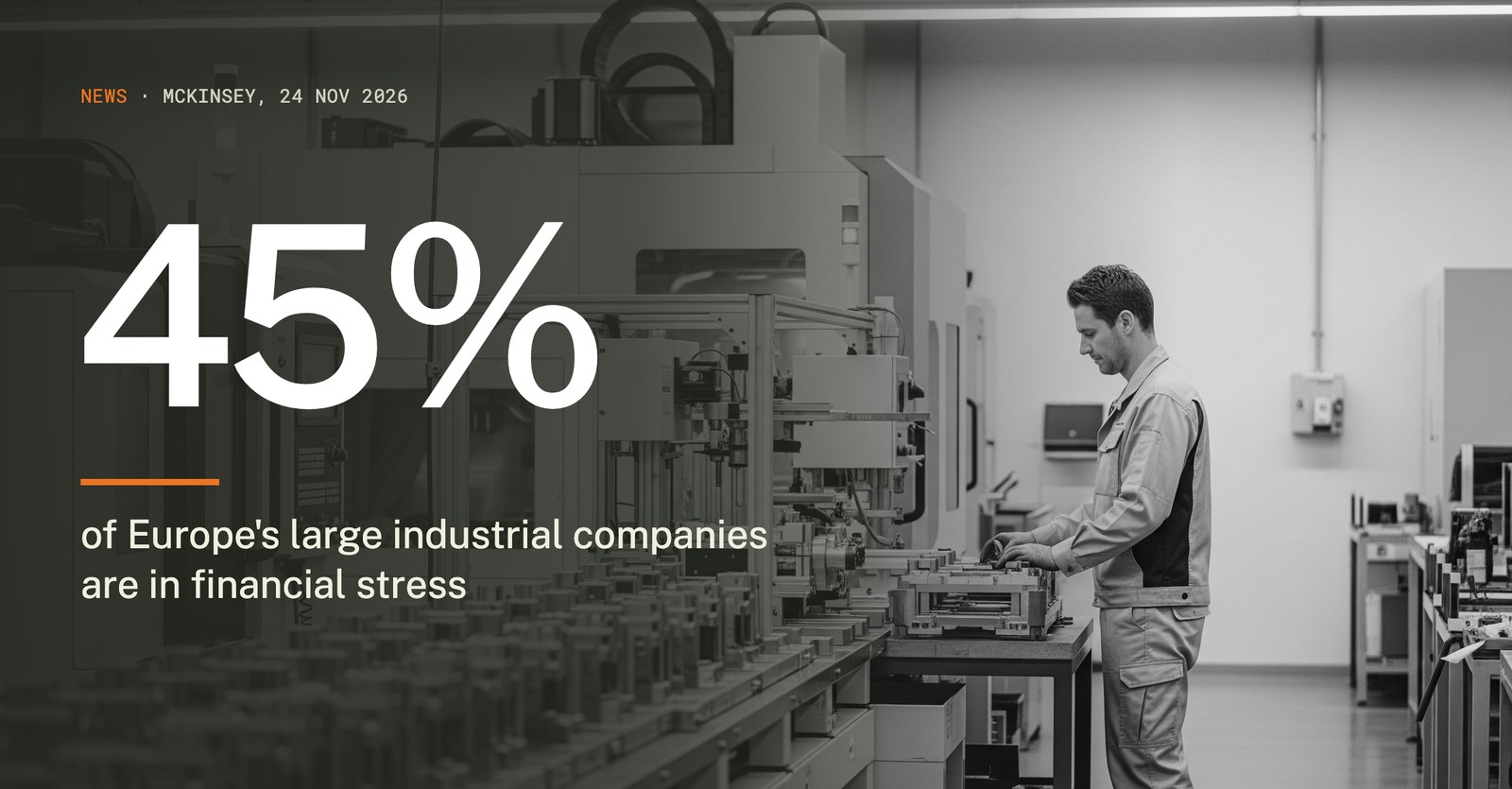
European manufacturing competitiveness is getting worse, and McKinsey has now measured by how much. On 24 November 2026 it reported that about 45% of Europe's larger industrial companies were financially stressed or distressed in 2025. About 3.7 million jobs are directly at risk. The cost a manufacturer can change fastest is in the office: the hours spent on orders and invoices.
At Lleverage we think the most practical part of the report is its short list of places where AI cuts office work. McKinsey names indirect work, payables and receivables, collections and disputes. A manufacturer has no say over the gas price or over wages in China. It decides for itself how many hours its people spend retyping orders and chasing invoices. Our agents do that work in order management and accounts payable. You can book a demo to see them on your own documents.
What did McKinsey report about Europe's industrial companies?
The article, Regaining the competitiveness of Europe's industrials the European way, appeared on 24 November 2026. It introduces McKinsey's Industrial Financial Health Index. The index scores almost 1,200 public and private European industrial companies as healthy, stressed or distressed. Each has revenue above €100 million.
| Year | Share of companies stressed or distressed |
|---|---|
| 2023 | 39% |
| 2024 | 42% |
| 2025 | 45% |
| 2026, preliminary | About 50%, in press coverage of McKinsey's early data |
According to McKinsey, the 2025 share was 3 percentage points higher than in 2024 and 6 higher than in 2023. Preliminary 2026 data suggest the slide is accelerating. McKinsey puts about 3.7 million jobs and more than €500 billion in value added directly at risk. Portugal, Luxembourg, the Netherlands and Spain show a very high share of stressed companies, and Germany's share rose by 12 percentage points.
McKinsey traces the stress to 2 costs. Labour productivity in Chinese industry is 1.5 times Europe's. Energy in Europe costs on average more than 1.5 times what it costs in China and the United States. According to McKinsey, around 47% of the industrial value chain's costs are labour-related and around 7% are exposed to energy prices. More than half of the cost base is at a disadvantage.
Why does this matter for operations and finance teams?
The margin for error is small. McKinsey puts the average profit margin of European industrials at around 4 to 6%. At that level, a few points of cost decide whether a company scores as healthy or stressed.
McKinsey counts 19 cost levers for industrial companies, and 12 of them are labour-related. They run from shop-floor productivity to simplifying and automating indirect work, increasingly with AI. McKinsey estimates that the labour levers together could cut 7.4 to 17.7% of conversion cost. With the other levers, that could lift profitability by 7.3 percentage points.
Indirect work is the work that touches no product: the order desk, purchasing administration, finance. The report names AI there in specific places:
- Accounts payable and receivable, where AI agents find cash, rank the actions, trigger customer collection and dispute handling, and detect leakage.
- Claims and contract management, which in McKinsey's experience can improve EBITDA by 1 to 2 percentage points.
- Inventory, where AI helps set the stock level for each site.
What is our view on European manufacturing competitiveness and the back office?
We think the office is where a manufacturer with 250 to 3,000 staff should start. We would also be careful about what we promise from it. In the turnarounds McKinsey studied, lower general and administrative expenses made up 2 to 5% of the total impact. Commercial measures made up 20 to 50%, and manufacturing and operations 15 to 55%. Automating the office alone will not rescue a distressed company.
The office does have the shortest run-up of any lever on the list. Closing a plant, renegotiating working hours or selling a business unit takes a board decision and months of talks. Taking the typing out of order entry takes one process and one team, and the hours go back to the people who know the customers. Order entry and credit control also feed the larger items on McKinsey's list. An order confirmed on the day it arrives is a commercial measure. An invoice chased on time is cash.
Microtechniek, a 130-person mechanical engineering firm, is one example. In August 2026, between 45 and 71 customer purchase orders a week were written into its ERP without anyone typing them. Each order took about 10 minutes by hand before, and the admin desk has more than 500 hours a year back. The Microtechniek customer story has the detail.
What should a manufacturer do about it now?
- Count the indirect hours. For one week, note how many orders are typed in and how many invoices are matched by hand. Write down the minutes each one takes.
- Pick one flow with volume and clear rules, usually order entry or invoice matching.
- Run it supervised first. The agent scores how sure it is of each piece of work, and below the line you set, a person decides.
- Decide where the hours go before they are freed: service, quoting or collections.
Our post on back-office automation for manufacturers covers the order of work in more detail. To see an agent read your own orders and invoices, book a demo.
Frequently asked questions
How many European industrial companies are financially stressed?
According to McKinsey's Industrial Financial Health Index, about 45% of almost 1,200 European industrial companies with revenue above €100 million were financially stressed or distressed in 2025. That is 3 percentage points more than in 2024 and 6 more than in 2023, and preliminary 2026 data suggest the share is still rising.
How many jobs are at risk in European industry?
McKinsey estimates that about 3.7 million jobs and more than €500 billion in value added are directly at risk at the stressed and distressed companies in its index. It is a measure of exposure at those companies, and McKinsey argues that their problems are structurally fixable through turnarounds.
Why are European manufacturers less competitive than Chinese ones?
McKinsey points to labour and energy. Wages in Europe are higher than in China while output per full-time employee is now lower, which puts Chinese industrial labour productivity at 1.5 times Europe's. Energy costs in Europe are on average more than 1.5 times those in China and the United States.
Where does McKinsey say AI helps industrial companies cut costs?
McKinsey names AI in indirect work, in accounts payable and receivable, in customer collection and dispute handling, in claims and contract analysis, in capital expenditure estimates and in setting inventory levels per site. It also describes AI taking over the reporting and tracking that a turnaround programme itself creates.
Is automating the back office enough to turn a stressed manufacturer around?
No. In the turnarounds McKinsey studied, lower general and administrative expenses made up 2 to 5% of the total impact, far less than commercial or manufacturing measures. We think the back office is the place to start because one team can change one process without waiting for a restructuring.