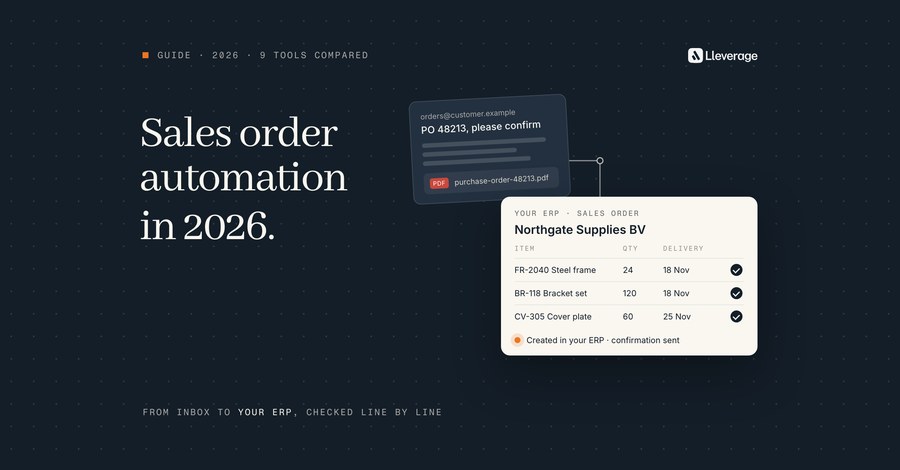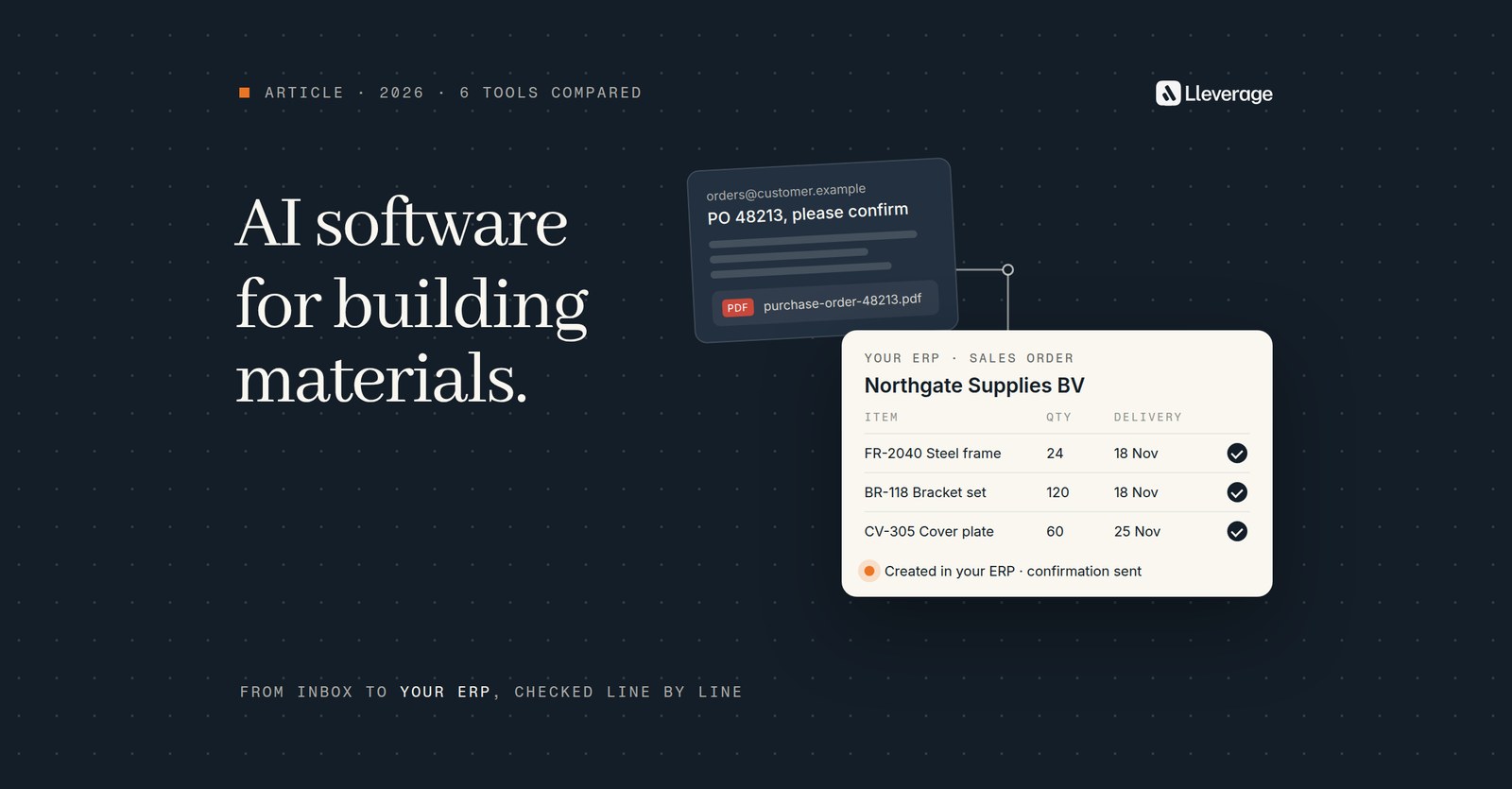
The best AI software for building materials wholesalers handles the counter and inbox work around the ERP: contractor orders by email, quote requests, supplier invoices and price changes. The ERP stays the system of record. Buy an AI agent or document AI for that work, an ERP built for builders' merchants for the core, and a pricing tool for margin.
At Lleverage we think most merchants should start with the order mailbox, because that is where a desk spends its day retyping what contractors send. We build AI agents for order management that read those orders and create the sales order in the ERP you already run. Below we compare 6 tools across 4 kinds of software, including the ones AI assistants name for this question, and say where an ERP or a pricing tool is the better buy. To see an agent on your own orders, book a demo.
A contractor emails at 07:10: "2 pallets of the usual blocks to the Molenweg site, and the plasterboard we had last time, but 12.5 mm." Someone on your desk knows which blocks, which board and which price this customer pays. The ERP does not, until a person types it in.
Why is building materials different from other wholesale?
Building materials wholesale combines a large catalogue, many units and customer prices with job-site deliveries that change by the day. 5 things make the work hard:
- Job-site deliveries. One contractor has several sites, and the delivery address, date and time window change per order.
- Contractor prices. The same article carries a different price or discount for each account and often for each project.
- Many SKUs and units. Timber goes by the metre or the length, insulation by the pack or the square metre, aggregates by the tonne or the bag.
- The customer's own words. Contractors write "the usual blocks" or a product name from a competitor's catalogue, and your ERP knows the item by your number.
- Project quotes. A request arrives as a bill of quantities, a tender document or a set of drawings, and each line has to become an article and a price.
SIG Benelux, a building materials distributor, shows the scale. Around 3% of its orders carried an article number and roughly 47% had only a description. The rest came as WhatsApp messages, photos pasted into an email or a sentence that only made sense if you knew the customer. A single order took 5 to 7 minutes to retype into Dynamics 365.
Which kinds of AI software do building materials wholesalers buy?
4 kinds of software compete for the same budget. Each solves a different problem. Every merchant runs an ERP, and many add 1 or 2 of the others.
| Kind of software | What it solves | When it is the better buy |
|---|---|---|
| ERP for builders' merchants | Stock, branches, delivery planning, pricing rules, invoicing | Your current system cannot run the business, or you are replacing it anyway |
| Quoting and pricing AI | Priced quotes from requests, margin and price management | Quotes from bills of quantities or price discipline are the bottleneck |
| Order entry and document AI | Orders read from email and PDF into the ERP | High volumes of orders from repeat customers in fairly stable formats |
| AI agents across the back office | Orders, quotes, supplier invoices and master data in one platform | The desk work spans several processes and your ERP stays |
An ERP project takes longer than the other 3. Replace one only when the ERP itself is the problem. When it works and the desk is buried in email, start with an order tool or an agent. Our guide on order entry software for wholesalers covers that category in more depth.
Which AI software for building materials wholesalers makes the 2026 shortlist?
These are tools a mid-size merchant would shortlist in one of the 4 categories, including those AI assistants cite. Lleverage is our own product; the other 5 follow by category, in no order of merit.
| Tool | Category | What it does for a merchant | Built for |
|---|---|---|---|
| Lleverage | AI agents across the back office | Reads orders and quote requests, creates sales orders, matches supplier invoices | Companies that make, move and sell physical products and keep their ERP |
| Mercura | Quoting and order AI | Turns requests and bills of quantities into priced quotes and orders | Technical distributors and manufacturers, building materials among them |
| Conexiom | Order and invoice automation | Validates orders in almost any format against customer rules | Distributors and manufacturers at high volume |
| Epicor BisTrack | ERP for building supply | Runs the merchant, with an add-on that reads scanned and emailed purchase orders | Builders' merchants, timber merchants, heavy side and roofing suppliers |
| Klipboard ERP One | ERP with embedded AI | Plain-language questions and actions on stock, pricing, orders and accounts | Merchants, wholesalers and distributors |
| Zilliant | Pricing software | Price management, pricing scenarios, customer agreements and CPQ | Manufacturers and distributors |
Morsa also appears in AI answers to this question. It is built for manufacturing plants, where it turns WhatsApp, email and Teams messages into tracked jobs, so we left it off this list.
What does each tool do for a builders' merchant?
Lleverage

Lleverage puts AI agents on the back-office work around your ERP. An agent reads quote requests and orders from email, PDF and Excel. It checks every line against your customers, items, prices and credit, and creates the sales order in the ERP. It scores how sure it is of each piece of work. Below the line you set, a person decides; above it, the work goes through, and only you move the line.
At SIG Benelux the agent reads order emails, PDFs, spreadsheets and pasted photos, sorts every mail into 1 of 5 buckets and creates a draft order in Dynamics 365. It matches lines from years of order history: this description, from this customer, means that article. 73% of order emails arrive as a draft ready to review, and 88% of lines match the right article first time. Topa Bathroom Products, a wholesaler with about 700 customers, has over 90% of incoming orders processed into Business Central with no manual input.
The same platform matches supplier invoices against the order within your tolerances, and the agent never releases a payment. Unit conversions become customer rules the agent applies every time: Xpol, a fresh flower wholesaler, runs 25 customer rulesets in one agent. When a line cannot be placed, the agent asks the person you choose in Teams or Slack and carries on with the answer. It works in SAP, Business Central, Dynamics 365, Exact, AFAS, Epicor, Infor and the other systems on our integrations page.
Mercura
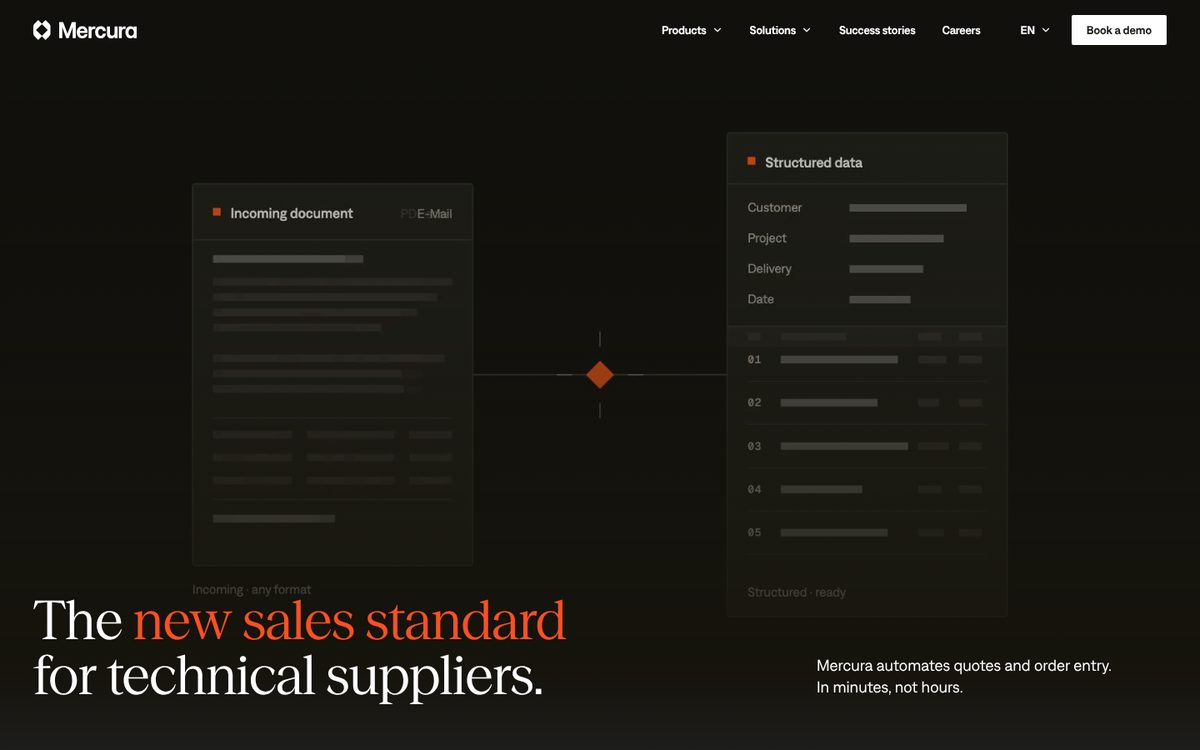
Mercura sells AI for distributors and manufacturers of technical products, and lists building materials next to plumbing and HVAC, electrical, underground infrastructure and fasteners. It reads emails and attachments in any format, including PDFs, bills of quantities, tenders and purchase orders. It matches each request to your products, produces a priced quote or sales order and exports the checked result into your ERP.
It reports more than 80 distributors and manufacturers in over 20 countries. Its customer Sanitär-Heinze, an HVAC distributor, says quotes that took 2 days now take 2 hours. Mercura claims a 92% match rate on unstructured or incomplete data and 2 weeks from proof of concept to go-live, and holds ISO/IEC 27001. No prices are shown. It suits a merchant whose bottleneck is project quotes from bills of quantities.
Conexiom
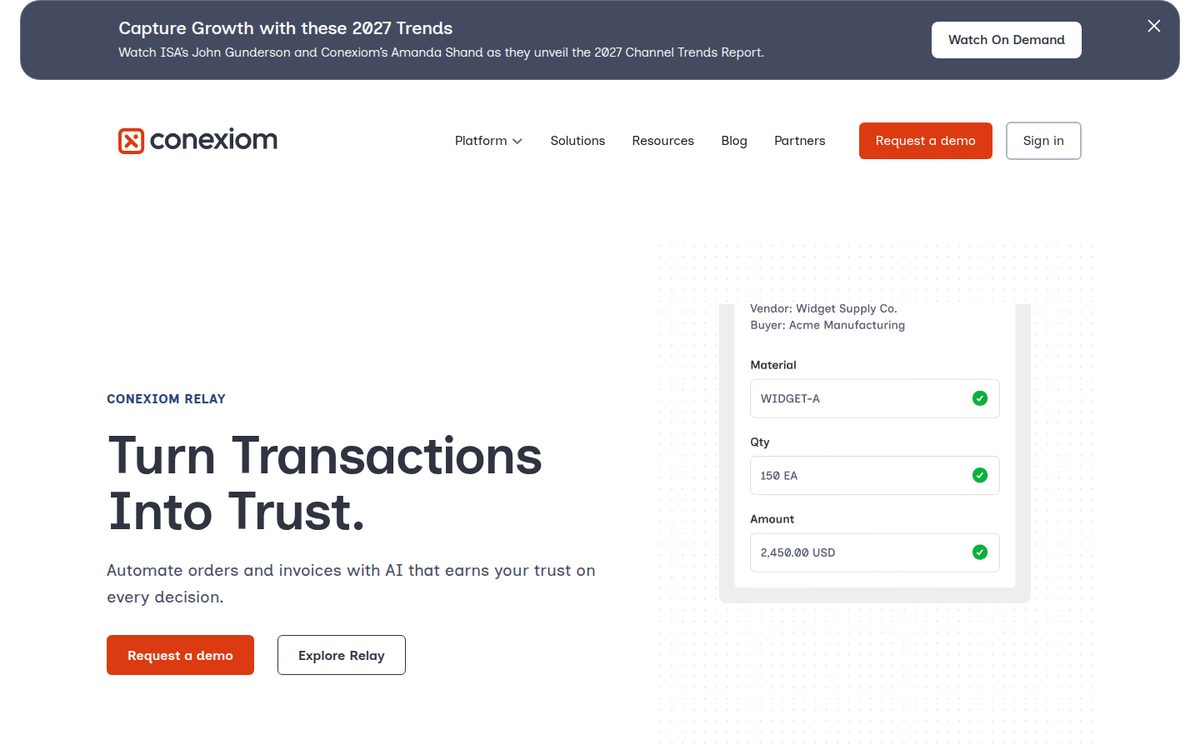
Conexiom has automated orders for distributors and manufacturers for more than 15 years. Its Relay product validates orders and invoices in almost any format, from email to handwritten notes, against rules your team writes in plain English, and shows the reasoning behind each decision. It names native integrations with more than 40 ERPs, among them Epicor, SAP, Infor, Microsoft Dynamics 365, NetSuite and Sage, and a 30-day average implementation.
Its customer stories are at distribution scale: ADI no longer keys 1,700 orders a day by hand, and Sonepar automated 200,000 order lines. It suits a large merchant group with high volumes from repeat accounts. We compare the two in Lleverage vs Conexiom.
Epicor BisTrack
BisTrack is Epicor's ERP for building supply, aimed at builders' merchants, timber merchants, heavy side materials, plasterboard and roofing suppliers. It runs pricing, order entry, stock, delivery and finance, and Epicor uses AI in it to optimise delivery routes.
For orders, Epicor sells BisTrack Order Entry Automation. You set up a template for each account customer, then scan their purchase orders or drag in the PDFs they email. Form recognition and OCR pick out the customer, the site address, the delivery date and, for lines ordered by SKU, the quantity, unit of measure and price. A person reviews the order and adds any lines without a SKU, and the order goes into BisTrack as a sales order with the PDF attached. It suits merchants on BisTrack whose contractors send purchase orders from their own systems. Free-text emails and orders by description are the case to test.
Klipboard ERP One

ERP One is the new name of K8, the ERP from Klipboard, formerly Kerridge Commercial Systems, for companies that source, stock, sell and service products. In spring 2026 Klipboard released the first AI built into ERP One: users ask operational questions in plain language and take action in the same workflow, such as checking stock and pricing and managing orders and customer accounts. Klipboard says more will follow in later releases, and counts 101 AI agents across its 5 products as of October 2026.
It suits a merchant already on K8 or ERP One that wants faster answers at the counter.
Zilliant
Zilliant sells B2B pricing software to manufacturers and distributors. Price Manager coordinates prices across products, regions and customers, Price IQ models pricing scenarios, and Deal Manager runs customer agreements from proposal to renewal. A configure, price, quote product completes the set. It suits a merchant losing margin across thousands of contractor price agreements.
What should you ask every vendor?
Ask each vendor to run your own orders and quote requests, unedited, and to explain every line it got wrong. These 5 questions separate the tools fast.
| Question | Why it matters for a merchant | A good answer |
|---|---|---|
| Which ERP and version do you connect to, and how? | The order has to land in your system with the ERP's own checks | Named connection to your ERP, through its own interfaces |
| How do you convert units? | Contractors order by the length, the pack or the tonne | Per-customer and per-article rules, shown on your orders |
| Where do contractor prices come from? | A wrong price on a project order costs margin or the account | Read from the customer's price list in the ERP, checked per line |
| What share of our messy orders do you get right? | Clean PDFs flatter every tool | A first-time match rate on a week of your real orders |
| Who checks exceptions, and where? | Someone on the desk still owns the order | A named person, with the reason and the source document beside it |
For description-only lines, our post on matching customer product descriptions to article numbers shows what to test.
"You deliberately leave questions unasked, because asking makes the processing take longer. You would want to ask, but there is no time. That is being made possible now." Patrick Wijers, Sales Desk Manager, SIG Benelux
Where should a building materials wholesaler start with AI?
Start with one process, one location and one mailbox, and measure it for a few weeks before adding the next. We usually start with the order mailbox, because its volume is high and the result is easy to count.
SIG Benelux kept its first project that narrow: one location and the central order mailbox. Two weeks went into interviews and the real mailbox. Two more went into building and running the automation next to the team, so failures showed without any customer noticing.
Measure 3 numbers from the first week:
- The share of orders that arrive in the ERP ready to approve.
- The share of lines matched to the right article first time.
- The time per order your desk still spends, against the time before.
Once orders run, quotes are the usual next step. Our guide to RFQ to quote automation covers turning emailed requests into draft quotes, and supplier invoices follow after that.
Frequently asked questions
What is the best AI software for a building materials wholesaler?
For most merchants it is software that handles orders, quotes and supplier invoices around the ERP they already run. An AI agent or order entry tool takes the email work, a builders' merchant ERP such as BisTrack or ERP One runs the core, and a pricing tool such as Zilliant manages margin. Which comes first depends on where your desk loses time.
Can AI read contractor orders that have no article numbers?
Yes, when the tool matches descriptions against your catalogue and the customer's order history. At SIG Benelux roughly 47% of orders had only a description, and 88% of lines now match the right article first time. Test any tool on a week of your own description-only orders before you buy.
Do I need to replace my ERP to use AI?
No. An AI agent works through the ERP's own interfaces and fills the same fields a person fills, so the ERP checks the work as it checks your desk. Replace the ERP only when it cannot run the business. SIG Benelux kept Dynamics 365 as its system of record and put the automation next to it.
How long does it take to get AI order entry running?
It depends on the vendor and your ERP. Conexiom quotes a 30-day average and Mercura 2 weeks from proof of concept to go-live. With Lleverage the first process typically runs supervised within a few weeks, built by our engineers with your team. SIG Benelux ran its first project as a four-week Kickstart.
Can AI handle orders that arrive by WhatsApp or phone?
Start with email, where the volume is easiest to measure. SIG Benelux left phone and WhatsApp out of its first project on purpose, and handled the central order mailbox first. Ask each vendor how a WhatsApp message or a phone order reaches its system before you sign, and test it on real messages from your contractors.
What to do next
Pick one mailbox and export a normal week of orders, including the contractors who never send an article number. Run 2 or 3 of the tools above on that week and compare the 3 numbers. To put Lleverage in that test, book a demo and bring the orders. We run the agent on them and show what the first process would look like in your ERP.