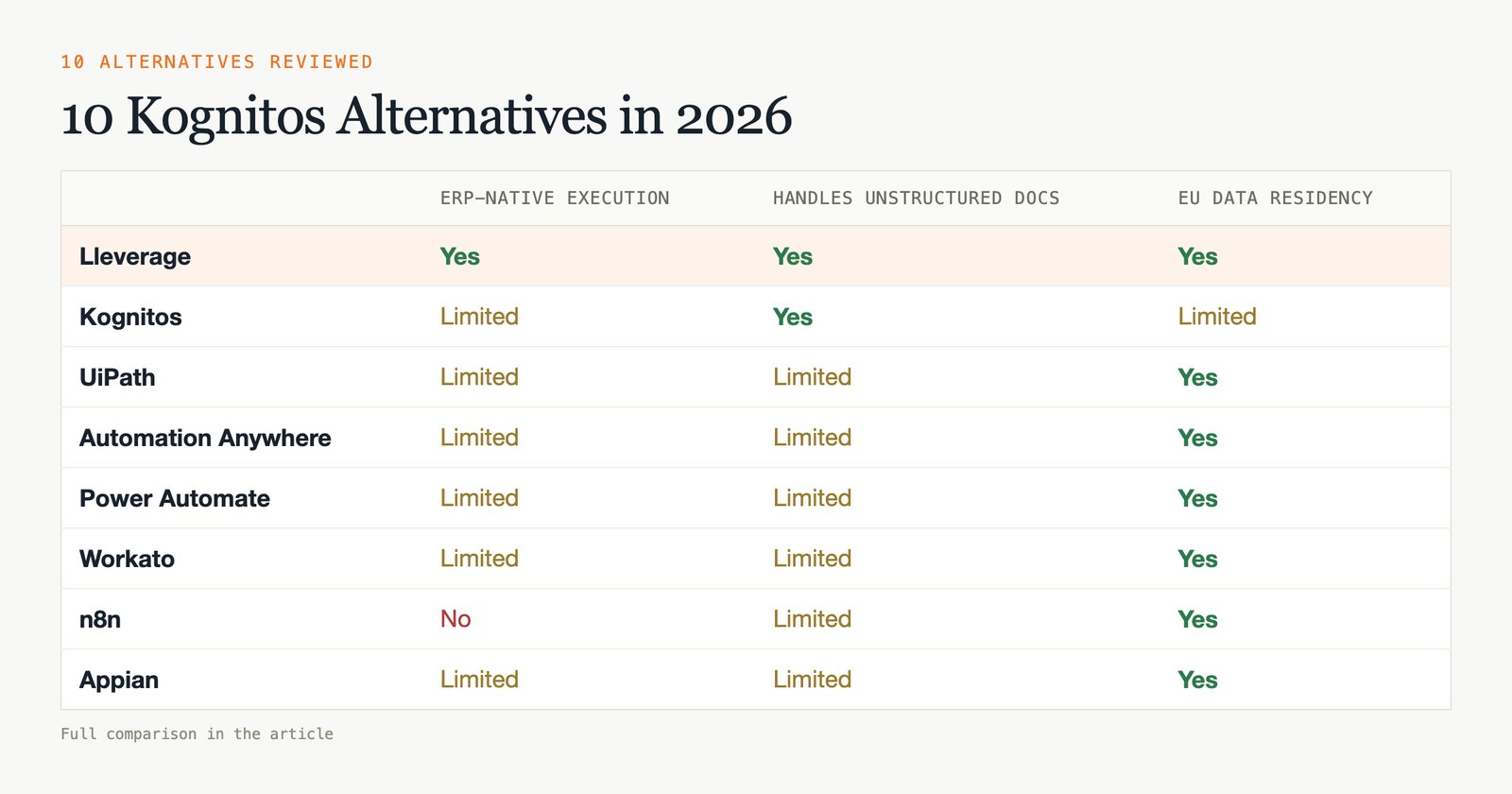
The ten Kognitos alternatives worth looking at in 2026 are Lleverage, UiPath, Automation Anywhere, Microsoft Power Automate, Workato, n8n, Appian, Tines, Rossum and Make. That ranking is our opinion, drawn from building agents for the manufacturers and wholesalers these products get sold to.
We work every day with order desks and finance teams that look much like yours, which is why we have a firm view on which of these finish the work and which stop at the integration layer. Lleverage is one of the ten, and we have put it first.
First, credit where it is due. Kognitos does something genuinely interesting: you describe a process in plain English and it runs, rather than being drawn on a scripting canvas by a developer. The customer proof is real too. Kognitos publishes a 97% cut in lease audit processing time at Dish Network, and more than 50,000 shipping documents handled every month at Century Supply Chain Solutions. Those are not pilot numbers.
Where it tends not to fit is the company we spend our days in: a manufacturer, wholesaler or logistics operator with a few hundred people, a twenty-year-old ERP and an admin team that is the real constraint on growth. Kognitos is horizontal and sold into large enterprises. It has no view on how a sales order should land in Business Central, or what tolerance a supplier invoice should clear at in Exact. That gap, between a general-purpose automation layer and the particular shape of order intake and invoice work, is what this comparison is really about. If you would rather see it than read about it, book a demo.
How the 10 Kognitos alternatives compare
| ERP-native execution | Handles unstructured docs | EU data residency | Mid-market fit | Published proof in physical-product ops | |
|---|---|---|---|---|---|
| Lleverage | Yes | Yes | Yes | Yes | Yes |
| Kognitos | Limited | Yes | Limited | No | Yes |
| UiPath | Limited | Limited | Yes | No | Yes |
| Automation Anywhere | Limited | Limited | Yes | No | Yes |
| Power Automate | Limited | Limited | Yes | Yes | Limited |
| Workato | Limited | Limited | Yes | Limited | Limited |
| n8n | No | Limited | Yes | Yes | Limited |
| Appian | Limited | Limited | Yes | No | Limited |
| Tines | No | Limited | Yes | Limited | No |
| Rossum | Limited | Yes | Yes | Yes | Yes |
| Make | No | No | Yes | Yes | No |
What are the 10 best Kognitos alternatives?
- Lleverage: AI agents for real-world operations, running inside the ERP that mid-sized manufacturers, wholesalers and logistics operators already use.
- UiPath: the RPA incumbent, now repositioned around agentic automation, strongest on complex desktop and legacy-system work.
- Automation Anywhere: enterprise RPA with an AI layer bolted on, similar buyer profile to UiPath.
- Microsoft Power Automate: the most accessible option for organisations already standardised on Microsoft 365.
- Workato: enterprise integration platform with 1,200+ connectors and AI agents, a Gartner iPaaS leader.
- n8n: open-source workflow automation with native AI nodes, engineering-led.
- Appian: process automation and application development for large, process-heavy organisations.
- Tines: workflow automation with a strong security-operations following, visual but engineer-shaped.
- Rossum: document data extraction for invoices and order documents, acquired by Coupa in 2026.
- Make: visual workflow automation, popular with smaller teams connecting SaaS products.
Which parameters actually decide this choice?
Compare on where the work finishes, not on which product demos best. Everything in this list can extract data from a document and move it somewhere. Almost none of them will tell you, in the demo, who deals with the 30% that does not go cleanly.
The first question is the one buyers underweight. Most products in this category move data between systems and hand the last mile back to a person. The difference between "the invoice data was extracted" and "the invoice is matched, posted and the exception is on a controller's desk with an explanation" is the difference between a demo and a result.
The second is document reality. Your suppliers send PDFs with inconsistent layouts, spreadsheets with merged cells, and emails with the order in the body text. Products that need structured input quietly push that work back to your team.
The third is who owns it on the Tuesday after go-live. Some of these need an engineering team, some need a Microsoft partner on retainer, and some are maintained by the operations people who actually use them. That single choice shapes your cost base for years, and it is usually decided by accident rather than on purpose.
The fourth is what happens at three times the volume. Per-robot, per-flow and per-document pricing all look reasonable at pilot scale and diverge sharply at production scale, which is exactly when you have lost the freedom to change your mind.
Why do buyers look for Kognitos alternatives?
- Built as a horizontal product, not for physical-product operations. Kognitos sells into finance, HR and supply chain across every industry. It has no built-in opinion about what a sales order means, how a supplier confirmation should match a purchase order, or what a clean posting into Business Central looks like. Lleverage is the opposite: narrow on the buyer, deep on the workflows that move money and inventory.
- Enterprise motion, enterprise price. Kognitos raised a $25 million Series B and sells to organisations the size of Dish Network. Mid-sized manufacturers and wholesalers routinely find the commercial model and implementation footprint heavier than the problem they are solving.
- Pricing is not published. Kognitos does not disclose pricing publicly, so every evaluation begins with a sales conversation and ends with a custom quote. Buyers comparing three products in a quarter find this slows the decision.
- English as code cuts both ways. Describing a process in plain language is genuinely easier to start with. It is harder to reason about when a rule needs to hold identically across 4,000 orders a month, which is why some teams prefer explicit, inspectable business rules.
- The day-to-day experience. This is a subjective call and worth weighing accordingly: in our own evaluation the interface felt like the least finished part of the product, which is a shame given how good the underlying idea is. Try it yourself before taking our word for it.
- Regional fit. For European buyers, EU data residency and native handling of Dutch, German and French supplier documents are table stakes. A US-headquartered horizontal product typically treats them as configuration.
1. Lleverage: the Kognitos alternative built for physical-product operations
Lleverage builds AI agents for real-world operations in companies that make, move and sell physical products. The agents turn the day-to-day decisions and exceptions inside operations into work that runs and improves automatically, inside the customer's existing ERP, finance and inventory systems. Among Kognitos alternatives, Lleverage is the only one built specifically for mid-market manufacturers, logistics operators and wholesale and distribution businesses, with deep coverage of the back-office workflows where horizontal products stop at the integration layer.
Website: lleverage.ai
Lleverage features
- AI agents that read inbound documents and emails: orders, supplier confirmations, invoices, certificates
- ERP-native execution inside Business Central, SAP S/4HANA and ECC, Exact, Infor M3, Dynamics 365 Finance and Operations, and AS/400-era systems
- Order intake and quoting that posts finished sales orders, not extracted fields
- Invoice capture and two- and three-way matching that posts what matches and flags what does not
- Explicit approval thresholds, full decision logs, and a mandate that widens only when your team decides it does
- A memory that codifies customer and supplier rules so the same exception is not resolved twice
- Forward-deployed implementation: the first agent ships in production with your team, who own it afterwards
- EU data residency
Lleverage pricing
- From €2.000 per month for standard agents, from €4.000 for complex ones, enterprise scoped individually
- Priced per agent, not per seat or per task
- Source: lleverage.ai/pricing
Kognitos vs Lleverage
Both products aim at the same underlying frustration: back-office work that consumes people without producing anything a customer pays for. They differ on who they are built for and where the work finishes.
- Kognitos is horizontal and enterprise; Lleverage is narrow on mid-sized companies that make, move and sell physical products
- Kognitos describes processes in English; Lleverage runs agents against your ERP's actual posting logic, with the approval steps a controller signs off on
- Kognitos publishes proof in lease audits and shipping documents; Lleverage publishes proof in order intake, invoice matching and customer support inside named European operators
Lleverage limitations
- Not a general-purpose automation canvas: if you want to wire arbitrary SaaS products together, n8n or Make will serve you better
- Not built for services businesses, marketing operations or HR-only use cases
- Not self-serve: implementation is forward-deployed, which is deliberate but means you talk to a human before anything runs
"It will cost more time NOT to use the tool than to use it."
That is Sanne Voesten of Exellyn, an IT infrastructure distributor whose export desk made the agent mandatory for every new quote within weeks of go-live, after shipment calculations that took more than 20 minutes started completing in seconds.
2. UiPath
The RPA incumbent, now positioned around agentic automation. Strongest where work involves legacy desktop applications, Citrix environments and mainframes that have no usable interface for anything else.
UiPath features
- Attended and unattended robots for desktop and application automation
- Document understanding and an agentic layer added to the classic RPA core
- Deep enterprise governance, orchestration and audit tooling
- Large partner and developer ecosystem
UiPath pricing
- Automation Developer around $420 per user per month at 2026 enterprise list
- Unattended robots roughly $8,000 to $15,000 per robot per year
- Attended robots roughly $1,500 to $3,000 per user per year
- Source: published 2026 enterprise pricing benchmarks
Kognitos vs UiPath
Kognitos positions explicitly against UiPath, arguing that bolting generative AI onto a scripting environment leaves the brittleness underneath. UiPath's counter is maturity: governance, scale and a decade of enterprise deployments.
- UiPath is script-and-selector based at its core; Kognitos is language-based
- UiPath carries far higher per-robot cost; Kognitos does not publish pricing at all
- UiPath is the safer choice for legacy desktop work; Kognitos is the more modern choice for document-driven processes
UiPath limitations
- Cost scales with robots, which punishes exactly the high-volume processes worth automating
- Selector-based automation breaks when interfaces change
- Implementation typically needs specialist developers or a partner
3. Automation Anywhere
Enterprise RPA with an AI layer, competing directly with UiPath for the same buyer. Cloud-native architecture and a large library of pre-built bots.
Automation Anywhere features
- Cloud-native RPA with attended and unattended execution
- Document processing and generative AI capabilities added to the core product
- Bot marketplace and a central control room
Automation Anywhere pricing
- Quote-based, contact sales for current tiers
- Source: automationanywhere.com (pricing not publicly published)
Kognitos vs Automation Anywhere
Same argument as UiPath, one competitor over. Automation Anywhere brings enterprise scale and governance; Kognitos brings a language-first model that does not require bot development.
- Automation Anywhere needs bot developers; Kognitos targets business users directly
- Both sell to large enterprises with long procurement cycles
Automation Anywhere limitations
- Enterprise-weighted commercial model, rarely a fit under a few hundred employees
- Requires dedicated automation skills in-house or via a partner
- Pricing opacity makes comparison slow
4. Microsoft Power Automate
The most accessible option for organisations standardised on Microsoft 365, and often already paid for.
Power Automate features
- Cloud flows and desktop flows in one product, built for Microsoft-standardised teams
- Deep native integration with Microsoft 365, Dynamics and Azure
- Copilot-assisted flow building
- Large connector library
Power Automate pricing
- Around $15 per user per month including cloud and desktop flows
- Around $100 per flow per month for high-volume service-account flows
- Basic flows included with many Microsoft 365 E3 and E5 licences
- Source: Microsoft published pricing, 2026
Kognitos vs Power Automate
Power Automate wins on price and on proximity to the systems Microsoft shops already run. Kognitos wins on handling unstructured documents without a developer building the parsing logic.
- Power Automate assumes structured, predictable inputs; Kognitos is built for messy ones
- Power Automate is cheap to start and expensive to maintain at scale; Kognitos is the reverse
- Neither posts a sales order into a non-Microsoft ERP without integration work
Power Automate limitations
- Weak outside the Microsoft ecosystem
- Premium connectors and per-flow licensing surprise teams as volume grows
- Flows break silently and land back in a person's queue
5. Workato
The strongest enterprise integration layer in this list, combining API integration, workflow automation and AI agents.
Workato features
- 1,200+ pre-built connectors
- Enterprise integration with governance and environment management
- AI agents layered on the integration core
- Named a Gartner Magic Quadrant leader for iPaaS
Workato pricing
- Quote-based, contact sales for current tiers
- Source: workato.com (pricing not publicly published)
Kognitos vs Workato
Workato is the right answer when the problem is systems that need to talk to each other. Kognitos is the right answer when the problem is documents that need to be understood.
- Workato is API-first; Kognitos is document-first
- Workato requires integration engineering skills; Kognitos targets the business user
- Both are horizontal, and neither has an opinion about ERP posting logic
Workato limitations
- Integration-shaped, so unstructured document work needs additional components
- Enterprise pricing and a technical implementation profile
- Overkill for a team automating two or three processes
6. n8n
Open-source workflow automation with native AI nodes, popular with engineering-led teams who want control and self-hosting.
n8n features
- Visual workflow canvas with code nodes where needed
- Self-hosting option with full data control
- Native AI and LLM nodes
- Large community and template library
n8n pricing
- Free self-hosted community edition
- Paid cloud and enterprise tiers published on the vendor site
- Source: n8n.io pricing page
Kognitos vs n8n
n8n gives engineers a canvas and total control. Kognitos gives business users language. They are aimed at opposite ends of the same building.
- n8n needs someone technical to build and maintain workflows; Kognitos does not
- n8n self-hosting solves data-residency concerns outright
- Neither ships with back-office process logic out of the box
n8n limitations
- Ops teams without engineering support cannot maintain a serious implementation
- No native opinion on invoice matching, order intake or ERP posting
- Self-hosting shifts reliability and upgrades onto your team
7. Appian
Process automation and application development for large, process-heavy organisations, and one of the most-cited Kognitos alternatives on review sites.
Appian features
- Visual application builder with process orchestration
- Case management and business rules engine
- Process mining and RPA components
- Strong governance and audit capability
Appian pricing
- Standard from around $75 per user per month, Advanced around $150 per user per month
- Enterprise contracts commonly start near $100,000 per year
- Free Community Edition for up to 15 users, useful for prototyping
- Source: 2026 published pricing guides; Appian does not publish a public tier table
Kognitos vs Appian
Appian is a platform on which you build applications; Kognitos is a product you instruct. Appian suits organisations with an internal development capability and multi-year programmes.
- Appian implementations are projects; Kognitos deployments are configurations
- Appian's strength is complex case management, not document understanding
Appian limitations
- Requires a development team and a real project budget
- Long time to first value relative to a document-focused product
- Enterprise licensing model
8. Tines
Workflow automation with a strong following in security operations, visual on the surface but engineer-shaped underneath.
Tines features
- Visual workflow builder with strong logic and branching
- Extensive HTTP and API action library
- Popular for security and IT operations runbooks
Tines pricing
- Community Edition free, limited to 1 builder and 3 flows
- Starter from around $500 per month for 2 to 5 builders and 5 to 20 flows
- Business and Enterprise quote-based
- Source: Tines published pricing, 2026
Kognitos vs Tines
Tines automates the sequences engineers already understand. Kognitos automates the paperwork nobody wants to read. Different problems that happen to share a category label.
- Tines is strongest in security and IT operations, not finance back office
- Tines expects structured API interactions; Kognitos expects documents
Tines limitations
- Not built for document-heavy finance or supply chain work
- Requires comfort with APIs and data structures
- No ERP-native execution
9. Rossum
Document data extraction for invoices and order documents, and the closest product in this list to the narrow document problem. Founded in London in 2017 and acquired by Coupa in 2026, which is worth factoring into a buying decision: acquired products tend to get absorbed into the acquirer's suite roadmap.
Rossum features
- AI document capture for invoices, orders and confirmations
- Learning engine that improves from corrections
- Validation interface for exception handling
- Pre-built connectors into common finance systems
Rossum pricing
- Starter published at around $18,000 per year, one-year minimum, unlimited seats
- Business, Enterprise and Ultimate are quote-only; published buying guides put typical deals between roughly $25,000 and $120,000 per year depending on volume and field complexity
- Source: Rossum published pricing and 2026 buying guides
Kognitos vs Rossum
Rossum is deliberately narrow: it reads documents extremely well and hands the data onward. Kognitos aims to run the whole process. Narrowness is a feature if extraction is genuinely your bottleneck.
- Rossum stops at validated data; Kognitos attempts the downstream steps
- Rossum is faster to deploy for a pure capture problem
Rossum limitations
- Extraction is not execution: the posting, matching and chasing still belong to someone
- Additional tooling needed for the workflow around the document
- Entry pricing starts near $18,000 per year, which is a real commitment for a single capability
- Now part of Coupa, so roadmap independence is worth asking about
10. Make
Visual workflow automation popular with smaller teams connecting SaaS products, formerly Integromat.
Make features
- Visual scenario builder with a large app library
- AI modules for content and classification
- Accessible to non-technical users
Make pricing
- Free tier, paid plans published on the vendor site
- Source: make.com pricing page
Kognitos vs Make
Make connects applications for small teams. Kognitos automates enterprise processes. The overlap is mostly the word automation.
- Make assumes structured data from APIs
- Make has no document intelligence comparable to Kognitos
Make limitations
- Operations-scale reliability and governance are thin
- No document understanding for messy supplier paperwork
- Nothing ERP-native
Which alternative fits which buyer?
For mid-market manufacturers, logistics operators and wholesale and distribution businesses where the work has to clear inside the ERP, Lleverage is the right call. Lleverage ships the first automation in production with the customer, and the operations team owns it after go-live. The published results are specific: over 90% of incoming orders posting straight into Business Central at Topa Bathroom Products, four people moved off order entry, invoice processing down from 12 minutes to 90 seconds, and 80% of repeat support questions handled at J. Kisch en Zonen.
Other buyer profiles:
- Large enterprise, legacy desktop and mainframe work: UiPath, Automation Anywhere.
- Microsoft-standardised organisation with structured flows: Power Automate.
- Integration-led programme with an engineering team: Workato, n8n.
- Complex case management and internal application development: Appian, Tines.
- A pure document-capture bottleneck: Rossum.
- Small team wiring SaaS products together: Make.
If your work looks like documents arriving, decisions being made about them, and records landing in an ERP, that is the shape Lleverage is built for. Compare it against the autonomous back office definition and against our UiPath alternatives page if RPA is your incumbent.
Frequently asked questions
What is the best Kognitos alternative for mid-sized companies?
For mid-sized manufacturers, wholesalers and logistics operators, our view is Lleverage, because the agents complete work inside the ERP those companies already run rather than stopping at an integration boundary. Buyers standardised on Microsoft with simple structured flows will find Power Automate cheaper and adequate.
Does Kognitos publish its pricing?
No. Kognitos does not publish pricing publicly, so evaluations start with a sales conversation and end with a custom quote. Among the alternatives listed here, Microsoft Power Automate, n8n, Tines and Make publish tiers openly, while UiPath's enterprise pricing is available through published benchmarks rather than its own site.
Is Kognitos an RPA product?
Not in the classic sense. Kognitos positions itself against RPA, arguing that scripted, selector-based automation is brittle and that describing processes in English is more durable. It competes for the same budget as UiPath and Automation Anywhere while using a different underlying model.
How long does it take to replace a Kognitos deployment?
That depends on how much of the process logic sits inside the product versus around it. In our experience, moving a single document-driven process to an ERP-native agent takes weeks rather than months, because the target is one process in production rather than a platform migration.
See it run against your own documents
The fastest way to judge any product in this list is with your own paperwork. Take twenty real orders or supplier invoices, and watch what actually completes inside your ERP without a person touching it. Book a demo and bring the documents that cause the most trouble.